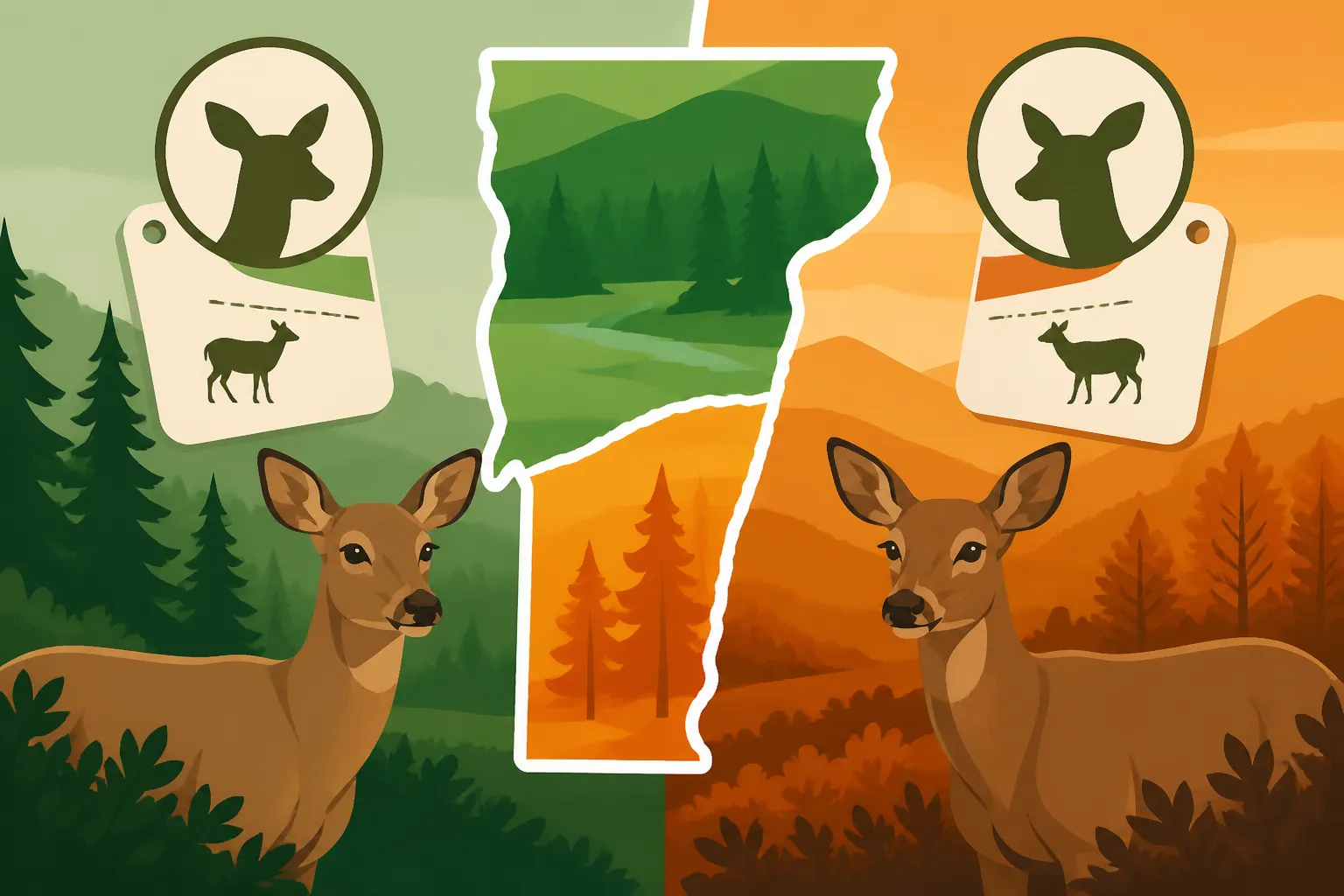
Holding Two Antlerless Permits in Different WMUs
It can feel like a real challenge to fill all your deer tags each season, especially those coveted antlerless permits that help manage the herd and put more venison in the freezer. Many Vermont hunters find themselves wishing for more opportunities or better chances in a different area. Thankfully, Vermont's regulations offer a smart strategic play: the ability to hold two antlerless permits in different Wildlife Management Units (WMUs), opening up a whole new world of hunting possibilities and increasing your odds significantly. This guide will walk you through understanding this system, leveraging its advantages, and mastering the logistics to make your next deer season even more successful.
Decoding Vermont's Antlerless Permit System
Vermont's deer management strategy is designed to maintain a healthy and balanced deer population across the state, and antlerless permits are a crucial tool in that effort. Unlike buck tags, which often come standard with your hunting license, antlerless permits are issued specifically to allow hunters to harvest does or fawns, helping to control herd numbers in specific areas. Understanding how these permits are allocated and how they function is the first step to maximizing your opportunities.
Understanding Antlerless Allocation and Purpose
The Vermont Fish & Wildlife Department carefully analyzes deer populations within each WMU every year. This analysis considers factors like habitat quality, winter severity, previous harvest data, and deer health indicators, including prevalence of issues like winter tick mortality, especially concerning moose populations. Based on these assessments, they determine how many antlerless permits to issue for each WMU. The goal is to fine-tune the herd size, ensuring it remains within the carrying capacity of the land and minimizes deer-related conflicts like agricultural damage or vehicle collisions. For hunters, this means some WMUs will have more available permits than others, and the availability can change year to year. It’s a dynamic system, and keeping an eye on the latest Vermont Deer Harvest Records and population estimates can give you a significant edge in planning.
These permits are typically valid during specific seasons, most notably the archery, youth and novice, and muzzleloader seasons. While the general rifle season primarily targets antlered deer, some WMUs might have special antlerless rifle permits available, though this is less common for the general public and more often tied to specific management needs. The real beauty of the system for many hunters, however, lies in the ability to hold more than one permit, if allocated, which brings us to the exciting possibility of targeting multiple WMUs. The department's strategic approach to these permits, particularly the rule allowing for a second antlerless permit, is a direct response to both hunter demand and conservation goals.
The Power of Holding Multiple Permits
For many years, hunters were generally limited to one antlerless permit. However, recognizing the desire for more opportunity and the biological need to manage deer populations effectively in diverse regions, Vermont introduced a rule change allowing hunters to hold two antlerless permits, provided they are for different WMUs. This isn't just about doubling your chances; it's about strategic flexibility. Imagine striking out in your home WMU, only to realize you still have a valid permit for another unit where the deer might be moving better, or the hunting pressure is different.
This rule essentially allows you to diversify your hunting portfolio. You might choose one WMU known for its high deer density, perhaps a popular lowland area in the Champlain Valley, and another in a more challenging, mountainous region of the Green Mountains where deer patterns might be harder to decipher but can yield a truly rewarding experience. The opportunity to hold Vermont's Dual Antlerless Permit Rule in different areas means you're no longer putting all your eggs in one basket. It can alleviate the pressure of having only one chance to fill your freezer, making your hunting season more relaxed and potentially more productive. This added flexibility is a game-changer for serious deer hunters in Vermont.
Strategic Advantages of Hunting Multiple WMUs
Why would a hunter go through the extra effort of applying for and hunting in two different WMUs? The answer lies in the strategic advantages this approach offers, moving beyond mere convenience to genuinely enhancing your overall hunting success and experience in Vermont.
Increasing Your Odds and Extending Your Season
Let's be honest, hunting can be tough, and success is never guaranteed. By securing antlerless permits in two distinct WMUs, you are inherently increasing your overall chances of harvesting a deer. If one area is experiencing an off-year due to a bad mast crop, heavy hunting pressure, or unusually warm weather affecting deer movement, you have a backup plan. You can simply shift your focus to your second WMU, where conditions might be more favorable. This isn't just about quantity; it's about quality of opportunity.
Consider a scenario where you've spent weeks scouting and preparing for the October antlerless window in your primary WMU. If a warm spell hits, keeping deer bedded down during legal shooting hours, your chances might plummet. But with a second permit for a WMU a couple of hours away, perhaps in a different elevation or habitat type, you might find deer activity is completely different. This flexibility can effectively extend your "prime" hunting window by allowing you to chase favorable conditions. For instance, a permit for an early archery season in an expanded zone could be combined with a permit for the Hunting Vermont's October Antlerless Muzzleloader Window, giving you continuous opportunities across different weapon types and timeframes.
Leveraging Diverse Habitats and Deer Behavior
Vermont is a state of incredible ecological diversity, from the fertile farmlands of the Champlain Valley to the rugged peaks of the Green Mountains and the sprawling forests of the Northeast Kingdom. Deer behavior and population dynamics vary significantly across these regions. Holding permits in different WMUs allows you to tap into this diversity directly. You might have one permit for a WMU dominated by agricultural fields, where deer patterns are often tied to specific food sources like corn or alfalfa. Your second permit could be for a forested, mountainous WMU where deer rely more on natural browse, acorns, and sheltered bedding areas.
Hunting a lowland agricultural WMU might involve sitting on a field edge, waiting for deer to emerge in the evenings. In contrast, a mountainous WMU might require extensive still-hunting through thick timber or focusing on saddles and benches along ridgelines. By experiencing these different hunting styles, you not only improve your versatility as a hunter but also deepen your understanding of whitetail ecology across the state. This varied experience can make you a more well-rounded and successful hunter in the long run. Utilizing tools like GoHunt can be immensely helpful here, as you can use its mapping features to research and compare habitat types, public land access, and terrain features between potential WMUs before you even apply.
Navigating the Application and Selection Process
The ability to hold two antlerless permits in different WMUs is a fantastic opportunity, but it requires careful planning and understanding of the application process. It's not as simple as just asking for two; there's a strategic element to selecting your WMUs and ensuring you meet all the requirements.
Timing Your Applications and Understanding the Lottery
Vermont's antlerless permits are typically issued via a lottery system, meaning you apply and hope your name is drawn for a permit in your desired WMU. The application period is usually in early summer, and it’s critical to mark these dates on your calendar. Missing the deadline means missing out on the opportunity. When applying, you'll generally select your preferred WMU for your first permit. If you're planning to take advantage of the dual-permit rule, you'll often have the option to apply for a second permit in a different WMU. It's not a guarantee that you'll get both, as it depends on availability and demand for each specific unit.
The Vermont Fish & Wildlife Department will announce the results of the lottery, usually by late summer or early fall. If you're drawn for a permit, you'll typically have a window to claim and pay for it. The cost for these permits is usually quite reasonable for residents, and even for non-residents, the investment can be well worth the increased opportunity. It’s important to remember that WMU boundaries are clearly defined, and you must adhere strictly to the unit for which your permit is valid. Don't assume that because two WMUs are adjacent, you can use a permit for one in the other. Precision in understanding boundaries is key, and resources like GoHunt can provide detailed map overlays showing WMU lines, which is invaluable for planning.
Strategic WMU Selection
Choosing your two WMUs is where the real strategy comes into play. You don't want to just pick two random units; you want to select them based on a combination of factors that enhance your hunting prospects.
First, consider deer density and harvest success rates. You can often find data on Deer Density by Vermont Region and past harvest numbers on the Vermont Fish & Wildlife Department website. Some WMUs consistently have higher success rates for antlerless deer than others. Second, think about accessibility and travel time. If your two WMUs are several hours apart, the logistical challenge of scouting and hunting both might become overwhelming. Aim for WMUs that are reasonably close, or that you're willing to travel to for a dedicated trip.
Third, factor in habitat and terrain. As discussed earlier, selecting WMUs with different habitat types can give you more varied opportunities. For example, you might choose a WMU in the Champlain Valley that offers good access to agricultural areas and rolling woodlots, and pair it with another in a more rugged, forested region like the Green Mountain National Forest. This gives you distinct hunting scenarios and broadens your experience. Finally, consider hunting pressure. Some WMUs are known for higher hunter densities, particularly on public lands. If you're drawn for a permit in a highly pressured area, having a second permit for a quieter WMU can offer a valuable escape plan. Researching public land opportunities in each WMU is also vital; for instance, understanding how to navigate Hunting Vermont's Green Mountain National Forest compared to a smaller State Forest might influence your choices.
Here’s a simple table to help you think through your WMU selection:
| Factor | Primary WMU Consideration | Secondary WMU Consideration | Example Strategy |
|---|---|---|---|
| Deer Density | High known density, consistent harvest success | Moderate-to-high density, good potential, less pressure | First: Widespread agricultural areas; Second: Remote timber for later season. |
| Habitat Type | Familiar terrain, perhaps private land access | Different habitat (e.g., mountains vs. lowlands, hardwoods vs. softwoods) | First: Champlain Valley farm country; Second: Green Mountain ridges. |
| Travel Time | Close to home, easy for day trips | Within a reasonable driving distance for a weekend trip | First: WMU-A (30 mins); Second: WMU-B (2 hours). |
| Hunting Pressure | May be higher in easily accessible areas | Potentially lower, or different pressure patterns | First: Popular WMA; Second: Less known state forest parcel. |
| Season Overlap | Focus on a specific season (e.g., early archery) | Target a different season or later window (e.g., muzzleloader) | First: September expanded archery; Second: December muzzleloader. |
| Public Land Access | Known public areas, familiar access points | New public areas, perhaps more challenging access | First: Well-maintained WMA; Second: Backcountry national forest. |
Tactical Approaches for Diverse WMU Hunting
Once you've successfully secured your two antlerless permits for different WMUs, the real work and fun begins: strategizing how to effectively hunt them both. This isn't just about showing up; it's about adapting your approach to the unique characteristics of each unit.
Adapting Scouting and Strategy to Each WMU
The key to successful hunting in diverse WMUs is understanding that what works in one area might not work in another. Your scouting efforts, therefore, need to be tailored to each specific unit. If your primary WMU is characterized by rolling hills and agricultural fields, your scouting might involve focusing on field edges, pinch points between woodlots, and visible travel corridors. You'd be looking for sign like tracks in mud along fencerows or deer feeding in cut cornfields. This might involve extensive glassing from a distance during early morning or late evening. For instance, understanding how to properly scout a Hanging a Stand on a Champlain Valley Field Edge will be crucial here.
Conversely, if your second WMU is in the rugged Green Mountains, your scouting might shift dramatically. You'd be looking for high-elevation benches, saddles between peaks, traditional deer yards, and subtle funnels created by terrain features. This often requires more intensive, boots-on-the-ground exploration, possibly utilizing contour maps and aerial photos from resources like GoHunt to identify promising areas. You might be focused on finding rub lines along a logging road or looking for Reading a Green Mountain Deer Yard in softwood thickets. The deer in these areas might behave differently, moving through denser cover and being less predictable in their patterns. Adapting your strategy means being flexible with your stand locations, hunting techniques (e.g., still-hunting versus sitting), and even your call choices based on the specific environment.
Adjusting Your Hunting Style for Different Conditions
The beauty of having two permits in different WMUs is the chance to experience and adapt to varied hunting conditions. Let's say one WMU offers excellent early-season archery opportunities in open hardwood forests, while the other is better suited for a late-season muzzleloader hunt in dense conifer stands.
For the early archery season, you might focus on ambushing deer near soft mast like apple trees or white oak acorns. This involves quiet entry and exit, often from a treestand, and requires meticulous attention to wind and thermals. The deer might be less wary, but still easily spooked. In such a scenario, you might find yourself practicing Hunting a Standing Apple Orchard. If your second permit takes you into the deep woods of the Northeast Kingdom for a December muzzleloader hunt, your approach would be entirely different. Deer would be focused on late-season food sources, often in sheltered areas, and snow might be a significant factor. Your hunting might involve slow, methodical still-hunting through thick cover, or setting up on a well-used trail leading to a known food source. You'd need appropriate gear for cold weather, and perhaps even snowshoes for efficient travel. This adaptability across seasons and landscapes is a skill that truly sets successful hunters apart.
Managing Logistics and Maximizing Success
Successfully hunting two different WMUs isn't just about tactics; it's also about effective logistical management. From travel to processing game, thoughtful planning can make or break your dual-WMU hunting season.
Planning Travel and Time Efficiently
Hunting two different WMUs inherently means more travel time and more strategic use of your limited hunting days. If your WMUs are close, say within an hour's drive, you might be able to alternate between them over a weekend, or even during different parts of the day if conditions warrant. For example, you might hunt a particular private land parcel near home in the morning and then drive to a public land tract in your second WMU for an afternoon sit.
If your WMUs are further apart, requiring a multi-hour drive, you'll need to dedicate specific blocks of time to each. This might mean spending a full weekend in one WMU early in the season, and then returning to the second WMU for another dedicated trip later. Consider the weather forecast for each region. If a cold front is coming through one area, boosting deer movement, that might be your cue to focus your efforts there. Always factor in potential delays, especially during busy hunting seasons when roads can be more congested. Optimizing your time by scouting thoroughly beforehand using tools like GoHunt and having multiple stand locations pre-hung or ground blind sites prepped can drastically reduce wasted time once you're in the field. This efficiency allows you to make the most of your Vermont Public Land Hunting Hours.
Processing Game and Reporting Your Harvest
Harvesting a deer is the goal, but it’s just the beginning of the work. When hunting in two different WMUs, especially if they are far apart, you need a solid plan for field dressing, packing out, and transporting your game. If you're hunting remotely, consider bringing a quality game cart or a sturdy pack frame designed for hauling meat. For instance, a game cart might be perfect for a flat farm field, but a pack frame is essential for Packing Out a Vermont Moose (or a big whitetail!) from a steep ravine in the Green Mountains.
Once the deer is out, remember Vermont's specific reporting requirements. Every deer harvested in Vermont, whether antlered or antlerless, must be reported to the Vermont Fish & Wildlife Department. This can often be done online through their official portal or app, which is incredibly convenient when you're hunting away from home. Ensure you understand the reporting deadlines. While Vermont has stayed CWD-free, understanding Vermont's CWD Prevention Rules is paramount, especially if you're traveling between units or if you ever hunt out of state. These rules prohibit the import of certain deer parts from CWD-positive areas, so always check the latest regulations. Having your tags correctly filled out and readily available for inspection is also non-negotiable.
Common Pitfalls and How to Avoid Them
While the dual-WMU strategy offers significant advantages, it's not without its potential drawbacks. Being aware of these common pitfalls and actively working to avoid them will ensure your expanded hunting opportunities are truly successful and enjoyable.
Spreading Yourself Too Thin
One of the biggest temptations when holding two permits is to try to hunt everywhere all the time. This can lead to what I call "analysis paralysis" or simply "spreading yourself too thin." Instead of focusing effectively on one location, you might spend too much time traveling, moving stands, or indecisively bouncing between units. This often results in a lack of consistent effort in any single area, significantly reducing your chances of success.
To avoid this, create a realistic hunting schedule before the season starts. Identify primary and secondary hunting dates for each WMU. For example, you might dedicate the first week of archery season to WMU-A, and then shift your focus to WMU-B for the second week. Be disciplined with your plan, but also allow for some flexibility to respond to changing conditions. If you've been putting in solid effort in WMU-A for several days with no luck, then shifting to WMU-B for a fresh start makes sense. But constantly changing locations after only a few hours of hunting will likely be counterproductive. Remember, consistent presence and understanding deer patterns in an area are often more effective than sporadic attempts in many different places.
Neglecting Pre-Season Scouting and Preparation
Another critical mistake is thinking that having two permits means you need less pre-season work for each. Quite the opposite! To effectively hunt two different WMUs, you need to double down on your scouting and preparation. Each WMU will have its own unique characteristics, deer patterns, and access points. Neglecting to adequately scout both areas will leave you guessing in the field and waste valuable hunting time.
Start early. Use aerial maps, topographical maps, and tools like GoHunt to identify potential hot spots, bedding areas, travel corridors, and food sources in both WMUs. Make scouting trips to walk the ground, look for fresh sign, and identify suitable stand locations. For an in-depth look at this, check out Scouting Vermont Public Land Before Season. Even if you're hunting private land, ensure you have permission well in advance and understand the property boundaries. A lack of preparation means you'll be spending your valuable hunting days doing work that should have been completed weeks or months earlier, costing you opportunities to put venison in the freezer.
Ignoring Local Regulations and Safety
Finally, always remember that each WMU can have subtle differences in local rules or considerations. While the overarching state regulations apply, specific public lands within a WMU might have additional restrictions on vehicle access, camping, or even stand placement. Always double-check the local regulations for any specific area you plan to hunt.
Safety is paramount, especially when hunting unfamiliar territory. Know your surroundings, carry appropriate navigation tools (like a GPS or a reliable mapping app on your phone with offline maps), and always let someone know where you're going and when you expect to return. Be especially mindful of other hunters, particularly during popular seasons. If you're hunting during the overlap where rifle and archery seasons might coincide, ensuring you meet Blaze Orange Requirements is not just a rule, it's a critical safety measure. Respect property lines, both public and private, and always be a responsible and ethical hunter.
Disclaimer
Please note: Hunting regulations and seasons in Vermont are subject to change. Always consult the official Vermont Fish & Wildlife Department website or printed regulations for the most current and accurate information before planning any hunting trip. This guide is for informational purposes only and should not replace official sources.