Hunting a Funnel Between Two Woodlots
It can feel incredibly frustrating to spend hours, days, even weeks in the Vermont woods, knowing the deer are there, but rarely getting a clean shot. Deer are notoriously elusive, and trying to predict their movements across vast tracts of timber or sprawling farm country can feel like a fool's errand. This comprehensive guide will equip you with the knowledge and tactics to effectively hunt one of the most reliable deer magnets in any landscape: the funnel between two woodlots, helping you turn those frustrating near-misses into successful harvests.
Understanding Deer Funnels in Vermont's Landscape
Deer, like most wildlife, are creatures of habit and efficiency. They seek the path of least resistance when traveling, but always with a keen eye on safety and cover. This innate behavior makes "funnels" such powerful hunting locations, as they naturally concentrate deer movement into predictable corridors. A funnel, at its core, is any geographic feature or combination of features that constricts deer travel from a wider area into a narrower one.
What Makes a Funnel So Effective for Whitetails?
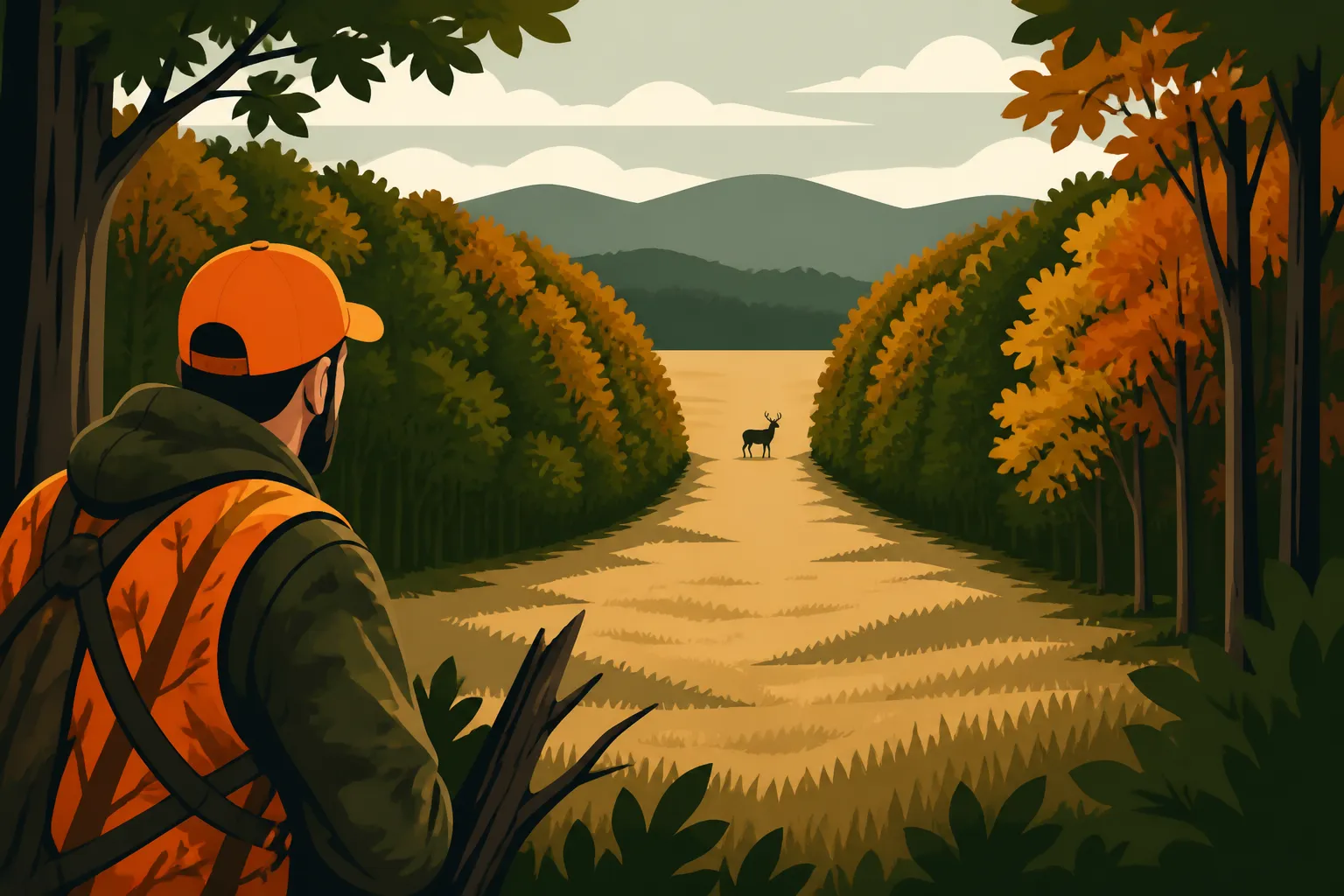
Think about it from a deer's perspective. If they need to move from a bedding area in one woodlot to a feeding area in another, or from dense cover to a water source, they'll choose the route that offers the most security with the least effort. Funnels exploit this preference. They act like natural highways, compelling deer to traverse a specific, often narrow, path. This makes them absolute goldmines for hunters because instead of trying to guess where a deer might cross a quarter-mile-wide timber edge, you're focusing on a path that might be only 50 or 100 yards wide.
The beauty of funnels is their versatility. They can be subtle shifts in elevation, a narrow strip of timber connecting larger blocks, or even man-made features that deer learn to utilize. The key is that they significantly reduce the number of potential travel routes for deer, making their movements far more predictable. This predictability is what transforms a challenging hunt into an opportunity.
Validation for hunters: We all know the feeling of a big block of woods, thousands of acres of Green Mountain National Forest, where deer could be anywhere. But when you find that small bottleneck, that's where the anxiety of "where will they come from?" melts away, replaced by the anticipation of "when will they come through here?"
Identifying Key Funnels in Vermont's Diverse Terrain
Vermont's landscape is incredibly varied, offering a multitude of funnel types, each requiring a slightly different approach. From the steep, rugged peaks of the Green Mountains to the gentle rolling hills of the Champlain Valley and the wild, boggy expanses of the Northeast Kingdom, understanding the local geography is paramount to pinpointing these deer hotspots.
In the Green Mountain National Forest and other mountainous regions, funnels often manifest as saddles, narrow benches along steep ridgelines, or creek bottoms that offer easier travel than climbing directly over a peak. Imagine two large, timbered mountainsides with a lower "saddle" connecting them; deer will almost invariably use that saddle to move between the two. Similarly, a slight bench running along a steep slope provides a level pathway that deer prefer to traversing vertical terrain. These funnels are often subtle and require careful scouting, sometimes using tools like GoHunt's mapping features to identify elevation changes and potential travel corridors.
The Champlain Valley, with its mix of agriculture and smaller woodlots, presents a different kind of funnel opportunity. Here, deer are often moving between isolated woodlots, crossing open fields, or utilizing overgrown fencerows. A narrow finger of woods extending into a cornfield, or a thick hedgerow connecting two larger timber blocks across a pasture, are classic examples. These funnels are often less about elevation and more about cover and the interface between different habitat types. Pay close attention to small creek drains or ditches that have grown up with brush, as these can provide excellent low-profile travel routes across otherwise open terrain.
Up in the Northeast Kingdom, where the terrain can be wilder and wetter, funnels might involve dense softwood thickets, the edges of expansive bogs, or narrow strips of higher ground between swampy areas. Deer don't like to wade through deep water or thick, sticky mud any more than we do, so they'll gravitate towards the drier, more solid ground. A narrow band of mature hardwoods separating two vast cedar swamps, or a natural levee along a winding river, can become critical travel corridors in this type of habitat. Understanding the intricacies of these different terrains is key to successfully scouting and Hunting a Funnel Between Two Woodlots.
Scouting and Setting Up Your Funnel Stand
Finding a funnel is just the first step; turning it into a productive hunting spot requires diligent scouting and strategic setup. This is where many hunters falter, rushing in without fully understanding the nuances of deer movement, wind, and access.
Reading the Land Before the Season
Effective funnel hunting begins long before opening day. Modern mapping applications, like GoHunt or onX, are indispensable for remote scouting. You can spend hours poring over satellite imagery and topographic maps, identifying potential funnels based on terrain features, woodlot boundaries, and water sources. Look for those "pinch points" where the land itself dictates deer movement. Once you've identified a few promising spots, it's time for boots-on-the-ground investigation.
During the off-season, or well before your chosen hunting period, walk these potential funnels. Look for fresh deer sign: well-worn trails, rub lines, and especially scrape lines along a logging road or other travel corridors. These are undeniable indicators that deer are actively using that funnel. Don't just look for current sign; try to interpret historical usage as well. Old rubs can tell you where bucks have traveled in previous seasons, offering insights into consistent funnel usage. Another critical aspect of scouting is understanding human pressure. If a funnel is easily accessible from a public road, it might see more hunting pressure. Sometimes, the most productive funnels are those that require a bit of a hike, as deer will often seek out areas with less disturbance. This is why it's so important when Scouting Vermont Public Land Before Season to really put in the leg work.
When you're out there, pay attention to the subtle details. Where does the thickest cover begin and end? Are there any natural obstacles, like downed trees or rocky outcrops, that might subtly shift deer traffic within the funnel? How does the sun hit the area throughout the day, influencing bedding choices? All these small observations contribute to a holistic understanding of how deer use that particular piece of landscape.
Strategic Stand Placement and Scent Control
Once you've confirmed a funnel is active, the next critical step is stand placement. This is not a task to be taken lightly, as a poorly placed stand can educate deer and ruin your spot for the season. The golden rule is always to position your stand downwind of the anticipated deer travel route. Deer rely heavily on their sense of smell, and even a faint whiff of human odor will send them packing. This often means finding a location slightly off the main trail, where the prevailing wind will carry your scent away from the funnel.
Consider your access routes carefully. You need to be able to get to and from your stand without spooking deer. This might mean utilizing a creek bottom, a ditch, or a field edge that offers concealment. Avoid walking directly through the funnel itself, especially on your way to the stand, as this will leave a scent trail. When Hunting a Bow During the Rifle Season Overlap, visibility from other hunters is also a concern, so blend in while adhering to blaze orange regulations.
In Vermont's varied terrain, the choice between a treestand and a ground blind depends heavily on the available cover and the specific funnel. For most woodlot funnels, a treestand offers an elevated vantage point, allowing your scent to dissipate above deer level and providing a better shooting lane. Ensure your stand is set up for shots in multiple directions, as deer may appear from unexpected angles within the funnel. If thick cover is abundant, a well-brushed-in ground blind can also be highly effective, especially for hunters who prefer to stay on the ground. Regardless of your choice, always have multiple options for entry and exit routes to adapt to changing wind conditions. Understanding Wind and Thermals in Steep Green Mountain Terrain is absolutely crucial for this, as swirling winds can carry your scent in unpredictable ways.
| Funnel Type | Characteristics | Ideal Stand Type | Key Considerations |
|---|---|---|---|
| Ridge Saddle | Low point between two higher elevations; often timbered. | Treestand | Wind direction, thermal drafts, hidden approach. |
| Woodlot Finger | Narrow strip of timber extending into open field/pasture. | Ladder Stand / Ground Blind | Field of view, morning/evening light, subtle movements. |
| Fenceline/Hedgerow | Linear cover connecting larger woodlots. | Treestand / Ground Blind | Shot angles, distance to fence, prevailing winds. |
| Creek Bottom | Natural low-lying travel corridor, often with thick brush. | Treestand / Ground Blind | Water levels, noise reduction, thermal drifts. |
| Swamp Edge | Interface between dry land and wet, dense vegetation. | Treestand | Access through wet terrain, mosquito control, prevailing wind over water. |
Effective Hunting Tactics for Funnels
Once you've identified your funnel and set up your stand, the real work begins. Hunting a funnel is about patience, observation, and knowing when to apply specific tactics to maximize your chances of success. It's not just about sitting there; it's about being actively engaged with your surroundings.
Still-Hunting the Edges and Approaches
While sitting in a stand in a funnel is often the most effective strategy, there are times when still-hunting the edges and approaches can pay off, especially if deer patterns are shifting or if you're trying to locate a specific animal. Still-hunting involves moving incredibly slowly, taking a few steps, then stopping to observe for several minutes before repeating the process. This method allows you to cover ground while still maintaining a high level of awareness. It's particularly effective when hunting a Funnel Between Two Woodlots that might be part of a larger, unpressured area, like sections of the Green Mountain National Forest.
When still-hunting a funnel, use the available cover to your advantage. Move from tree to tree, along the natural contours of the land, and keep the wind in your face. Focus your attention on pinch points, crossings, and areas where cover meets more open terrain. Listen intently for any sounds – a rustle in the leaves, a branch snapping, the distinct sound of a deer walking. During the early season, when leaves are still on the trees, visibility can be reduced, making still-hunting more challenging but also allowing for closer approaches. As the season progresses and leaves fall, you'll need to move even more cautiously, using every piece of cover, no matter how small. Remember, the goal is not to cover distance quickly, but to move as if you are a part of the forest, blending in and detecting deer before they detect you. This patient, methodical approach is often the key to success when deer are bedded down in thick cover.
Incorporating Calls and Decoys in Funnel Hunts
Funnels are prime locations for integrating various deer calls and even decoys, especially during the peak of the rut. Since deer are already concentrated in these corridors, adding a vocal or visual element can be incredibly effective in luring them into shooting range. When Hunting the Rut in Early-to-Mid November, bucks are actively seeking does and are more susceptible to calling.
Rattling and Grunting Vermont Bucks can be highly productive in funnels. During the pre-rut and rut, the sound of two bucks fighting or a buck grunting can pique the interest of nearby deer, drawing them directly into your funnel. Start with light rattling and soft grunts, increasing the intensity if there's no response. Position yourself so the deer will approach from a favorable direction relative to your stand and the wind. Don't be afraid to experiment with different sequences and volumes; sometimes a short, aggressive burst is all it takes, while other times a prolonged, softer sequence is more effective. The tight confines of a funnel often mean deer will approach quickly, so be ready.
Doe bleats and fawn bleats can also work wonders, especially outside the rut, to attract curious does that might be moving through the funnel. These are often softer calls, designed to mimic a deer casually moving through the woods. Decoys, while more logistically challenging to deploy, can provide a powerful visual stimulus in more open funnels, such as those along a field edge. A single doe decoy positioned to appear calm and feeding can draw in curious bucks, especially if paired with subtle grunts. Always position your decoy so that an approaching deer will offer you a broadside shot, and be mindful of other hunters if you're on public land.
Timing Your Hunt: The Best Windows for Funnel Success
Timing is everything in funnel hunting. While deer can use funnels at any time, certain periods offer significantly higher chances of success. Generally, early morning and late evening are prime times for deer movement, as they travel between bedding and feeding areas. If you're set up on a funnel connecting a bedding area in one woodlot to a prime feeding spot in another, these twilight hours are when you're most likely to see action.
However, during the peak of the rut, midday can also be incredibly productive. Bucks are often cruising incessantly during this period, tirelessly searching for does. A funnel provides an efficient way for them to cover ground and check for scent, making it a natural magnet for these rutting bucks. It's not uncommon to see a mature buck moving through a funnel at 11 AM or 2 PM during November in Vermont. Don't make the mistake of leaving your stand just as the midday action is heating up during the rut.
Weather patterns also play a significant role. Deer often become more active just before or after a cold front, or during periods of light rain or snow, as these conditions offer natural cover for their movements. Pay attention to the forecast and try to time your hunts around these favorable conditions. A quiet, still morning after a fresh snowfall can make deer feel more secure, and their tracks will be easy to spot within the funnel. For those hunting into the December Muzzleloader Season, late-season food sources for Vermont whitetails become critical, and funnels leading to these food sources are paramount. Always consider how deer movement will be influenced by the current conditions and adjust your hunting strategy accordingly.
Disclaimer
Please remember that hunting regulations and seasons can change. Always consult the most current Vermont Fish & Wildlife Department regulations before heading afield. Safety should be your top priority, including proper tree stand usage and firearm handling.