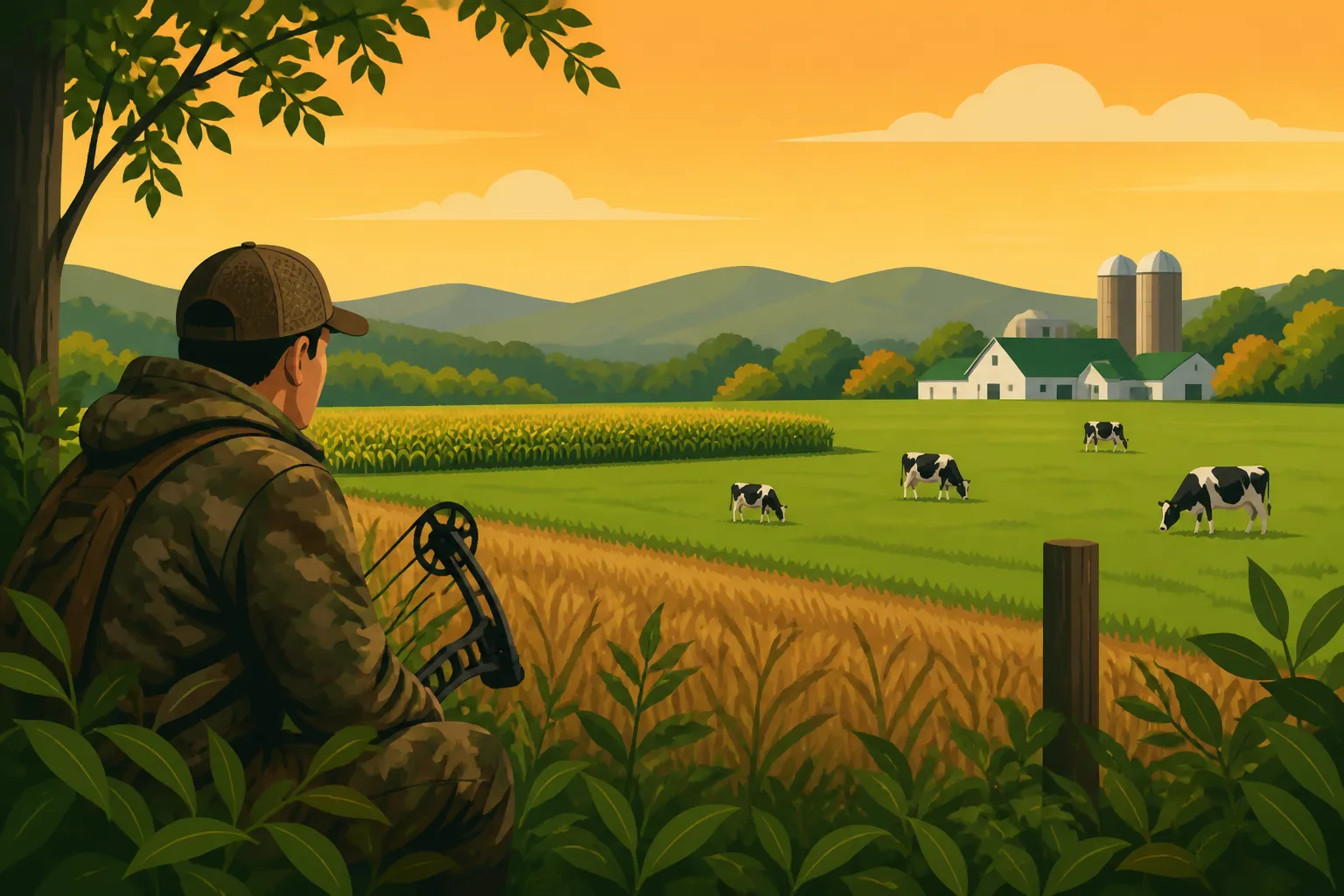
Setting Up on a Dairy Farm Field Edge
Hunting deer on Vermont dairy farm field edges can be incredibly productive, yet it’s also undeniably challenging. Whitetails here are incredibly sharp, constantly navigating between their bedding areas, favored food sources, and water, often utilizing the very edges of those sprawling fields. The real frustration hits when you meticulously plan a hunt only to bust deer before you’re even settled, or worse, watch them effortlessly skirt your setup just out of range. This guide is designed to cut through that frustration, providing you with the detailed strategies needed to master setting up on these dynamic farm edges, transforming those challenges into consistent, ethical hunting success.
The Allure of Vermont Dairy Farm Edges for Deer
Dairy farms, with their mix of cultivated fields, woodlots, hedgerows, and often streams or ponds, create a mosaic of highly attractive habitat for white-tailed deer. Understanding why deer are drawn to these areas is the first step in formulating a successful hunting strategy. It’s not just about the food; it’s about the entire ecosystem a working farm provides.
Why Deer Gravitate to Farm Fields
Deer are, at their core, creatures of opportunity, and dairy farm fields present an irresistible buffet. Think about it: a freshly cut hayfield, rows of standing corn, or even the remnants of a silage harvest offer easily accessible, high-calorie forage that deer simply can’t pass up. While a mature hardwood forest offers acorns and browse, a cornfield or alfalfa patch provides a concentrated, reliable food source that deer will travel to exploit. This abundance means deer spend a significant portion of their time either in these fields or staging very close to them, especially during the crucial low-light hours of dawn and dusk.
Beyond the immediate food source, these fields are almost always situated adjacent to crucial cover. Whether it’s a thick, unkempt woodlot, a dense hedgerow, a brushy creek bottom, or even a swampy depression, deer need a place to feel safe and bed down during daylight hours. The beauty of a farm edge is this immediate proximity: deer can feed heavily and then quickly melt back into the security of the timber without venturing far. This makes the transition zones—where field meets forest—absolute hotspots for activity, particularly as they move to and from these bedding areas.
Water is another often-overlooked factor. Many dairy farms have natural springs, small ponds, irrigation ditches, or even active streams running through or alongside their property. Deer need water daily, and if they can access it close to their feeding and bedding grounds, they will. These water sources can create natural funnels or congregation points, especially in drier periods, drawing deer along specific paths as they move to or from the fields.
Ultimately, deer thrive in edge habitat. The boundary where two different habitat types meet—like a field and a forest—provides the best of both worlds. It offers varied forage, diverse cover, and often more sunlight or moisture, leading to a richer array of plant life. Deer inherently feel safer and more comfortable in these transitional areas, making them natural travel corridors and staging grounds before they commit to stepping out into the open field.
Understanding Local Deer Patterns
It’s crucial to recognize that not all farm fields are created equal in the eyes of a deer. While one field might be a primary feeding ground, another might serve as a less frequented travel corridor, or perhaps a staging area where bucks will scent-check for does before entering. Observing how deer use specific fields on a particular farm can inform your entire hunting plan. Are they hitting a specific corner more often? Do they seem to prefer a certain type of crop? These are vital questions to answer.
Deer operate on daily routines, especially when undisturbed. They’ll typically bed in a nearby woodlot or dense cover during the day, then, as evening approaches, begin their journey towards the fields to feed. This movement often occurs in the last hour or two of daylight. Conversely, as dawn breaks, they’ll move from the fields back to their bedding areas. Understanding these ebb and flow patterns is fundamental to timing your hunts effectively.
Seasonal shifts also play a massive role in deer behavior around farm fields. In the early archery season, deer might be hammering alfalfa or clover fields. As fall progresses and crops are harvested, their focus will shift. Later in the season, particularly after a few hard frosts, deer will often target standing or cut cornfields for their carbohydrate-rich kernels or even switch to winter wheat. Identifying these changing food preferences is key to staying on the deer. Keeping an eye on Late-Season Food Sources for Vermont Whitetails can be a real game-changer.
Finally, the impact of active farming operations cannot be overstated. Deer are incredibly adaptable creatures. They learn to associate the sound of a tractor with activity and will often shift their patterns accordingly. A freshly harvested cornfield might be ignored for a day or two after machinery has been through, only to be hammered by deer a few nights later once human disturbance has subsided. Conversely, some deer seem almost accustomed to the sounds and sights of farm life, moving cautiously even during the day. Observing how deer react to these ongoing changes provides invaluable insight.
Meticulous Scouting: Your Foundation for Success
You can have the best gear and the steadiest aim, but if you’re not in the right spot, it’s all for naught. This is where meticulous scouting comes into play, especially on dynamic farm edges where deer patterns can be subtly influenced by so many factors. It’s a multi-layered approach, combining digital tools with boots-on-the-ground verification.
Digital Reconnaissance and On-the-Ground Verification
Before you even step foot on the property, fire up your mapping apps. Tools like GoHunt or other detailed satellite imagery are your initial eyes in the sky. Look for the big picture: where are the woodlots connecting to the fields? Are there any obvious pinch points, funnels, or narrow strips of cover that deer might use to travel between larger blocks of timber? Identify creek beds, old fencerows, or dense hedgerows that provide linear cover right along the field edge. These features are often magnets for deer movement and are excellent starting points for more detailed investigation.
Leverage the powerful features found in apps like GoHunt to mark potential bedding areas you identify from aerial photos—dense thickets, south-facing slopes, or pockets of conifers. Then, pinpoint probable travel routes and transition zones. Don't just mark field edges; focus on where the cover meets the field edge, or where subtle changes in topography might provide a hidden travel lane. This kind of virtual legwork makes your real-world scouting far more efficient. It also helps you start Reading Aerial Photos for Green Mountain Deer with a more informed perspective.
Once you have your digital map populated with potential hotspots, it’s time for boots-on-the-ground verification. This is where the rubber meets the road. Walk the edges you identified digitally, but do so strategically. Be hyper-aware of your scent and the disturbance you’re creating. Ideally, do this during the middle of the day when deer are most likely bedded down, or when a strong wind is blowing your scent away from suspected bedding areas. This ground truth is invaluable, especially if you're fortunate enough to be Hunting a Champlain Valley Dairy Farm Edge.
While walking, look for fresh deer sign. Soft soil along field edges, muddy creek banks, or even dusty tractor paths are excellent places to find tracks, telling you not only that deer are present but how recently they’ve been there and which direction they were traveling. During the rut, look for rubs on saplings and scrapes along the field edges – these are explicit markers of buck activity. Pay close attention to droppings; their freshness can indicate very recent presence. The goal is to focus on where these signs funnel to or from the field, pinpointing the exact entry and exit points deer are consistently using.
Identifying High-Traffic Corridors
Deer, being prey animals, prefer to move with a sense of security. This means they will almost always gravitate towards the path of least resistance that also offers the most cover. Funnels between woodlots are prime examples of this. Imagine two blocks of timber separated by a narrow strip of field or a low-lying area with dense brush. Deer will consistently use this bottleneck to move between the safety of the woods, rather than exposing themselves by walking directly across a wide-open field. Setting up near these natural choke points can be incredibly productive. This is exactly why you'd want to be Hunting a Funnel Between Two Woodlots.
Inside corners of fields are another hotspot. This is where two different types of cover—say, a hardwood ridge and a dense pine thicket—converge at the field edge. Deer feel secure moving along these corners because they have multiple escape routes and varied cover to disappear into. These spots often see higher traffic as deer transition from one cover type to another while heading to the field.
Subtle linear features like hedgerows, old stone walls overgrown with brush, or even drainage ditches can act as hidden highways for deer. They provide just enough cover to give deer a sense of security as they travel parallel to a field. Often, these features are overlooked by hunters who focus only on the main woodline, but deer are masters of using even minimal cover to their advantage.
Ultimately, your goal is to find the worn trails—the actual paths deer are taking. These aren't always obvious, especially in taller grass or undergrowth, but with careful inspection, you'll see where deer have habitually pushed through. Don't just assume where they should go; find where they are going. This ground-level detective work is what separates successful hunters from those who just hope for a deer to walk by.
Strategic Stand Placement and Setup Options
Once you've done your due diligence in scouting, the next critical step is deciding where and how you'll hunt. This involves a careful consideration of your chosen hunting method, the specific terrain, and, crucially, how to get in and out undetected.
Choosing Your Perch: Treestand vs. Ground Blind
The choice between a treestand and a ground blind largely depends on the specific field edge, available cover, and your hunting style. Each has distinct advantages and disadvantages that warrant careful thought.
Treestands offer a significant advantage through elevation. Getting up in a tree provides a wider vantage point, allowing you to survey more of the field and its edges. Critically, it helps with scent dispersal. While thermals and wind can still carry your scent, being higher off the ground generally allows your scent cone to disperse more effectively, making it harder for deer to pinpoint your exact location. This elevation also often provides clearer shot lanes over ground-level obstacles. For many hunters, being Hanging a Stand on a Champlain Valley Field Edge is a go-to strategy.
However, treestands come with their challenges. Finding a suitable tree that offers good cover and is positioned correctly for the wind can be difficult. Getting into a treestand quietly, especially in the dark before dawn, can be noisy, potentially alerting nearby deer. Furthermore, once you're up, you're relatively committed. If deer approach from an unexpected direction, or if the wind shifts, your options for adjustment are limited.
Ground blinds, on the other hand, offer excellent concealment. When properly brushed in, a ground blind can virtually disappear into the environment, allowing you to draw a bow or shoulder a rifle with minimal movement detection. They're much easier and quieter to set up, and they offer more flexibility if deer come from an unexpected direction, as you can often shift your shot or even reposition slightly within the blind. For areas with unpredictable winds or a lack of suitable trees, a ground blind is an excellent choice, especially if you spend time Brushing In a Blind on a Field Edge properly.
The downsides of ground blinds include limited visibility compared to a treestand, and the challenge of scent pooling. Your scent tends to linger closer to the ground, making careful wind management even more critical. Deer are also incredibly wary of unnatural shapes, so a ground blind that isn't meticulously brushed in and allowed to "air out" for a few days can be easily spotted and avoided.
| Setup Type | Pros | Cons | Best Use Case |
|---|---|---|---|
| Treestand | Elevated view, scent dispersed (better), wide shot angles | Requires suitable tree, noisy entry/exit, less mobile | Stable winds, good cover trees, longer sits, larger field views |
| Ground Blind | Excellent concealment, mobile, easy setup, allows movement, less weather exposed | Limited view, scent pooling (worse), needs heavy brushing | Unpredictable winds, open areas, quick setups, multiple hunters |
Optimizing for Wind, Sun, and Access
Once you've decided on your type of setup, its exact placement is paramount. Forget about where you want to put it; focus on where it needs to be.
Wind is absolutely king. This cannot be stressed enough. Always choose a setup location that ensures your scent is blowing away from where you expect deer to approach, bed, or feed. Deer have an incredible sense of smell, and a single whiff of human scent will send them scattering. Check the forecast religiously, use a wind checker frequently, and be prepared to move if the wind shifts unexpectedly. A perfectly placed stand is useless if the wind is wrong. Even in a treestand, you're not completely immune to Wind and Thermals in Steep Green Mountain Terrain, though farm edges tend to be flatter than steep mountain slopes.
The sun's position is another crucial factor. You don't want the rising or setting sun directly in your eyes, blinding you when that trophy buck steps out. Nor do you want to be silhouetted against the bright sky, making you an obvious target for wary deer. Plan your setup so the sun is either at your back or to your side during the prime hunting hours. This will provide you with optimal visibility and keep you concealed.
Finally, and often overlooked, is your access route. How will you get to your stand or blind without alerting deer? This means using natural terrain features—a creek bed, a ditch line, the backside of a hill, or a dense thicket—to hide your approach. In some cases, approaching from the field side during the middle of the day, when deer are likely bedded elsewhere, might be the quietest option, especially if you're Hunting the Regular Archery Opener in October and deer patterns are still somewhat predictable.
Your entry and exit routes are just as important as the stand itself. Don't blow out deer on your way in or out. This means planning your approach and departure to use prevailing winds and minimal disturbance. If you repeatedly bump deer coming or going, you'll quickly educate them to avoid that area entirely. Often, the best entry path isn't the shortest one, but the one that keeps you most concealed and quiet.
Minimizing Impact and Maximizing Stealth
Getting to the right spot is only half the battle; staying undetected is the other, equally critical, half. Deer on farm edges, particularly older animals, are hyper-vigilant. Every detail, from your scent to your movements, contributes to your success or failure.
Scent Control and Quiet Movement
On a farm edge, where deer are often in close proximity and cover can be sparse, scent control is not just a suggestion; it's an absolute necessity. Your scent is your number one enemy. Adopt a full scent control regimen: shower with scent-eliminating soap, wash your hunting clothes in scent-free detergent, and use carbon-lined clothing or an ozone treatment system. Some hunters even go as far as using scent-eliminating sprays on their boots and gear.
Crucially, store your hunting clothes separately from your everyday garments and anything with strong odors like gasoline, food, or campfire smoke. These seemingly small details can make a huge difference. Imagine all that meticulous scouting going to waste because a faint whiff of diesel from your truck, clinging to your jacket, spooked a buck you’ve been chasing all season. Even during Muzzleloader Deer Hunting in Vermont when the weather is colder, deer still rely heavily on their nose.
Beyond scent, quiet movement is paramount. No jingling keys, rattling equipment, or noisy zippers. Every sound you make in the woods carries much further than you think, especially on still mornings or evenings. Walk softly, taking deliberate steps, particularly when you’re within striking distance of your setup. Use natural sounds to your advantage: a strong wind can mask your approach, as can light rain or even the distant hum of farm machinery. Wait for a gust of wind to take those last few steps to your stand.
Blending In and Patience
Your choice of camouflage patterns matters. Farm edges present a unique visual environment—a mix of open fields, brushy transitions, and various types of timber. Select a camo pattern that breaks up your outline effectively against this specific backdrop. A pattern designed for deep woods might not blend as well against the lighter tones of a cut cornfield or a dormant hayfield. Focus on patterns that incorporate elements of natural vegetation, bark, and shadows specific to the Vermont landscape you're hunting.
Beyond the pattern, breaking up your outline is critical. Even in a treestand, try to position yourself so a tree trunk or branches help obscure your shape. For ground blinds, this is where brushing in becomes an art form. Use native vegetation—corn stalks, branches, tall grasses—to completely blend the blind into its surroundings. The goal is for the blind to look like a natural part of the landscape, not an alien blob.
Patience is a virtue in deer hunting, and nowhere is this more true than on a farm edge. Deer, especially mature animals, will often test the edge of a field for long periods before stepping out fully. They’ll stand in the shadows, scent-checking the air, listening, and looking for any sign of danger. Don't rush a shot. Wait for the deer to be comfortable, broadside, and within your ethical shooting range. A hurried shot at a nervous deer often leads to a missed opportunity or, worse, a wounded animal. This patience is particularly important when Hunting the Rut in Early-to-Mid November, as bucks can be moving erratically.
Finally, and perhaps most importantly, remember the importance of maintaining good landowner relations, especially on a working dairy farm. Always coordinate with the farmer. Understand their schedule, know which fields are active, and respect their property. A little communication goes a long, long way in ensuring you continue to have access for years to come. This commitment to being a respectful guest is vital for Getting Private Land Permission in Vermont.
Disclaimer
Hunting is an inherently dangerous activity. This article is for informational purposes only and does not endorse or encourage unsafe practices. Always prioritize safety, adhere to all local, state, and federal hunting regulations, and complete necessary hunter education courses. Consult the Vermont Fish and Wildlife Department for the most current rules and requirements before heading afield.