Wind and Thermals in Steep Green Mountain Terrain
There's nothing quite like the humbling experience of hunting Vermont's Green Mountains, only to have a swirling wind betray your presence to a wary buck you've stalked for hours. The frustration is real, and it's a common story for anyone who’s spent time in this steep, unforgiving terrain. This guide is dedicated to demystifying the complex world of wind and thermals in these challenging environments, helping you understand and ultimately leverage these invisible forces to become a more successful hunter.
Understanding the Unpredictable Nature of Mountain Wind
When you're out in the relatively flat farmlands of the Champlain Valley, you might get used to a fairly consistent wind direction. But step into the rugged, broken topography of the Green Mountains, and that predictability often vanishes faster than a whitetail buck at first light. The wind in steep country isn't just a simple breeze; it's a complex, ever-changing current, influenced by every peak, valley, and even individual tree. Learning to read this invisible flow is paramount for success.
The Basics of Wind Movement
At its most fundamental level, wind is simply air moving from an area of high pressure to an area of low pressure. This movement is influenced by large-scale weather systems, but in mountainous regions, it's also dramatically affected by local features. Think of it like a river flowing; sometimes it's a wide, gentle current, other times it's a turbulent eddy around a rock, or a roaring cascade through a narrow gorge.
Many hunters make the mistake of trusting a perceived consistent wind, only to be busted repeatedly. You might feel a steady breeze on your face as you climb a ridge, assuming it's carrying your scent away from where you expect deer to be. However, that "steady" breeze might only be consistent at your immediate elevation, with entirely different air currents just above or below you, or even swirling violently in a nearby draw. It's an illusion that the mountains excel at creating, designed to humble even the most seasoned outdoorsmen. The real key is to constantly check and re-evaluate, never trusting a static reading for long.
How Topography Shapes Airflow
The Green Mountains are a tapestry of ridges, valleys, saddles, and draws, and each one acts as a natural guide or barrier to airflow. A narrow valley, for instance, can funnel wind with surprising speed and consistency, acting like a wind tunnel. Conversely, a wide, open bowl can allow wind to swirl unpredictably, creating dead spots and unexpected updrafts. These are the micro-climates that can make or break a hunt.
Imagine you're still-hunting a timbered fence line for deer. A steady, prevailing wind might be blowing from the west. However, as you approach a steep-sided draw that runs north-south, that westerly wind can hit the side of the draw, be deflected down into it, travel along the bottom, and then curl back up the other side, creating a complete reversal of what you'd expect at the top. This phenomenon, known as an eddy, is why your scent can be carried in multiple directions simultaneously, even on a day with a strong "prevailing" wind. Understanding how these features interact with the wind is crucial for planning your approach and stand placement, preventing you from simply hoping for the best.
Decoding Thermals: The Green Mountain's Breath
Beyond the large-scale wind patterns, mountains breathe with their own rhythm, creating localized air currents called thermals. These are driven by temperature differences and are often more predictable than wind, following a general pattern throughout the day. However, ignoring them is a surefire way to get winded, especially during the calmest parts of the day when larger weather patterns might not be dominant.
Daytime Updrafts and Their Impact
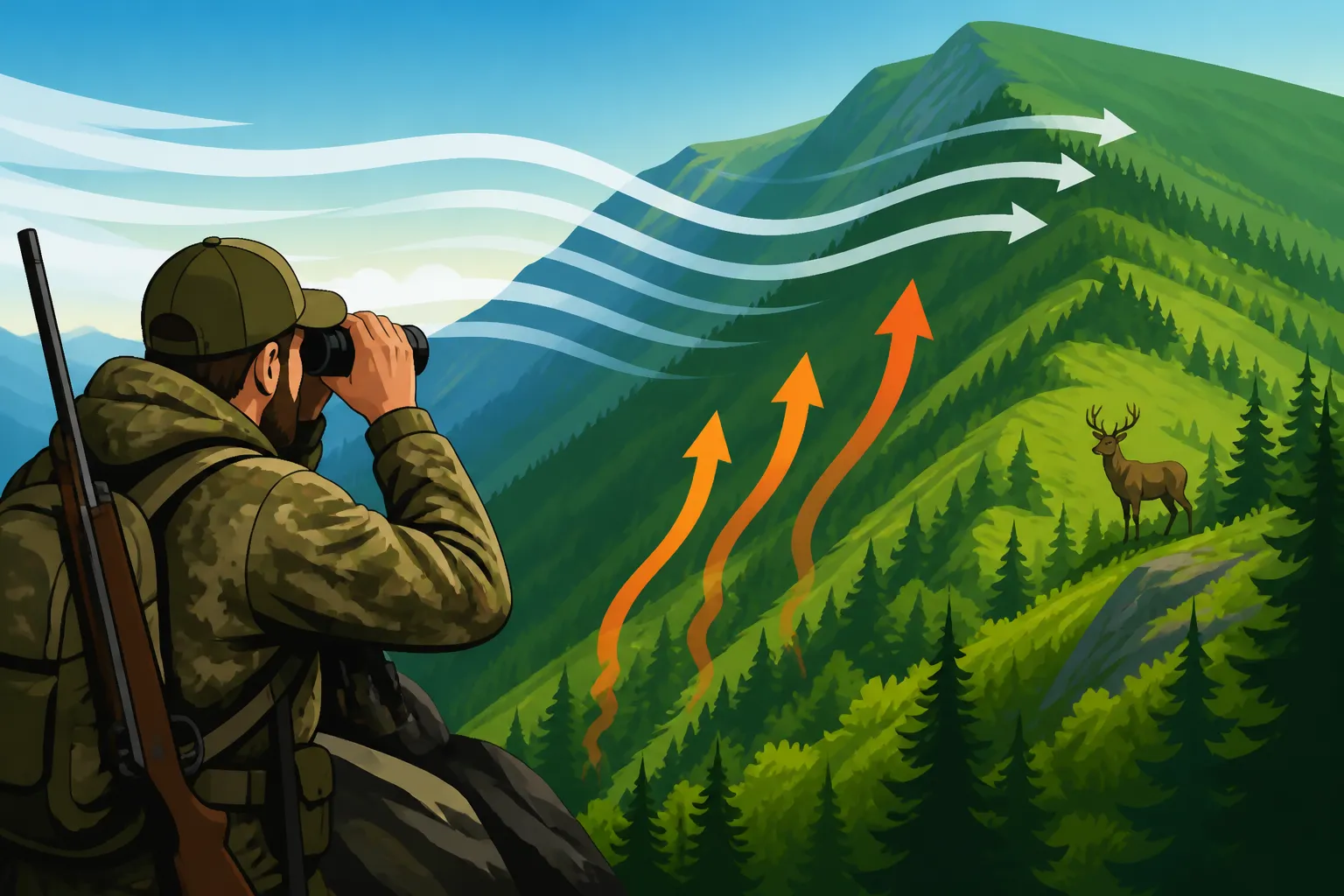
As the sun rises and warms the earth, particularly the exposed slopes and rock faces, the air above these surfaces heats up and begins to rise. This rising air creates an uphill thermal current, pulling air (and any scent it carries) from lower elevations up towards the ridge tops. This phenomenon is often strongest from late morning through the afternoon, especially on sunny days.
Consider a crisp autumn morning as you begin your hike into a steep basin where you've been Scouting Vermont Public Land Before Season. Initially, there might be little to no wind. As the sun begins to hit the eastern slopes, the air starts to warm, and you'll notice your milkweed silk or wind powder being pulled steadily uphill. If you're trying to sneak into a bedding area situated midway up that slope, these daytime updrafts can carry your scent directly to the deer above you. This means your approach needs to be carefully planned to either stay below their line of sight and scent, or circle wide to get above them before the thermals fully establish themselves. This is why many experienced hunters try to reach their morning stands before the thermals begin to rise significantly.
Evening Downdrafts and Their Importance
Conversely, as the sun begins to set and the slopes cool, the air above them also cools, becoming denser and heavier. This cooler, heavier air then sinks, creating a downhill thermal current. This downdraft typically begins in the late afternoon and continues into the night, pushing scent from higher elevations down towards the valleys and lowlands.
For an evening hunt, this means that as dusk approaches, any scent you're emitting from your stand on a ridge or bench will be carried downhill. If you're set up on a high-elevation bench overlooking a feeding area in the valley below, these evening downdrafts are your friend, carrying your scent harmlessly away over the deer you're watching. However, they also dictate your exit strategy. If you walk directly down the game trail you expect deer to be using to access that feeding area, your scent will precede you, alerting any late-moving animals. An ideal strategy might involve approaching a stand in the morning via a route that uses rising thermals, and then exiting that same stand in the evening via a different route that uses falling thermals, or waiting until full dark when deer are already actively moving.
The Dance Between Wind and Thermals
The true challenge and fascination of hunting in steep Green Mountain terrain lies in the constant interaction between the prevailing wind and localized thermals. They don't always cooperate, and understanding when one will override the other, or how they might combine, is a high-level skill that takes years to master.
When One Dominates the Other
On days with a strong, consistent prevailing wind, that wind will often overpower and effectively neutralize the thermal currents. If a 20 mph westerly wind is screaming through a notch pass in the Green Mountains, it's highly unlikely that rising or falling thermals will have a significant impact on scent dispersion. In these conditions, you can often rely more heavily on the prevailing wind direction, though you still need to be wary of topographical features creating localized eddies.
However, on calm days, especially during periods of high pressure, the thermals become the dominant force. In these situations, the mountains breathe their distinct uphill and downhill patterns with clear precision. If you wake up to a perfectly still, crisp morning, you can almost guarantee that within an hour or two of sunrise, the thermals will begin their steady ascent. Conversely, as evening settles in and the air stills, the falling thermals will take over. The most difficult conditions are when the prevailing wind is weak or variable, as it can then clash with, or be subtly redirected by, the thermals, creating unpredictable swirls and confused air currents.
Predicting the Crossover Points
The most critical times for thermal awareness are the "crossover points" – the periods around sunrise and sunset when thermals switch directions. In the morning, as the sun begins to warm the slopes, the downhill thermal (which dominated the night) will gradually weaken and reverse, giving way to the rising uphill thermal. This transition isn't instantaneous; there's often a period of confused, swirling air where your scent could go anywhere.
Similarly, in the evening, as the sun dips below the horizon and temperatures drop, the uphill thermal will slowly dissipate, replaced by the developing downhill thermal. This transition period, roughly an hour on either side of sunrise and sunset, is often the trickiest to predict. Hunters who understand this phenomenon will often try to be in position well before these switches occur, allowing the thermals to stabilize. Alternatively, they might use this transition time as an opportunity to move when deer are also likely moving, hoping any confused scent is diluted in the chaotic air. This transitional period, often around the time animals are most active, can be particularly challenging.
Practical Strategies for Hunting Steep Terrain
Successfully hunting the Green Mountains isn't just about understanding wind and thermals, but actively integrating that knowledge into your hunting strategy. It means planning your approach, stand location, and even your hunting style around these invisible forces.
Playing the Wind for Deer Movement
Deer, like most wild animals, are masters of using the wind to their advantage. They will almost always try to bed in a spot where they can smell danger approaching from downhill or downwind, while visually scanning for threats uphill or upwind. This natural defense mechanism is ingrained. When still-hunting Green Mountain National Forest Timber, a smart hunter will leverage this. Instead of fighting the wind, you play it.
You might find bucks Reading a Green Mountain Deer Yard where they stage just below a ridge on a thermal current that pulls their scent uphill, allowing them to smell anything above them, while they watch their back trail. To hunt this, you might hike around and approach from above them, allowing the falling thermals of late evening to carry your scent over their heads, or waiting for a blustery day when the prevailing wind is steady. Often, you're not just trying to keep your scent away from deer, you're trying to put your scent in a place that causes them to move into an area where you have an advantage. Using a powerful mapping tool like GoHunt can help you analyze terrain features, visualize wind direction overlays, and identify potential bedding areas and travel corridors based on prevailing winds and expected thermal shifts.
Leveraging Thermals for Approach and Exit
The key to successfully navigating steep terrain is to use thermals to conceal your presence during ingress and egress. For a morning hunt, plan your approach to stay low in the valley or on the leeward side of a ridge where cool, heavy air still pools. This allows you to climb and get into your stand or still-hunting area before the thermals begin to rise, keeping your scent low and away from deer bedded higher up. If you're trying to target a buck you've seen Hunting a Ridge-Top Saddle for Rutting Bucks, getting in early, even before first light, is crucial.
For an evening hunt, reversing this strategy is often effective. Approach your stand from a higher elevation, if possible, allowing your scent to be carried downhill with the cooling air. When you exit, especially if you're Tracking a Deer in Fresh Green Mountain Snow after a shot, always consider the thermals. If you need to cross through a known feeding area where deer are likely to be, wait until full dark when animals are already active or the thermals have fully settled into their downhill flow, minimizing your chances of spooking future game. This deliberate strategy, planned with tools like GoHunt that show topographical contours, enhances your chances significantly.
The Importance of Micro-Thermals and Eddies
While large-scale wind and thermal patterns are important, it's the smaller, localized "micro-thermals" and eddies that often trip up hunters. These are caused by subtle changes in terrain, dense patches of cover, or even large rocks and boulders. A small dip in the terrain, a rock outcrop, or a patch of thick softwood cover can create its own tiny pressure system, causing scent to swirl unpredictably for just a few feet before rejoining the main airflow.
This is why constant vigilance is so critical. Even if the main wind seems steady, always be checking your wind checker (milkweed, puff bottle, etc.) every few steps, especially when cresting small rises, dipping into minor swales, or moving around large obstacles. A real-life example might be traversing a relatively flat bench on a ridge. Suddenly, as you pass a cluster of hemlocks at the edge of a small ravine, your wind checker shows your scent swirling backwards for a moment. That subtle eddy could be enough to alert a deer bedded just beyond that cover. Understanding these subtle shifts is what truly separates experienced mountain hunters from those who consistently get busted.
Gear and Tools for Wind and Thermal Awareness
You can have all the knowledge in the world, but without the right tools to confirm what you're sensing and experiencing, it's just theory. Modern hunting gear and technology offer significant advantages in understanding and reacting to wind and thermals in real-time.
Wind Checkers and Other Indicators
The most fundamental tool for wind awareness is a simple wind checker. Forget licking your finger; you need something that shows the exact direction and even subtle shifts in air current. Milkweed silk is a classic for a reason – its delicate fibers drift on the slightest breeze. But a squeeze bottle of unscented talcum powder or commercial wind-checking powder is arguably more practical and readily available. Keep it handy and use it constantly.
Imagine you're Still-Hunting Green Mountain National Forest Timber with a light breeze. You think the wind is consistent, but a quick puff of your wind checker reveals that it's actually swirling in small eddies as it navigates through dense timber, or that a thermal is just starting to pull it upwards unexpectedly. Without that visual confirmation, you might walk right into a deer's nose. A good rule of thumb is to check your wind every minute or two, especially when moving, changing elevation, or entering a new patch of cover. This constant feedback loop is your best defense against being winded.
Advanced Weather Apps and Mapping Tools
While a physical wind checker is essential for micro-reads, advanced weather apps and mapping platforms provide invaluable macro-level intelligence. Applications like GoHunt offer detailed topographical maps, satellite imagery, and often integrate sophisticated weather overlays that can predict wind direction, speed, and even thermal shifts for specific locations and times of day. This foresight allows for significantly better planning.
Before you even leave your truck, you can use these apps to analyze your intended hunting area. You can look at the predicted wind direction, understand how it will interact with the terrain, and identify potential funnels or eddy spots. Some apps even allow you to drop pins and simulate scent cones based on projected wind, helping you plan your exact approach and stand location. When combined with other layers like onX Layers for Vermont Land Status to verify property boundaries, these tools transform how you prepare for a hunt in the Green Mountains, giving you an unparalleled edge in deciphering the invisible language of the air.
| Thermal/Wind Scenario | Time of Day | General Airflow Direction | Impact on Hunter's Scent | Recommended Hunter Action |
|---|---|---|---|---|
| Morning Thermal | Sunrise to Mid-day | Uphill (Rising) | Scent pulled uphill | Approach from low, get in early, stay below deer. |
| Evening Thermal | Late Afternoon/Dusk | Downhill (Falling) | Scent pushed downhill | Approach from high, exit carefully or wait till dark. |
| Strong Prevailing Wind | Any | Consistent with direction | Scent follows prevailing wind | Use main wind for approach, be mindful of terrain funnels. |
| Weak/Variable Wind | Any | Swirling, unpredictable | Scent can go anywhere | Extreme caution, constant wind checks, slow movement. |
| Crossover Period | Sunrise/Sunset | Highly variable, switching | Scent chaotic | Be in stand early/late, minimize movement, re-evaluate. |
Disclaimer
Please remember that hunting involves inherent risks. Always prioritize safety, follow all Vermont Fish and Wildlife Department regulations, and obtain proper licenses and permits. This guide provides informational advice, but local conditions and individual situations can vary. Stay safe and hunt ethically.