Rattling Volume in Thick Softwood Cover
We’ve all been there: you’ve found that perfect pocket of thick softwood cover, you know a big Vermont buck is likely holed up there, and you decide to try a rattling sequence. You crash your antlers together with conviction, only to have the sound swallowed almost immediately by the dense spruce, fir, or cedar. It’s incredibly frustrating to put in the effort, feeling like your efforts are just dissolving into the quiet woods, leaving you wondering if any deer heard it at all. This guide is all about overcoming that specific challenge, helping you understand how to adjust your rattling volume and technique to effectively call in bucks, even when hunting in the thickest softwood cover Vermont has to offer.
The Unique Acoustic Challenge of Thick Softwoods
Hunting in Vermont often means navigating incredibly dense softwood stands. These areas are prime bedding and security cover for mature bucks, especially during the rut, but they present a unique challenge when it comes to sound propagation. The very nature of thick evergreens can make your carefully executed rattling sequences feel utterly ineffectual.
Why Softwoods Muffle Sound So Effectively
It’s not just your imagination; thick softwood cover genuinely mutes and absorbs sound in a way that open hardwoods or field edges don't. Imagine standing in a dense spruce thicket – the air feels still, almost dead, doesn't it? That's because the countless needles, branches, and trunks of these evergreen trees act like a natural sound dampener. Each obstacle deflects and absorbs sound waves, preventing them from traveling far. Unlike the wide-open spaces of a hardwood forest in late fall, where sound can echo and carry for hundreds of yards, a softwood thicket will often gobble up your calls within 50 to 75 yards, sometimes even less. This absorption effect means that if you're rattling with the same intensity you would in more open country, you're severely limiting the range of your audible invitation. It's a critical factor to understand before you even think about bringing your antlers together.
Visibility Versus Audibility in Dense Cover
The paradox of hunting thick softwoods is that what makes them great for deer often makes them incredibly challenging for hunters. You're trying to coax a buck into a spot where visibility is already extremely limited. A deer might only be able to see 20 or 30 yards, sometimes even less, depending on the density of the cover. This means that if they hear your rattling, they need to be able to close that distance quickly and confidently to get into a shooting lane. The reduced audibility of your calls combined with the poor visibility creates a tight window of opportunity. A buck might hear a faint sound but be reluctant to move far into what it perceives as unknown territory if it can't pinpoint the source. This is where hunters often fail: they don't adjust their expectations or their tactics to match these limitations, assuming a buck will just come charging in like they might in more open woods. Understanding this dual challenge is the first step to successful rattling in these environments.
How Bucks Behave Differently in Thick Cover
Deer, especially mature bucks, use thick softwood cover for security, bedding, and staging areas. They move through these areas differently, often more deliberately and cautiously, relying heavily on their sense of smell and hearing. When a buck hears rattling in open hardwoods, its curiosity or aggression might draw it in quickly, sometimes even on a run. But in dense softwoods, their response is often much more subtle. They might circle downwind, attempting to scent-check the source of the sound, or simply slip silently through the cover to get a visual before committing. You're far less likely to see a full-on charge in these environments. Instead, anticipate a slow, deliberate approach, often with the buck using every bit of available cover to conceal its movement. They are already in their safe zone, so the risk-reward calculation changes for them. This means you need to be patient, stay vigilant, and understand that their "response" might just be a shadow moving through the evergreens, or the subtle twitch of an ear rather than a full-blown appearance.
Tailoring Your Rattling Volume to the Cover
Given the acoustic challenges of thick softwood cover, a one-size-fits-all approach to rattling is simply going to lead to frustration. You need to adjust your volume and intensity based on the immediate environment and the deer you're trying to attract. This isn't about simply rattling louder; it's about rattling smarter.
The Nuance of "Soft Rattling" in Tight Spaces
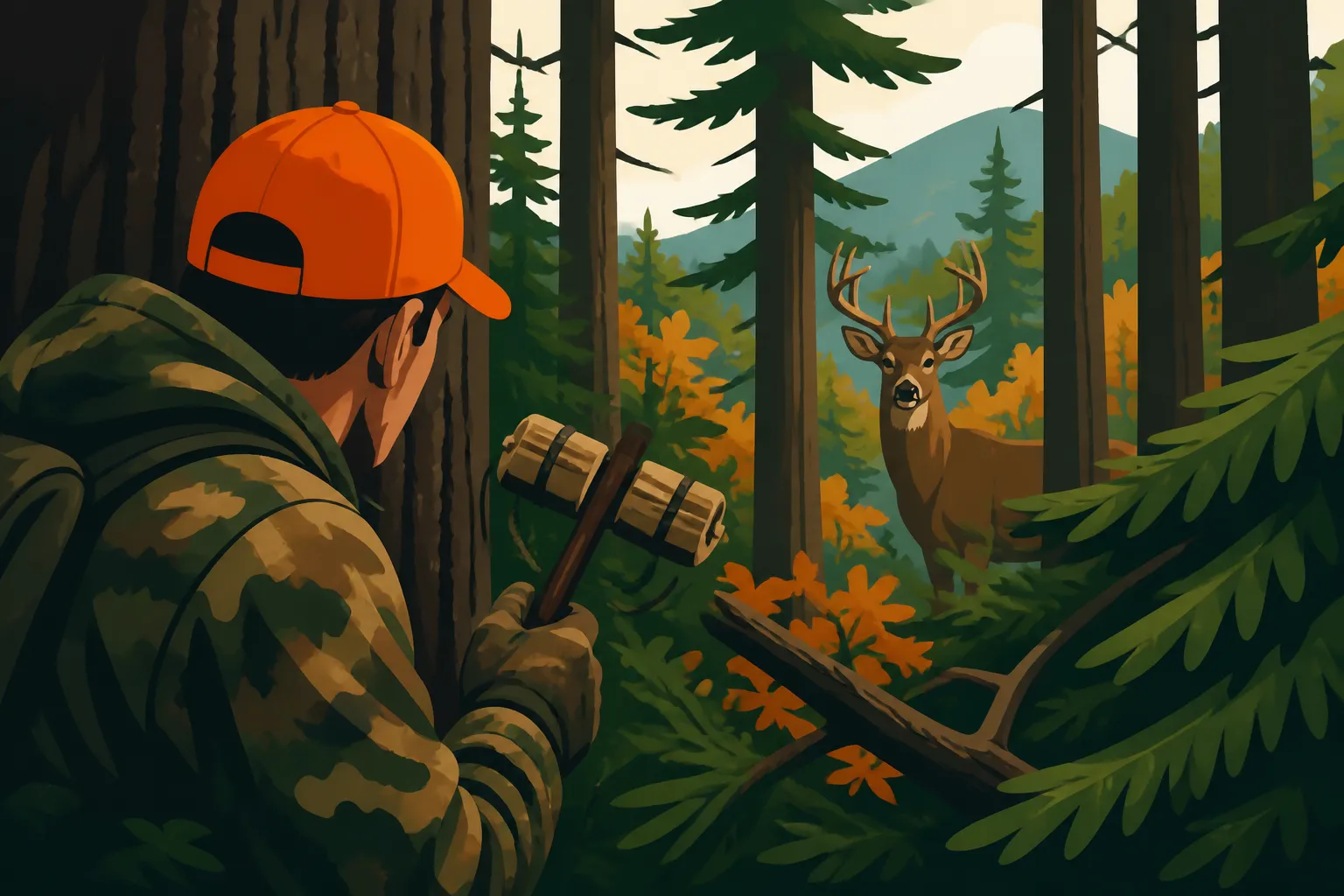
When you're buried deep in a tight softwood stand, where visibility is measured in mere yards, an overly aggressive, loud rattling sequence can be counterproductive. Think about it: a real buck fight happening that close to another deer would be incredibly intense and localized. Therefore, a "soft rattling" approach can often be more effective. This involves lightly clashing your antlers together, maybe even just rubbing them, and incorporating gentle grunts and light breaking of twigs. The goal here isn't to draw a buck from a quarter-mile away, but rather to pique the interest of deer that are already very close – perhaps bedded or staging within 75 yards.
This technique mimics a subtle sparring match, two younger bucks testing each other, or a dominant buck making his presence known quietly. A soft rattle in these conditions can sound incredibly realistic and non-threatening, especially if you're trying to pull in a wary, mature buck who might be spooked by an all-out brawl directly over his head. It’s about creating just enough auditory stimulation to make a nearby buck curious enough to investigate without immediately circling downwind or bolting in the opposite direction. Your setup location is key here; you want to be as close to suspected bedding areas as safely possible without blowing out deer on your entry.
When to Try an Aggressive Rattle and Wait Strategy
Despite the sound-muffling nature of softwoods, there are times when an aggressive, high-volume rattling sequence can still be your best bet, particularly if you suspect bucks are a bit further out than your soft rattling might reach, but still within the general vicinity of the thick cover. This strategy is less about drawing them from miles away and more about making sure the sound cuts through enough of the immediate buffer zone to reach them. The key difference here is the "and wait" part. You might initiate a very loud, violent clash of antlers, really mimicking a serious fight, and then go completely silent for an extended period—15 to 20 minutes, sometimes even longer.
The idea is that the initial burst of sound, despite being muffled, might carry just far enough to get the attention of a buck that’s maybe 100-150 yards away. Because of the limited visibility, that buck will likely take its time approaching, moving cautiously, trying to pinpoint the source. Your long period of silence gives the deer the confidence to move in without feeling pressured. It also allows time for the sound waves to dissipate and for the woods to settle, making any approaching deer feel more secure. This tactic relies on the sheer primal allure of a fight, hoping that even a muted version will be enough to trigger curiosity or aggression. Just remember, once you commit to a loud rattle, stay still and silent. Any subsequent movement will likely blow your chances.
Using Directional Sound Control to Your Advantage
One often-overlooked aspect of rattling in thick cover is how you can use the cover itself to help direct or shape your sound. Instead of just rattling randomly, consider the topography and the density of the evergreens around you. If there’s a slightly less dense corridor, or a subtle dip in the terrain that might carry sound better, try to direct your rattling towards it. Similarly, if you know bucks prefer to stage on a certain side of a thicket, orient your rattling towards that area.
You can also use physical barriers as natural soundboards. Rattling near a larger tree trunk or a rock outcrop can help project the sound a little further, or at least prevent it from being completely absorbed by the softwoods directly behind you. This isn't about "bouncing" sound like in an open amphitheater, but rather minimizing the immediate dampening effect in one direction. Consider using a mapping tool like GoHunt to analyze the topography and canopy density of your hunting area beforehand. These tools can reveal subtle changes in cover that might offer a slight advantage for sound travel. By thinking tactically about how and where you rattle, you can maximize the limited sound propagation available in these challenging environments.
Strategic Rattling: Location, Timing, and Call Combinations
Rattling in thick softwood isn't just about how loud you are; it's about the entire approach. Where you set up, when you rattle, and what other sounds you incorporate are just as crucial, if not more so, than the intensity of your antler clashes.
Optimal Positioning within Softwood Thickets
Choosing the right spot to rattle in thick softwoods is paramount. You can't just set up anywhere and expect results. The ideal location is typically on the edge of the thickest cover, or just inside it, but always with good visibility into an area where a buck might approach or stage. Avoid going too deep where you can only see 10-20 yards, as this severely limits your shooting lanes and makes it nearly impossible to spot an incoming buck before it spots you. Instead, look for natural funnels, pinch points, or slight openings within the cover.
Think about where bucks might naturally travel. Is there a faint deer trail, a transition line between softwood and hardwood, or a slight ridge that offers a vantage point? Setting up along a key travel corridor within the softwoods, or at the intersection of several trails, gives you the best chance of intercepting a curious buck. You'll want to be set up so that you can see downwind as much as possible, as a buck's first move will almost always be to circle. Considering where Vermont bucks bed in thick cover, positioning yourself intelligently between their bedding and feeding areas, or along a ridge-top saddle for rutting bucks, can dramatically increase your chances. Always aim to have your back against something solid to break up your silhouette and minimize your movement profile.
Timing Your Rattling Sequences for Maximum Effect
The timing of your rattling sequence can be as important as the technique itself. While rattling can work throughout the rut, it's often most effective during the pre-rut and the peak rut, when bucks are actively seeking does and are more prone to aggression or curiosity. In the thick softwoods, early morning and late afternoon are generally your best windows. Deer are often moving between bedding and feeding areas during these times, and a well-timed rattle can intercept them.
During the middle of the day, when bucks are often bedded down, a very subtle, soft rattling sequence might entice a bedded buck to stand and investigate, but a full-blown aggressive sequence might be too much. Pay close attention to the wind and thermals. In steep Green Mountain terrain, thermals often drop in the morning and rise in the afternoon, influencing how your scent and sound carry. Try to position yourself so your scent is blowing away from the expected approach of a buck, minimizing the chance of them winding you before you see them. Persistence is key; if one sequence doesn't work, don't be afraid to try another a bit later, or move to a different location within the thicket.
Integrating Grunts and Bleats with Rattling
Rattling on its own can be effective, but combining it with other vocalizations significantly increases its realism and appeal, especially in environments where sound is muffled. Integrating grunts and bleats into your rattling sequence can create a more complete picture of a buck fight or interaction. Start with some light rattling, then add a few aggressive buck grunts, as if the bucks are communicating during the fight. A doe bleat or two can simulate a doe caught in the middle of a squabble, which can be irresistible to a cruising buck.
For instance, you might begin with a soft tickle of the antlers, followed by a few tending grunts. If nothing responds, escalate to a more aggressive rattling sequence, immediately followed by several deeper, more guttural buck grunts. Don't be afraid to add sounds of breaking branches or pawing the ground (if your setup allows for stealthy execution) to further sell the realism of a physical confrontation. The goal is to paint an auditory picture that’s so compelling, a nearby buck feels compelled to investigate, even if they can only hear fragmented sounds. Remember, variety and realism are your friends, especially when trying to cut through the sound-absorbing properties of dense evergreens.
Interpreting Buck Response in Dense Timber
One of the biggest challenges when rattling in thick softwood cover is discerning whether a buck has heard you and, if so, how it’s reacting. Unlike open country where a buck might appear quickly and boldly, responses in dense timber are often subtle and require sharp senses and immense patience.
Subtle Cues from Incoming Deer
When you rattle in a thick softwood stand, don't expect a deer to come crashing in like a locomotive. Most often, the response is incredibly subtle. You might catch a flicker of movement far back in the trees, or hear a faint twig snap that sounds just a little different from the ambient forest noise. Listen for changes in the rhythm of the woods – an unusual silence, or the distinct sound of footsteps when there shouldn't be any. Pay attention to the birds and squirrels; if they suddenly go quiet or become agitated, it can be a huge indicator that a larger animal is moving nearby.
Sometimes, all you'll get is the briefest glimpse of an ear twitching, a nose raised to catch wind, or the subtle outline of a deer through the dense foliage. These are your "tells" in thick cover. If you suspect a deer is responding, freeze. Become a statue. Any movement on your part could blow the whole interaction. Remember that deer in thick cover are already on high alert, relying on their senses to navigate. Your job is to be an invisible, silent observer once the rattling sequence is complete, waiting for them to make a mistake and present a shot. Tools like an application such as GoHunt can help you scout those subtle visual openings where a buck might appear.
Knowing When to Go Quiet and Stay Put
Once you’ve initiated a rattling sequence, the single most important thing you can do is go completely silent and remain absolutely still. In thick softwoods, a buck that hears your calls is likely to approach slowly and cautiously, often circling downwind to get a scent of the source. This means you need to be prepared for a long wait. Resist the urge to fidget, check your phone, or repeat your calls too soon. The woods need time to settle, and the buck needs time to feel confident enough to move in.
A good rule of thumb is to wait at least 15-20 minutes after a rattling sequence, sometimes even longer if conditions are particularly still. If you believe a buck is working its way in, every second of stillness you maintain increases your chances. If, after a significant wait, you haven't seen or heard anything, you can consider another, perhaps softer, sequence, or quietly relocate. However, if you see any sign of a deer – even just a flick of a tail or a distant snort – hold your position. That buck might be hanging up just out of sight, trying to figure things out. Patience is truly a virtue when bowhunting during Vermont's rifle season or even during the regular archery opener in October.
Adjusting Your Approach Based on Conditions
Successful rattling in thick softwoods isn't a static strategy; it's a dynamic one that requires constant adaptation. Weather conditions play a huge role. On windy days, the sound of your rattling will be even more muffled and travel even less distance. On such days, you might need to increase your volume slightly and shorten the intervals between sequences, or focus your efforts on very tight, sheltered pockets of cover. If it's raining or snowing, the natural sounds of precipitation hitting the foliage can also dampen your calls, but can also mask your movement.
The phase of the rut also dictates your approach. During the pre-rut, bucks might be more inclined to respond aggressively to a challenge. During the peak rut, when they're locked down with does, they might ignore your calls entirely or respond only out of intense territoriality. Late-season food sources for Vermont whitetails become critical, and bucks might be less interested in fighting and more interested in conserving energy and finding food. Always consider the time of day, wind direction, and recent deer activity in the area. By continuously assessing and adjusting, you can maximize the effectiveness of your rattling in these challenging, yet often productive, softwood sanctuaries.
| Rattling Scenario | Cover Type | Visibility | Recommended Volume | Wait Time (after sequence) | Expected Buck Response |
|---|---|---|---|---|---|
| Deep Softwood Thicket | Very Dense | 10-30 yards | Soft/Medium | 15-20+ minutes | Slow, cautious approach, often circling downwind, subtle cues |
| Softwood Edge | Dense to Moderate | 30-75 yards | Medium/Aggressive | 10-15 minutes | Deliberate approach, might appear at the edge, listening |
| Open Hardwoods | Sparse/Open | 75-200+ yards | Medium/Aggressive | 5-10 minutes | More direct approach, sometimes charging in |
| Field Edge | Open | 100-300+ yards | Loud/Aggressive | 5-10 minutes | Often fast, direct response, may hang up at a distance |
Navigating the unique challenges of rattling in thick softwood cover demands a thoughtful and adaptive approach. By understanding how sound behaves in these dense environments, adjusting your rattling volume and intensity, and paying close attention to the subtle cues deer provide, you can significantly increase your chances of calling in that wary Vermont buck. It’s about being a student of the woods, always learning, always adapting, and always ready for that silent, ghost-like appearance. Remember that hunting a funnel between two woodlots or scouting Vermont public land before season can help you pinpoint those productive softwood pockets.
Disclaimer
Hunting is an inherently dangerous activity. Always prioritize safety, follow all Vermont Fish & Wildlife Department regulations, and obtain appropriate licenses and permits. The information provided here is for educational and informational purposes only and should not be considered a substitute for proper hunter education, on-the-ground scouting, or professional guidance. Always respect wildlife, private property, and the environment.