Scrape Lines Along a Logging Road
It can be incredibly frustrating to spend hours in the Vermont woods, hiking miles, only to find sparse or old deer sign. We've all been there, questioning if we're even in the right country. This guide aims to cut through that frustration, focusing on a consistently productive signpost: scrape lines along logging roads, and how understanding and hunting them can drastically improve your deer hunting success here in the Green Mountain State.
Why Logging Roads are Buck Magnets for Scrape Activity
Logging roads, whether active or long abandoned, are more than just paths for machinery or hikers; they're essential arteries in the whitetail world, especially when it comes to mature bucks and their pre-rut and rut-time movements. These seemingly simple disturbances in the forest floor create a unique set of conditions that make them prime locations for deer, particularly bucks, to leave their calling cards in the form of scrapes. Ignoring them is like leaving money on the table.
Natural Travel Corridors and Edge Habitat
Imagine a dense forest, thick with undergrowth, fallen timber, and tangled briars. Moving through it quietly and efficiently can be a real chore for a deer, just like it is for us. Logging roads, even overgrown ones, offer a much easier path of travel. Bucks, being inherently efficient creatures, will often utilize these clear lanes to move between bedding areas, feeding grounds, and water sources. This makes them natural travel corridors. When these roads cut through diverse habitat—say, a mature hardwood stand on one side and a regenerating clear-cut on the other—they create what we call "edge habitat." This edge is a biological hotspot, offering the security of thick cover alongside easier movement and often diverse food sources. Deer love edges because they provide both safety and resources. A buck cruising these edges during the rut is essentially patrolling his domain, and what better place to announce his presence than along a well-used thoroughfare? This is particularly true when you consider the concept of Hunting a Funnel Between Two Woodlots, where these roads can act as natural pinch points for deer movement.
Moreover, these corridors aren't just for primary travel; they also serve as secondary routes for cautious bucks. They can move silently along the soft earth of an old roadbed, keeping an eye (and nose) on the wind. As they travel, they’re constantly surveying for other deer, and a visible, scent-laden scrape along the edge of their path is a perfect communication point. It’s like a billboard strategically placed along a highway—hard to miss and designed to convey a message quickly.
Visibility and Scent Dissemination
One of the often-underestimated advantages of a logging road for scrape placement is the sheer visibility and superior scent dissemination it provides. In a dense forest, a scrape hidden deep in the brush might only be discovered by a deer that stumbles right upon it. On a logging road, however, the relatively open canopy and wider path mean that both the visual sign of a pawed-up patch of earth and the scent of urine and glandular secretions are broadcast much more effectively.
When a buck makes a scrape, he's depositing a cocktail of scent from his interdigital glands (from his hooves), his preorbital glands (from rubbing the licking branch), and often, from urinating over his tarsal glands onto the scrape itself. On a bare, damp logging road, these scents can persist longer and travel further. Air currents, even subtle ones, can carry these messages down the road, attracting curious does and challenging rival bucks. Think about the slight breeze that often funnels down a logging road; it's perfectly positioned to carry that buck's message. Hunters, too, can spot these scrapes from a greater distance, allowing for better scouting and strategic planning. A good mapping tool, like the one offered by GoHunt, can help you identify these road networks and plan your scouting routes to maximize your chances of finding active scrape lines.
Identifying Productive Scrape Lines on Logging Roads
Not all scrapes are created equal, and not all logging roads will be deer superhighways. The real skill lies in discerning which scrape lines are truly hot and which are merely incidental. This isn't about finding a scrape; it's about finding the scrape line that signals consistent buck activity.
Key Indicators of Active Scrapes
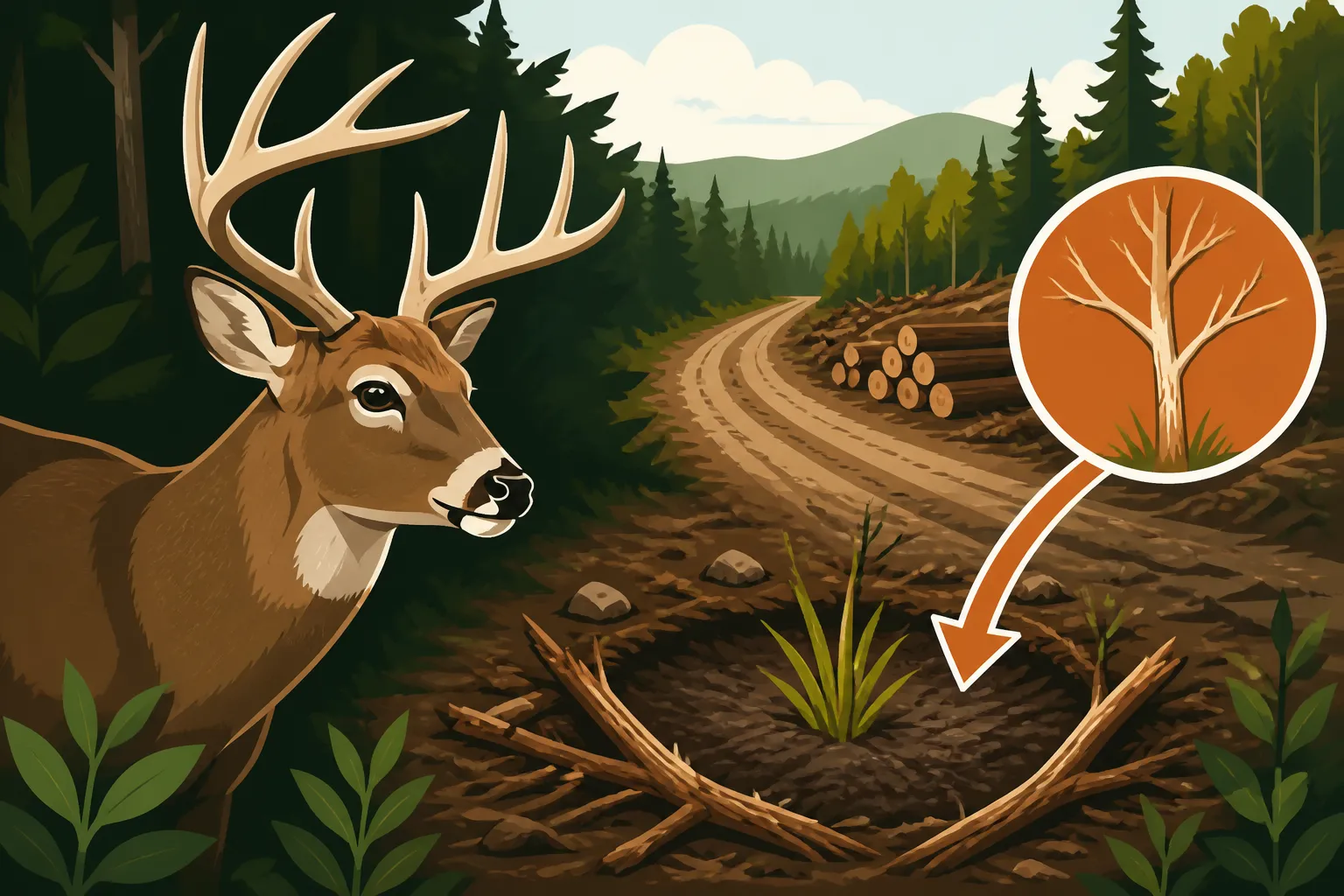
When you're walking an old logging road, you need to become a detective. Look for a series of scrapes, often strung out over several hundred yards, rather than just an isolated one. The first thing you're looking for is freshness. A truly active scrape will have damp, recently pawed-up earth, usually dark from moisture, contrasting with the surrounding leaf litter or roadbed. The edges of the pawing might still be sharp, not weathered by rain or heavy dew. Look for fresh deer tracks directly in the scrape or leading into it – particularly large, splayed tracks from a mature buck. Sometimes you'll even see the indentations of a dewclaw, indicating a heavier deer.
Above each scrape, there should almost always be a "licking branch." This is a low-hanging branch, typically 3-5 feet off the ground, that the buck chews, rubs his preorbital glands on, and often urinates beneath. Look for a frayed or broken end on the branch, sometimes with bark stripped away or a sticky, dark residue. The branch should be at a height consistent with a standing deer reaching it comfortably. The presence of a well-worked licking branch is a huge indicator of an active scrape. Additionally, keep an eye out for fresh rub lines on saplings or small trees nearby. These often parallel the scrape line, with fresh sap or wood shavings visible, indicating a buck is actively marking his territory as he cruises. Understanding how to interpret these signs is crucial when you're Reading Vermont Mud for Fresh Deer Movement or trying to pinpoint where bucks are spending their time.
Terrain Features to Prioritize
While any logging road can have scrapes, certain terrain features make a logging road scrape line exponentially more productive. Prioritize roads that run along the base of a ridge, especially those that parallel thick bedding cover. Bucks love to travel just inside the cover, using the road as an open edge, and will often create scrapes just off this edge or sometimes right on the road itself. These scrapes become even more valuable if they're near a transition in habitat, like where a softwood stand meets hardwoods, or where a dense hemlock thicket gives way to an old apple orchard.
Also, pay close attention to any natural funnels or pinch points the logging road creates. This could be where the road squeezes between a steep hillside and a beaver flowage, or where it crosses a small stream. Bucks are forced into these narrower corridors, increasing the likelihood of interaction and, therefore, scrape creation. Roads that lead directly to or from known feeding areas, such as abandoned agricultural fields, powerline cuts, or clear-cuts with abundant browse, are also high-priority areas. Even a subtle bend in the road, or where a smaller game trail intersects the logging road, can be enough to concentrate deer movement and encourage a buck to leave his mark. Using an app like GoHunt to analyze topography, satellite imagery, and identify these funnels and transitions before you even step foot in the woods can save you countless hours.
Hunting Strategies for Logging Road Scrapes
Finding an active scrape line on a logging road is exciting, but it's only half the battle. The true art lies in knowing how to effectively hunt it without spooking the very buck you're trying to attract. This requires careful planning and an understanding of deer behavior.
Stand Placement for Optimal Opportunity
When you've located a hot scrape line on a logging road, your next move is to strategize your stand placement. This isn't about setting up directly over the scrape; that's often a recipe for disaster. Instead, focus on where the buck comes from or goes to when he visits that scrape. Look for a vantage point 20-30 yards downwind or crosswind from the most active scrapes, giving you a clear shot opportunity to the primary travel path the buck is using along the road or just inside the timber. Think about the prevailing wind direction for the time of year you'll be hunting. A buck will almost always approach a scrape from downwind, circling to scent-check for other deer. Placing your stand so your scent cone drifts away from the scrape and the buck's likely approach path is absolutely critical.
Consider the background your stand offers and how you can break up your silhouette. Are there thick evergreens you can back up against? Is there enough cover to conceal your draw if you're bowhunting? Also, plan your entry and exit routes meticulously. You want to be able to get to and from your stand without alerting deer that might be in the area, especially during low light conditions. Often, this means circling wide around the scrape area or using natural terrain features to shield your approach. For example, if the road runs along a ridge, you might approach from the backside of the ridge, coming over just as daylight breaks. This thoughtful approach extends to your gear as well; quiet boots and silent clothing are a must. If you're Hanging a Stand on a Champlain Valley Field Edge, similar principles apply: focus on approach, wind, and background.
Timing Your Hunt: The Rut and Beyond
Scrape lines on logging roads are most active during the pre-rut and the peak of the rut, typically from late October through mid-November in Vermont. This is when bucks are actively seeking does and challenging rivals, and scrapes serve as vital communication hubs. During the pre-rut, bucks will start "opening up" scrapes, but they might not visit them consistently during daylight hours. As the rut intensifies, however, the frequency of daytime visits increases dramatically. This is prime time to be on a scrape line. During the peak of the rut, bucks might revisit the same scrape several times a day, sometimes even just to quickly check it before moving on.
However, don't overlook scrape lines after the peak rut, especially if they are located near secure bedding areas or late-season food sources like standing corn or forgotten apple trees. Bucks, while less focused on breeding, will still use these scent posts as general communication, and they might still be looking for a late-estrous doe. While the frenzy might die down, the established travel pattern around the scrape can persist. Also, keep in mind that a fresh scrape spotted during the December muzzleloader season, though rare, can indicate a late-season estrous doe. For a broader understanding of deer movement during different phases, consider delving into Hunting the Rut in Early-to-Mid November.
Utilizing Scrapes as Informational Hubs
Beyond being potential kill zones, logging road scrape lines are incredible informational hubs. They offer a direct window into the local buck population and their movements. By regularly checking scrapes (discreetly, from a distance, or via trail cameras), you can learn a tremendous amount. You can identify the presence of specific bucks, gauge their activity levels, and even begin to predict their travel patterns. If you're seeing fresh activity every other day, you know a buck is consistently using that area. If the scrapes suddenly go cold, it might indicate a shift in deer movement due to hunting pressure, a change in food sources, or a buck having moved on to breed elsewhere.
Use trail cameras strategically placed 15-20 yards off the scrape, angled to capture the buck as he approaches or works the scrape, ensuring the camera is downwind of the primary approach. This allows you to collect intel without putting human scent directly on the scrape itself. Pay attention to the time stamps on your photos – are bucks visiting only at night, or are there daylight visits? This intel will inform your hunting schedule. A scrape line that consistently shows daylight activity, even if it's brief, is a gold mine. This information can be invaluable for adjusting your hunting strategy on the fly, especially when combined with mapping data from GoHunt to cross-reference scrape locations with bedding and feeding areas.
| Scrape Activity Level | Appearance | Best Time to Hunt | Action to Take |
|---|---|---|---|
| Hot/Fresh | Dark, damp earth; fresh tracks; broken/chewed licking branch; strong scent | Pre-rut & Peak Rut (mid-Oct to mid-Nov) | Set up immediately, focus on approach/exit |
| Warm/Recent | Pawing visible but slightly weathered; licking branch intact; some scent | Early Pre-rut (late Sep-early Oct) & Post-rut | Monitor with cameras, scout nearby for fresh sign |
| Cold/Old | Dried, crusty earth; leaf litter blown over; no fresh tracks/scent | Early Season (Sep) & Late Season (Dec) | Use for general scouting, but don't prioritize for hunting |
Common Mistakes and How to Avoid Them
Even with the best intentions, hunters often make mistakes when trying to capitalize on scrape lines. These errors can quickly turn a promising situation into a frustrated deer-less hunt. Knowing what to avoid is just as important as knowing what to do.
Overhunting and Educating Deer
One of the biggest pitfalls when hunting scrape lines is simply overdoing it. It's tempting to sit on a hot scrape day after day, convinced that "he has to show up eventually." However, excessive pressure, especially with human scent contamination, can quickly educate even the most rut-crazed buck. Deer are incredibly sensitive to human presence, and once they associate an area with danger, they'll often shift their patterns to avoid it, especially during daylight.
Instead of camping out on a scrape, adopt a less-is-more approach. Hunt a hot scrape line perhaps once every few days, or only during ideal conditions (e.g., favorable wind, peak rut activity, after a cold front). Use trail camera intel to confirm daylight activity before you commit to a sit. If you have multiple hot spots identified, rotate between them. Think about it: if a buck keeps checking his "communication board" and consistently smells or sees hunters, he'll simply create a new one, or, more likely, start checking it exclusively under the cover of darkness. This strategy is similar to what's needed when you're considering Hunting Pressure on Vermont Public Land; knowing when to back off can be key to long-term success.
Ignoring Wind and Thermals
We talk about wind constantly in hunting, but it cannot be stressed enough how critical it is, especially on a logging road scrape line. Logging roads, due to their open nature and often running through varied terrain, can create tricky wind currents and thermals. Your scent will travel along the road, sometimes swirling or eddying in unexpected ways. A steady wind might seem ideal, but watch how it interacts with the topography. Does the road funnel the wind? Does it create a venturi effect that pulls air from unexpected directions?
Always play the wind. Period. If the wind isn't right for your chosen stand location, don't hunt it. Go to a different spot with a more favorable wind, or better yet, stay home. Early mornings, thermals tend to flow downhill, pulling your scent lower into valleys. Evenings, they often rise, carrying scent uphill. A logging road running up a steep incline will exacerbate these effects. Use a reliable wind checker often, and observe the natural movement of leaves or dust to truly understand the airflow in your immediate area. Ignoring this fundamental rule is arguably the fastest way to blow a hunt.
Misinterpreting Scrape Activity
It's easy to get excited by any scrape, but not all scrapes mean the same thing. A common mistake is interpreting a single, isolated scrape, or an old, crusty one, as a sign of imminent buck activity. Bucks make "casual" or "incidental" scrapes throughout the year, sometimes just a quick pawing without a dedicated licking branch. These are typically not high-priority hunting locations.
The key is to look for a scrape line — multiple, fresh, well-worked scrapes, often with distinct licking branches and parallel rub lines, indicating a buck's regular travel pattern. Furthermore, differentiate between daytime and nighttime activity. Trail cameras are your best friend here. If a scrape line is only showing nighttime visits, your hunting strategy needs to adapt. You might need to move your stand closer to a known bedding area if the buck is hitting the scrape only after dark on his way to feed, or conversely, closer to a feeding area if he's hitting it before retreating to bed at dawn. This nuanced interpretation of sign is vital for maximizing your chances when hunting specific areas like Scouting Vermont Public Land Before Season.
Disclaimer
Hunting is an inherently risky activity. Always prioritize safety, adhere to all Vermont hunting regulations, and ensure you have the necessary licenses and permits. The information provided here is for educational purposes and should not replace proper hunter education or professional guidance. Conditions in the field can change rapidly, and personal responsibility is paramount.