Hunting a Champlain Valley Dairy Farm Edge
Hunting the edges of a sprawling dairy farm in Vermont’s Champlain Valley can be incredibly rewarding, but it’s often fraught with unique challenges that can make even seasoned hunters pull their hair out. From navigating constantly changing crops to understanding deer movement influenced by agricultural schedules, and most critically, gaining and maintaining landowner trust, it’s a whole different ballgame than still-hunting the Green Mountains. This guide will walk you through the nuances of scouting, accessing, and effectively hunting these productive farm edges, helping you unlock their potential for a successful season.
Understanding the Champlain Valley Dairy Farm Landscape
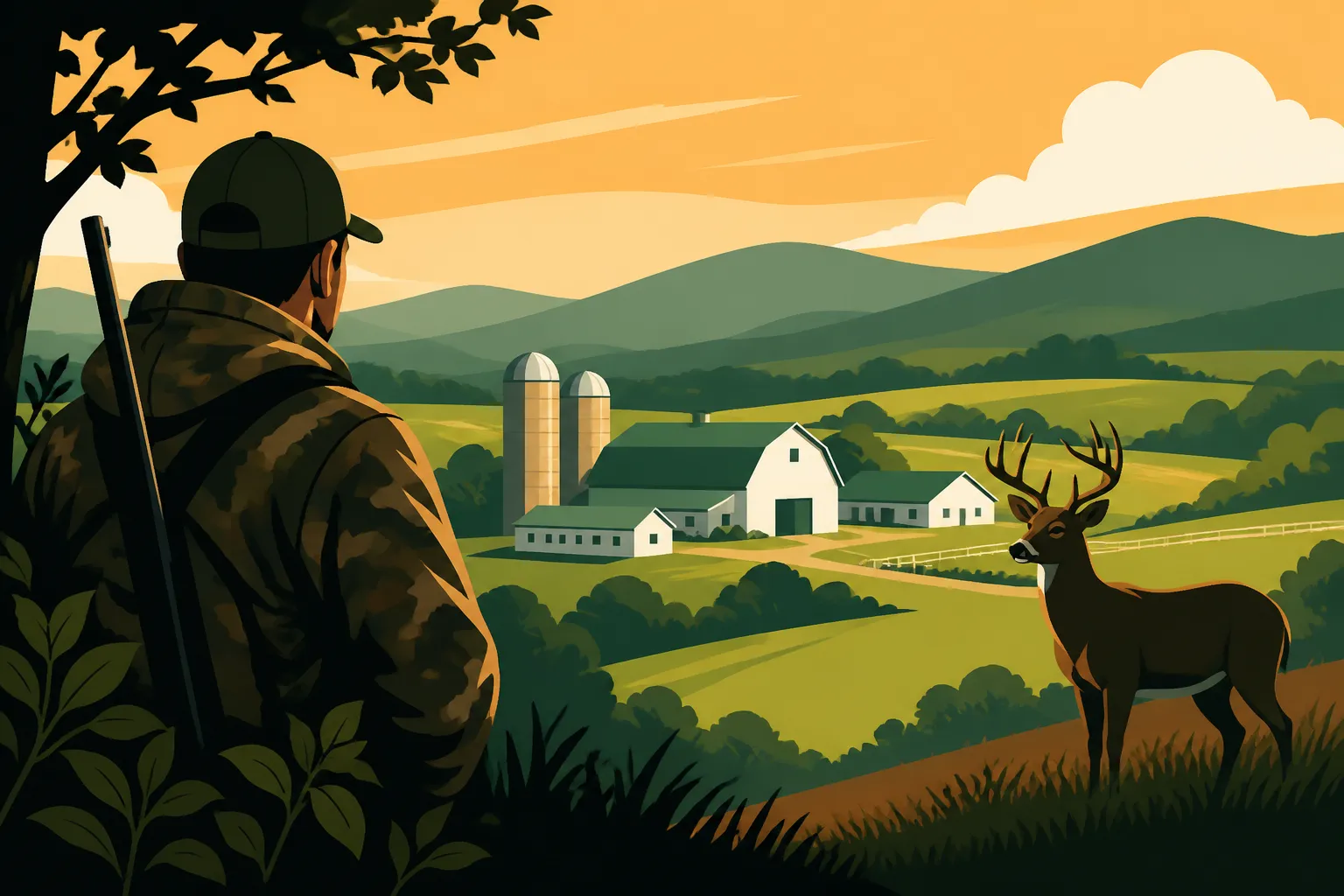
The Champlain Valley, with its fertile soils and relatively gentle topography, is a prime agricultural region, particularly known for its dairy farms. These farms create a mosaic of habitat types that deer absolutely thrive in, but they also introduce complexities not found in vast wilderness areas.
The Allure and Challenge of Farm Edges
Why are farm edges so appealing to deer, and by extension, to hunters? It’s simple: food, cover, and water, often in close proximity. Deer gravitate to these zones for the abundant food sources—lush alfalfa, corn, soybeans, even the tender shoots of winter wheat—that fuel their growth, especially during the crucial pre-rut and rut phases. The edges themselves, where dense woodlots meet open fields, provide essential bedding cover and travel corridors, allowing deer to move between feeding and bedding areas with a sense of security. You’ll often find fresh tracks and rub lines exactly where the woods transition to open ground.
However, this bounty comes with significant challenges. Unlike public land, access to private dairy farms hinges entirely on landowner permission. Moreover, the landscape is dynamic; a standing cornfield one week could be a barren stubble field the next, completely altering deer patterns. The constant activity of farm machinery, livestock, and people means deer here are often more pressured and nocturnal than their backcountry cousins. You might spend hours observing a beautiful field only to realize deer are hitting it exclusively under the cloak of darkness.
Deer Movement Patterns on Farmland
Deer inhabiting farm country often exhibit different movement patterns compared to those in heavily wooded, mountainous terrain. Instead of long-range seasonal migrations, their movements are typically localized, focusing on the immediate availability of food and cover. During daylight hours, deer will often bed in dense thickets, brushy fencerows, or small woodlots adjacent to fields. As evening approaches, they’ll stage along the edges, slowly filtering into fields to feed after sunset. The reverse happens in the mornings, with deer moving from feeding areas back to bedding cover as dawn breaks.
Understanding these daily commutes is paramount. Bucks, especially mature ones, will use predictable travel corridors, such as old logging roads, creek bottoms, or natural funnels between woodlots. These are the classic pinch points you want to identify. For a deeper dive into how deer react to changes in their environment, you might find our article on Reading Vermont Mud for Fresh Deer Movement particularly insightful, as it details how to interpret subtle signs. The specific crop in a field also dictates movement. A standing cornfield provides not just food but also incredible cover, allowing deer to move and feed within it during daylight hours. Conversely, a recently cut hayfield offers little security, pushing deer to the edges or out entirely during the day.
Unique Pressures of Agricultural Zones
Hunting on agricultural land, particularly active dairy farms, means contending with pressures beyond just other hunters. The daily rhythm of farm life, with tractors rumbling, cows being milked, and workers moving about, constantly educates and displaces deer. These animals become acutely aware of human presence and activity, often resulting in them becoming extremely nocturnal. This can be incredibly frustrating when you’re scouting during the day and seeing tons of sign, only to sit for hours in the stand without seeing a single deer during legal shooting light.
Furthermore, access can be a double-edged sword. While private land often means fewer other hunters compared to popular public lands, a landowner might grant permission to several people, leading to unexpected competition. Deer in these areas also learn to use property lines and no-hunting zones as safe havens, often darting across boundaries the moment they feel threatened. This constant pressure necessitates a highly adaptable hunting strategy, focusing on subtle entry and exit routes, minimizing scent, and often adjusting your hunt times to coincide with the brief windows when deer feel secure enough to move.
Scouting and Gaining Access to Dairy Farm Edges
Successful farm edge hunting begins long before opening day. It's a year-round commitment to scouting and, perhaps more importantly, cultivating relationships.
Knocking on Doors: Building Landowner Relationships
This is arguably the most critical step for hunting private land in Vermont. You can't hunt what you can't access, and dairy farms are almost exclusively private. Don't just show up a week before the season; start early, ideally in late winter or early spring after deer season closes. This allows you to introduce yourself, offer help around the farm – maybe stacking wood, fixing fences, or helping with chores – and build a rapport before you ever ask for permission to hunt. Approach landowners with respect, professionalism, and a clear understanding of their needs. Many farmers are wary of hunters who leave gates open, damage property, or disrespect their land and livestock.
When you do ask, be specific about where and when you'd like to hunt. Offer to share your harvest, clean up any trash, and always, always close gates. Consider leaving your contact information and following up with a thank-you note, whether permission is granted or not. A good relationship is built on trust, and one negative experience can ruin it for everyone. For more detailed advice on this crucial step, check out our guide on Knocking on Doors in Champlain Valley Farm Country. Remember, a verbal agreement is a good start, but in Vermont, Do You Need Written Permission in Vermont? is a question worth considering to clarify terms and avoid misunderstandings.
Reading the Land: Sign on the Perimeter
Once you have permission, or even while you’re scouting with the hope of gaining it, you need to become a detective of deer sign. On farm edges, deer sign can be abundant but also spread out. Look for rub lines along the woods-edge transition, particularly where small saplings or brush meet the open field. These indicate a buck’s travel route during the rut. Scrapes, often found along fencerows or under overhanging branches at the edge of the woods, are another prime indicator of buck activity. Look for fresh tracks, not just in the soft mud of a field entrance, but also along logging roads or ATV trails that border the woods.
Droppings can tell you a lot about diet and recent presence. Small, pellet-like droppings indicate browse, while softer, cow-patty-like droppings suggest a diet of lush green forage, common in alfalfa or winter wheat fields. Pay close attention to pinch points—these are natural funnels where deer movement is concentrated. This could be a narrow strip of woods between two large fields, a dip in the terrain, or a bottleneck created by a creek or pond. Our article on Reading Aerial Photos for Green Mountain Deer offers excellent tips that can be applied to flatter farm country as well, helping you identify these key features before you even step foot on the property.
Using Technology for Farm Scouting
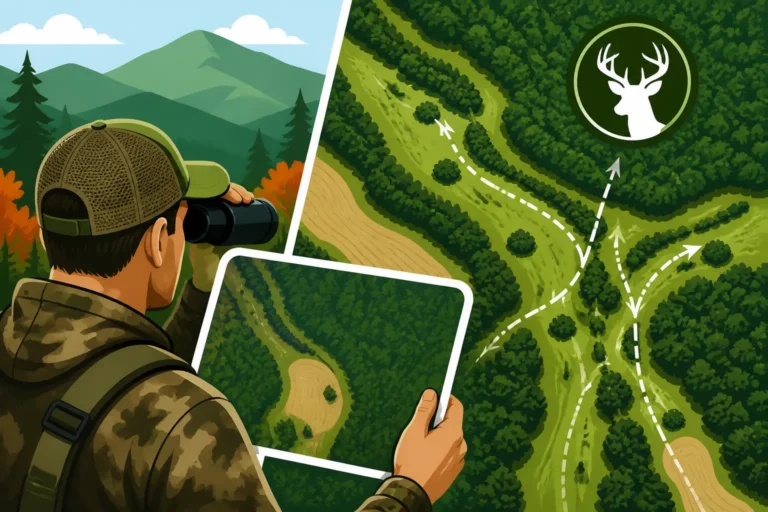
In today's hunting world, technology can be a powerful ally, especially on expansive farm properties. Satellite imagery and topographic maps available through apps like GoHunt or onX Hunt are invaluable for identifying property lines, access points, bedding cover, and potential travel corridors from the comfort of your home. You can mark potential stand locations, observe elevation changes (even subtle ones can influence thermals), and pinpoint specific field edges that look promising.
For instance, using the aerial layers, you can often spot abandoned farm structures, old apple orchards (Hunting a Standing Apple Orchard), or overgrown fencerows that might not be immediately obvious on the ground. These are often forgotten pockets that deer use for cover and food. The ability to drop waypoints for scrapes, rubs, and bedding areas creates a comprehensive map of deer activity. When dealing with private land, having precise boundary information is crucial to avoid trespassing, a feature these apps excel at providing. This digital scouting can save you countless hours of tromping around, allowing you to focus your on-the-ground efforts more efficiently.
Effective Strategies for Hunting Farm Edges
Hunting farm edges requires a nuanced approach, blending careful observation with strategic setup. It's about being present when the deer are, and being as invisible as possible.
Stand Placement and Concealment
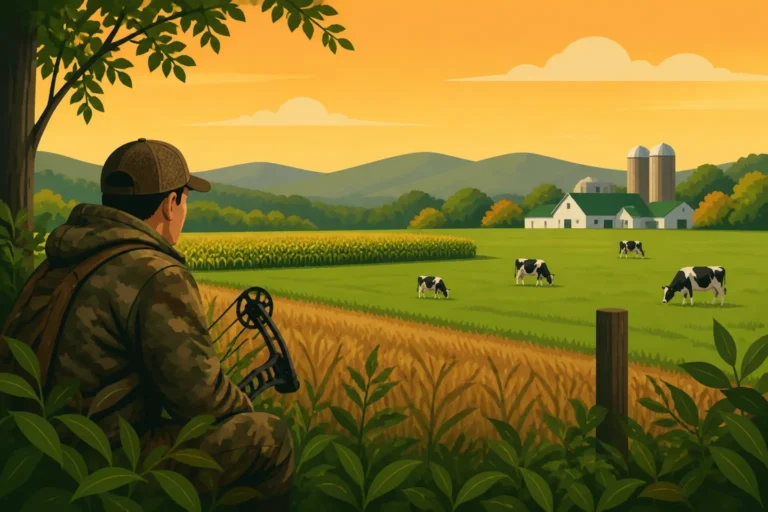
The right stand placement is absolutely critical on farm edges, more so than in dense timber. Because deer often stage at the edge of cover before entering open fields, you want to be positioned to intercept them during these transitional movements. This often means placing your stand just inside the treeline, offering both concealment and a good view of the field and the immediate edge. Look for large, mature trees that offer good cover for your silhouette, or consider using a sturdy ladder stand along a fencerow if available.
Ground blinds can also be highly effective, especially if you can brush them in naturally or utilize existing cover like a thick hedgerow. The key is to break up your outline and blend into the environment. Remember that deer on farm edges are highly conditioned to open sightlines, so any anomaly will be quickly detected. Think about the sun's angle – you don't want to be backlit at dawn or dusk, making you stand out. For more on this, our article on Setting Up on a Dairy Farm Field Edge offers practical advice. When considering a ground blind, learn the ins and outs of Brushing In a Blind on a Field Edge to maximize your concealment.
| Stand Type | Pros | Cons | Ideal Scenario |
|---|---|---|---|
| Hang-on Stand | Portable, adaptable, quiet | Requires tree climbing, less comfortable for long sits | Scouting new areas, mobile hunting, dense cover near edges |
| Ladder Stand | Stable, comfortable, easy access, good height | Less portable, conspicuous, requires suitable tree | Established spots, consistent deer movement, minimal pressure |
| Ground Blind | Excellent concealment, weather protection | Limited visibility, scent can be trapped, conspicuous if not brushed in well | Open field edges, thick fencerows, heavy cover, changing winds |
Playing the Wind and Thermals
Wind direction is always a paramount consideration in deer hunting, but it takes on an even greater significance when hunting farm edges, especially in the relatively flat topography of the Champlain Valley. Deer often approach fields with the wind in their favor, circling downwind of potential danger before committing to open ground. You absolutely must position yourself so that your scent isn't blowing into their likely approach routes or feeding areas. This often means having your back to the field and facing into the woods, or positioning yourself on a crosswind.
Thermals also play a role, particularly during early mornings and late evenings. As the sun rises, warm air begins to rise, carrying scent upwards. Conversely, as the sun sets and the air cools, thermals drop, pushing scent downhill. While the Champlain Valley isn't as dramatic as the Green Mountains, even subtle elevation changes around a field or a creek bottom can create thermal currents that will carry your scent. Be aware of these subtle shifts throughout your hunt, as a change in weather can quickly render your carefully chosen stand useless. Patience and adaptability, especially when the wind is swirling, are key.
Patience and Timing: The Key to Success
Hunting farm edges often demands immense patience. As mentioned, deer here can be heavily pressured and nocturnal. You might sit for multiple hunts without seeing much daylight activity. This is where understanding daily deer patterns and agricultural schedules becomes crucial. During the early season, deer might come out earlier in the evening to feed on lush forage. In late season, when natural food sources dwindle, they might be forced to visit crop fields more frequently, even during daylight. Consider hunting the Late-Season Food Sources for Vermont Whitetails.
The best timing often revolves around those precious low-light hours: the first hour or two of daylight and the last hour or two before dark. If a field has standing corn, deer might be moving within it all day, making entry and exit routes paramount. Furthermore, if you’re hunting during the rut in early-to-mid November, deer behavior can become more erratic, with bucks actively cruising edges looking for does. Pay attention to weather fronts as well; deer often move actively just before a cold front or a storm, providing brief windows of opportunity.
Gear Considerations for Farm Edge Hunting
Having the right gear can make all the difference between a frustrating hunt and a successful one, especially when adapting to the specific demands of farm country.
Optics and Rangefinding
Given the often-open nature of farm fields, quality optics are indispensable. Good binoculars (10×42 or 10×50) will help you scour distant field edges, pick apart fencerows, and identify deer as they emerge from cover, long before they get close to your stand. You'll want to be able to identify antlers and determine if a deer is legal from a distance, minimizing unnecessary movement.
A reliable rangefinder is equally critical. Shots across open fields can be deceiving, and quickly ranging a target as it moves along an edge will ensure ethical and accurate shot placement. Many of the big brands like Leupold, Vortex, or Sig Sauer offer excellent options. Some advanced hunting apps, including GoHunt, even integrate rangefinding capabilities with map overlays, allowing you to estimate distances to known landmarks from your stand. This can be especially useful when you're glassing a clear-cut for a bull moose, or a vast cornfield for a whitetail, making it easier to judge those longer shots.
Clothing and Scent Control
Deer on farm edges are accustomed to human scent from daily farm operations, but hunting scent is different. They associate it with danger. Therefore, meticulous scent control is paramount. This starts long before you get to the stand. Wash your hunting clothes in scent-free detergent, store them in airtight containers, and dress in the field to minimize contamination. Use scent-eliminating sprays on your outer layers, boots, and even your bow or rifle.
Layering is also key, as temperatures can fluctuate dramatically between a cold pre-dawn sit and a warmer midday lull. Choose quiet fabrics that won't rustle as you draw your bow or shoulder your rifle. Camouflage patterns should match the local environment; patterns designed for hardwoods or agricultural settings will help you blend into the treeline or fencerow you're hunting. And remember, during rifle season, blaze orange requirements are strictly enforced, so make sure your outer layers meet the legal visibility standards for How Much Blaze Orange Vermont Requires.
Mobile vs. Permanent Setups
The dynamic nature of farm country often dictates your stand strategy. A permanent ladder stand might be great for a consistently productive funnel, but what happens when the farmer rotates crops or harvests the field early? This is where a mobile approach shines. Using lightweight hang-on stands, saddle hunting gear, or pop-up ground blinds allows you to adapt to changing deer patterns and crop cycles. If deer suddenly shift their preferred entry point by 100 yards because a new cover crop was planted, a mobile setup allows you to follow them.
Many successful farm edge hunters rely on a combination: a couple of strategically placed, permanent stands in high-confidence areas, complemented by a mobile setup for scouting and adapting to real-time information. Having the flexibility to quickly move your setup based on fresh sign or new information can significantly increase your success rate. This also makes Hanging a Stand on a Champlain Valley Field Edge a less permanent decision, allowing for adjustment.
Overcoming Common Challenges
Hunting farm edges, while potentially very rewarding, is rarely straightforward. There are specific hurdles unique to this environment that you need to be prepared for.
Dealing with Heavy Human and Farm Activity
One of the biggest frustrations for farm edge hunters is the constant presence of human and farm activity. Deer here are conditioned to it, but it also means they have a high tolerance for certain levels of disturbance, and an immediate flight response to others. Tractors, cows, and daily routines are background noise, but a hunter walking through their bedding area is an immediate threat. Your strategy must minimize your impact. This means careful entry and exit routes that avoid disturbing deer. Often, this involves walking through open fields to your stand before light, or along farm lanes that are regularly used by equipment, where deer are less likely to be surprised.
Avoid pushing deer around. If you spook deer off a field edge during your morning walk-in, you’ve likely educated them further. Consider using a utility corridor right-of-way or a class 4 town road for discreet access. If a field has been recently harvested, deer might move into adjacent woodlots or deeper cover. Keep an eye on the farmer's schedule – knowing when they'll be in the fields can help you avoid conflicts and plan your hunts accordingly, often focusing on days when activity is lighter.
Recovering Deer in Open Fields
The moment of truth arrives, and you’ve made a great shot on a deer entering a cornfield. Now comes the challenge: recovery. An injured deer can travel surprisingly far, and tracking a blood trail through a vast, cut cornfield or an open alfalfa field can be daunting, especially after dark. Always watch where the deer goes. Pick out a landmark – a lone tree, a distinctive fencerow, a utility pole – where you last saw the deer. Take your time before beginning the track. Give the deer at least 30 minutes, or even a few hours for a gut shot, to bed down and expire.
When you do start tracking, move slowly and deliberately. If the blood trail peters out, expand your search in circles around the last confirmed sign. Having a tracking dog (if legal and trained) can be invaluable. If you’re hunting in a group, spread out and grid-search the area. Be prepared for the possibility of a longer recovery than in dense woods, and make sure you understand the rules around Blood Trailing After Dark in Vermont, which can differ depending on local ordinances and landowner permission.
Adapting to Seasonal Crop Changes
The agricultural cycle dictates a lot about deer movement on farm edges. Early season, deer might be drawn to lush alfalfa or clover plots (Hunting a Clover Plot at First Light). As summer progresses, standing cornfields become magnets, offering both abundant food and crucial cover. Deer will bed, feed, and travel entirely within these fields. Our article on Hunting a Standing Corn Field for Deer provides detailed strategies for this unique scenario.
Once the corn is harvested, deer patterns shift dramatically. They’ll move to other available food sources, such as winter wheat, brassicas, or acorn crops in nearby woods (Hunting After a Poor Acorn Year). The open stubble fields offer less security, pushing deer to the edges or into denser cover during daylight. This means you need to scout constantly throughout the season, paying attention to what crops are being planted and harvested. Your stand locations will likely need to change as well. What was a perfect spot overlooking a standing cornfield in September might be completely unproductive after the combines roll through in October. Flexibility and continuous scouting are your best friends in farm country.
Disclaimer
Please note that hunting regulations, seasons, and licensing requirements can change. Always consult the Vermont Fish & Wildlife Department's official publications and website for the most current and accurate information before planning your hunt. Respect private property, adhere to all laws, and hunt ethically and safely.