Best Muzzleloader Scope for Timber Shots
Trying to make that critical muzzleloader shot in the dense Vermont timber can feel like a high-stakes guessing game. With fleeting glimpses of deer moving through thick softwoods or across a ridge at dawn, you need equipment that helps you acquire your target fast and place your shot accurately, even when the light is low or the branches are thick. This guide is all about helping you cut through the confusion and choose the best muzzleloader scope specifically designed for the close, quick action you often encounter in our beautiful Green Mountain woods.
Why Timber Shots Demand a Specific Muzzleloader Scope
When you head into Vermont's backcountry with your muzzleloader, whether it's for Muzzleloader Deer Hunting in Vermont during the October antlerless window or the late December season, you're not typically lining up 300-yard shots across wide-open fields. Our woods are a different beast entirely. It's about navigating thick cover, spotting deer in dappled light, and often taking shots at much closer ranges. This unique environment really highlights why a specialized scope can make all the difference.
The Unique Challenges of Vermont's Woods
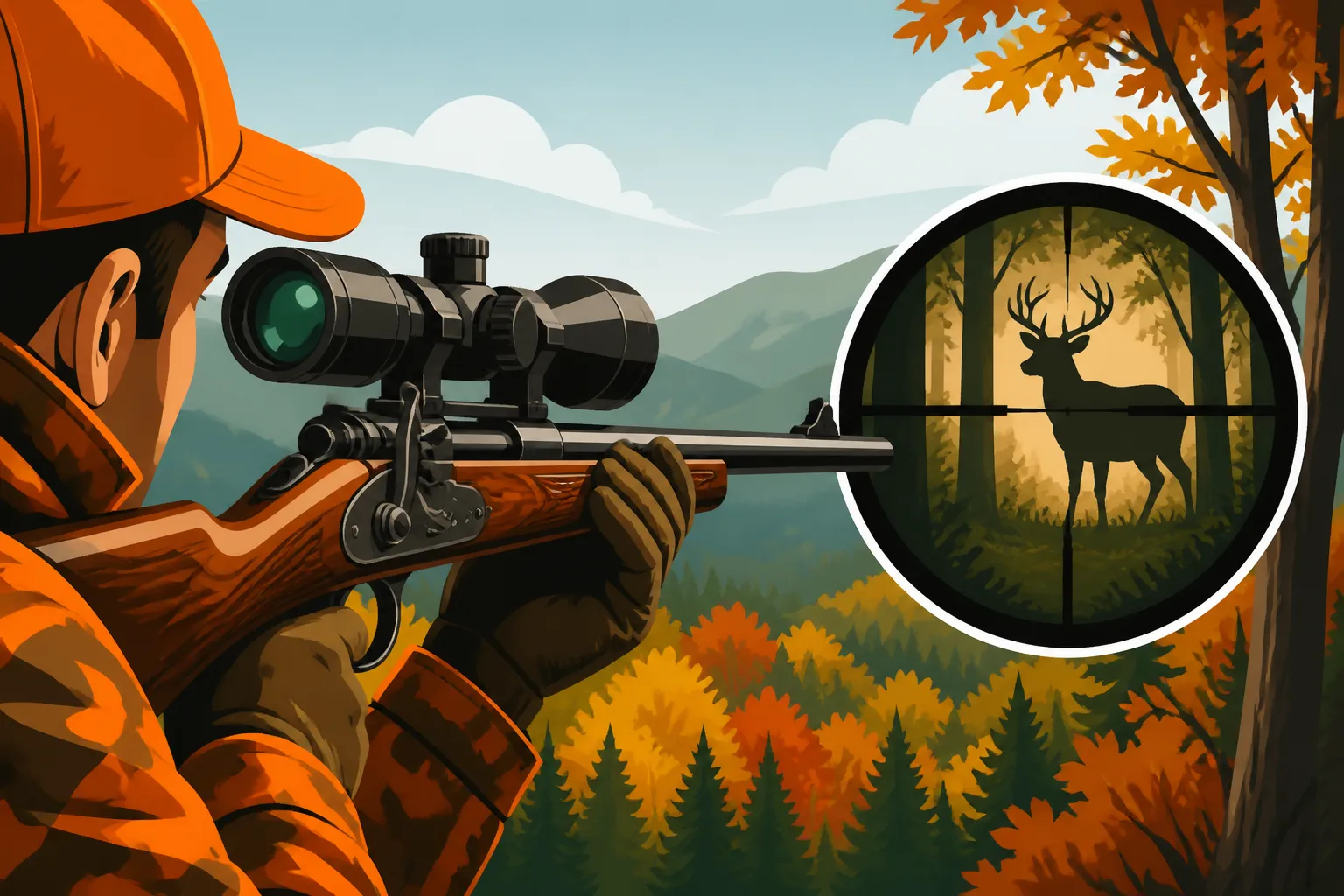
Hunting deer with a muzzleloader in Vermont's timber means embracing a distinct set of challenges. Picture this: you're still-hunting through a thick stand of hemlocks, snow muffling your steps, when a mature buck suddenly materializes out of the shadows at 40 yards. The light is dim, the trees are dense, and you have mere seconds to shoulder your firearm, acquire the target, and make the shot. This isn't the time for a scope that's designed for vast prairie landscapes or extreme long-range precision. You need something that excels at fast target acquisition, offers a wide field of view to track movement, and gathers enough light to give you a clear sight picture in those crucial low-light moments that are so common at dawn and dusk.
Beyond the immediate shot scenario, Vermont's weather can be unpredictable. Rain, snow, and fog are common companions during the Hunting Vermont's December Muzzleloader Season. Your equipment needs to stand up to these elements, ensuring your scope doesn't fog up internally or get obscured by moisture at the worst possible moment. The dense timber also means you're often navigating uneven terrain, climbing over blowdowns, or pushing through thick brush, all of which can be tough on gear. A robust, reliable scope is paramount, one that can take a bump without losing its zero.
Moving Beyond Open Sights or High-Power Scopes
For many traditionalists, open sights are the quintessential choice for a muzzleloader. And there's certainly a romantic appeal to them, a directness that connects you to the history of the hunt. However, in modern hunting scenarios, especially when light fades or precision is critical, open sights have their limitations. They can be hard to see against a dark animal in deep shadow, and they don't offer any magnification, which can make target identification tougher at even moderate ranges, particularly if you're like me and your eyes aren't quite what they used to be!
On the flip side, some hunters might be tempted to put a high-magnification rifle scope, perhaps a 3-9×40 or even a 4-12×40, on their muzzleloader. While these scopes are fantastic for longer-range rifle shooting, they often hinder more than they help in the timber. A high magnification significantly narrows your field of view, making it incredibly difficult to find a moving deer quickly in dense woods. Imagine trying to track a deer through a small straw when you need to see the whole haystack. Furthermore, high magnification amplifies every little wobble, making it harder to hold steady for a quick shot. For the specific demands of close-to-moderate range timber hunting, we need to think differently than we would for open country.
Key Features to Look For in a Timber Muzzleloader Scope
Choosing the right muzzleloader scope for the Vermont timber means focusing on features that enhance speed, clarity, and adaptability in challenging conditions. It's not about the biggest or most powerful, but about what performs best when you've got a narrow window of opportunity and limited visibility.
Magnification: Less is Often More
When you're hunting in the thick stuff, often the biggest mistake you can make with a scope is choosing one with too much magnification. For timber hunting, where shots are typically inside 100 yards and often much closer, a low variable power scope is your absolute best friend. Think scopes with a magnification range like 1-4x, 1.5-5x, or even 2-7x. These ranges offer a wide field of view on the lowest setting, which is crucial for quickly picking up a deer that suddenly appears in front of you. That wide field of view allows you to see more of the surrounding environment, helping you track movement and gauge distances to obstacles like tree limbs.
The ability to dial up to a slightly higher magnification, say 4x or 5x, is still useful for those slightly longer shots, or to get a better look at antlers for positive identification before taking a shot. But the beauty is that you can quickly drop back to the lowest power for those tight, fast encounters. A fixed power scope, while simple, might be too much at 4x if a deer is practically under your stand, or too little at 2.5x if you need to pick out a specific branch in the way. Variable power gives you that necessary flexibility in a dynamic environment. I've found that setting my scope to 1.5x or 2x as I walk is perfect for quick reaction shots, and I can always bump it up if the situation allows for it.
Light Transmission and Objective Lens Size
Vermont mornings and evenings are magical, but they are also when deer are most active, and the light is notoriously low. This is where good light transmission in a scope becomes paramount. It's not just about the size of the objective lens (the front lens), but also the quality of the glass and the coatings applied to it. High-quality, fully multi-coated lenses can make a significant difference in how much light reaches your eye, giving you precious extra minutes of usable shooting light at the edges of the day.
For timber hunting, you generally don't need a massive objective lens like a 50mm or 56mm. While those gather a lot of light, they also add bulk, weight, and often require higher rings, which can affect your cheek weld and overall comfort. A 32mm, 36mm, or 40mm objective lens is usually a sweet spot. It offers excellent light-gathering capabilities for close-to-medium ranges without making your muzzleloader feel top-heavy or awkward to carry through dense cover. This balance is key to keeping your setup nimble, especially when you might be carrying it for miles while Still-Hunting Green Mountain National Forest Timber.
Reticle Choices for Fast Timber Action
The reticle (the crosshairs or aiming point inside your scope) is your direct link to the target, and for timber hunting, simplicity and visibility are key. A standard duplex reticle is a classic for a reason – it offers a clear, uncluttered view. However, a heavy duplex reticle can be even better in low light or against a dark background, as its thicker outer posts draw your eye quickly to the center aiming point. This slight upgrade can make a huge difference when you're trying to find your aiming point on a dark hide in deep shadows.
Another excellent option for timber hunting is an illuminated reticle, particularly one with a fine dot or crosshair. These allow you to adjust the brightness of your aiming point, making it stand out clearly in any light condition, from bright midday sun to the deepest twilight. You're not relying on light passing through the scope to illuminate the reticle; it generates its own light. This can dramatically improve target acquisition speed and confidence, especially if you're dealing with a deer moving through a mixed bag of light and shadow. Just remember to always check your batteries before heading out! Many hunters, myself included, have found value in platforms like GoHunt for researching different reticle types and their practical applications in varying hunting conditions.
Durability and Reliability in the Vermont Woods
A scope is only as good as its ability to perform when you need it most. In the rugged, often wet, and cold environment of Vermont's hunting seasons, durability and reliability are not just nice-to-haves; they are absolute necessities. Your muzzleloader scope needs to be able to shrug off bumps, dings, and the elements without faltering.
Waterproofing, Fogproofing, and Shockproofing
Let's be realistic: hunting in Vermont means dealing with Mother Nature at her finest, or sometimes, her most challenging. Rain, snow, and dense fog are common companions. A quality muzzleloader scope must be waterproof to prevent moisture from seeping in and ruining the internal components or creating condensation. Look for scopes that are O-ring sealed and nitrogen or argon purged. This purging process also makes the scope fogproof, meaning the internal lenses won't fog up when you move from a cold outdoor environment into a warmer one, or when the external temperature fluctuates rapidly. There's nothing worse than raising your muzzleloader for a shot only to look through a milky, obscured lens.
Beyond the weather, hunting in timber inevitably means bumping your rifle against trees, dropping it in the snow, or taking a minor tumble. That's why shockproofing is non-negotiable. A good scope will have a robust, one-piece tube construction, often aircraft-grade aluminum, designed to withstand the recoil of your muzzleloader and the inevitable knocks and jolts of a hunt. This ensures that your scope holds its zero, shot after shot, season after season. Don't skimp here; a scope that can't handle the abuse of the field is a liability.
Mounting and Eye Relief Considerations
Even the best scope won't perform if it's not mounted correctly, especially on a muzzleloader known for its substantial recoil. Solid, high-quality rings and bases are paramount. You want them to be secure, stable, and capable of holding your scope firmly in place, even after repeated shots. Many hunters prefer steel rings for their strength and durability. Make sure your rings are the correct height for your chosen objective lens, allowing the scope to clear the barrel and receiver without being unnecessarily high, which can compromise your cheek weld.
Eye relief is another critical factor, particularly with muzzleloaders. This is the distance your eye needs to be from the eyepiece to see a full, clear picture. With recoil, you want ample eye relief (typically 3.5 to 4 inches or more) to prevent the scope from hitting you in the brow during a shot. While not usually as violent as some magnum centerfire rifles, muzzleloader recoil is significant, and you want to be comfortable and safe. Check the manufacturer's specifications for eye relief and ensure it feels natural and safe when you shoulder your muzzleloader. A generous eye box, which is the area behind the eyepiece where you can still see a full image, also helps with quick target acquisition, as you don't have to be perfectly aligned every time. This is a huge benefit when a deer jumps suddenly and you need to get on target fast.
| Feature Category | Timber Hunting (Ideal) | Open Country (Alternative) |
|---|---|---|
| Magnification Range | 1-4x, 1.5-5x, 2-7x (Low variable) | 3-9x, 4-12x, Higher variable (Medium to High) |
| Objective Lens Size | 32mm – 40mm (Balanced light & compactness) | 40mm – 56mm (Maximized light gathering) |
| Reticle Type | Heavy Duplex, Illuminated Dot, Simple Crosshair | Fine Duplex, BDC (Ballistic Drop Compensating), Mil-dot |
| Field of View | Very Wide (at low power) | Moderate to Narrow |
| Eye Relief | Generous (3.5"+) | Moderate (3"-4") |
| Weight & Bulk | Lighter, More Compact | Can be heavier, larger |
| Durability Needs | High (waterproof, fogproof, shockproof) | High (but perhaps less emphasis on physical knocks) |
| Typical Shot Range | 20 – 125 yards | 100 – 300+ yards |
Balancing Cost and Performance for Your Muzzleloader Setup
Let's face it, hunting gear can be an investment, and muzzleloader scopes are no exception. It's easy to get caught up in the allure of the most expensive optics, but the truth is, you can find excellent performance at various price points. The key is to understand where to prioritize your budget for the conditions you'll be hunting in here in Vermont.
Investing in Quality Glass vs. Budget Options
When it comes to scopes, the old adage "buy once, cry once" often rings true, especially concerning the glass itself. Higher quality glass and superior lens coatings translate directly into better light transmission, sharper image clarity, and truer colors. In the low-light, often cluttered environment of Vermont's timber, this can be the difference between confidently identifying a legal deer and passing on a shot because of an unclear sight picture. Investing a bit more in a scope from a reputable brand known for its optical clarity will generally pay dividends in terms of performance and user satisfaction, particularly during those critical dawn and dusk hours.
However, that doesn't mean you need to break the bank. There are many fantastic mid-range options that offer superb performance without the premium price tag of top-tier brands. These scopes often strike an excellent balance between durable construction, acceptable light transmission, and clear reticles that are more than sufficient for timber hunting ranges. Platforms like GoHunt often feature reviews and comparisons that can help you understand the real-world performance differences between various models, helping you make an informed decision within your budget. It's about finding the sweet spot where performance meets your financial comfort zone.
Field Testing Your Setup Before the Season
Once you've chosen your muzzleloader scope and mounted it securely, your work isn't done. In fact, a crucial part of ensuring success in the timber is rigorous field testing before the season opens. Don't just sight it in at the range and call it good. Take your muzzleloader, with its new scope, out to the woods or a suitable practice area that mimics your hunting conditions. Practice shouldering the firearm quickly and acquiring targets in varied lighting, similar to what you'd experience at first light or last light. Simulate shots at different ranges, from 20 yards out to your comfortable maximum, whether that's 75, 100, or 125 yards.
Pay attention to your cheek weld, eye relief, and how quickly you can get a clear sight picture. Does the scope feel balanced on your muzzleloader? Does the reticle stand out clearly against different backgrounds like dark timber or fallen leaves? This is also the time to experiment with your chosen sabots and powder charges, understanding your muzzleloader's unique trajectory with that specific load. Knowing precisely where your bullet will impact at various ranges is invaluable. Take notes, make adjustments, and gain complete confidence in your setup. Remember, familiarity breeds confidence, and that confidence is what will empower you to make an ethical, accurate shot when that long-awaited buck finally steps out from behind the cedars. This preparation is just as important as Keeping a Muzzleloader Dry in Late-Fall Rain or understanding Best Sabot Weight for an Antlerless-Only Hunt.
Disclaimer
This article is for general informational purposes only and does not constitute professional advice. Laws, prices and regulations vary by location and change over time. Consult a qualified professional for guidance on your specific situation.