Best Game Cart for Hauling Out a Moose
Bringing down a magnificent Vermont moose is the hunt of a lifetime for many, a truly humbling experience in our wild landscape. But let's be honest, the moment that majestic creature hits the ground, the real work, the back-breaking challenge, begins. Hauling a moose out of the Green Mountain wilderness isn't just a chore; it's a test of grit, planning, and the right gear. This guide is here to walk you through choosing and using the best game cart to tackle the monumental task of recovering your Vermont moose, transforming a potential nightmare into a manageable, albeit still strenuous, part of your hunting adventure.
The Unique Challenge of a Vermont Moose Harvest
You've put in the time, studied the land, perhaps even been lucky enough to draw one of Vermont's coveted moose permits. The shot was perfect, and now you're standing over an animal that can weigh well over a thousand pounds. This isn't your average whitetail deer recovery. This is a whole different beast, literally, and it demands a specialized approach, especially when it comes to getting that valuable meat back to the truck.
Why a Moose is Not a Deer
If you're accustomed to deer hunting, you might think a game cart is just a game cart. But let me tell you, trying to haul a full-grown Vermont moose out of the woods with a cart designed for a 150-pound whitetail is like bringing a butter knife to a chainsaw fight. Moose are enormous. An adult bull can easily tip the scales at 800-1200 pounds, and cows aren't far behind. Their sheer bulk, coupled with their long legs and awkward mass, makes moving them incredibly difficult. A standard deer cart, with its smaller wheels and lighter frame, simply isn't built for that kind of load. You'll bend axles, pop tires, and likely just get stuck a few yards in, adding frustration to an already intense situation. The goal is to get that meat home efficiently and safely, not to leave it for scavengers because your gear failed. Packing Out a Vermont Moose is an endeavor that requires serious forethought.
Vermont's Terrain: Not for the Faint of Heart
Vermont isn't flat, especially in the areas where moose thrive, like the Northeast Kingdom. We've got steep grades, rocky outcrops, beaver flows, thick bogs, and dense timber. Even what looks like a gentle slope on a map can turn into a grueling ascent or a dangerous descent when you're trying to move hundreds of pounds of meat. Many logging roads become impassable with mud after a rain, and game trails can be littered with roots and rocks. Your game cart needs to be able to navigate these challenges. Tiny wheels will get bogged down in mud or caught on every stick. Flimsy construction will twist and break under the strain of a heavy load on uneven ground. You're not just hauling weight; you're battling gravity, friction, and the very landscape itself. Understanding the topography, whether you're hunting in the Green Mountain National Forest's Two Districts or on smaller state parcels, is paramount.
What Makes a Game Cart "Moose-Worthy"?
So, if a regular deer cart won't cut it, what exactly should you be looking for in a game cart capable of handling a Vermont moose? It comes down to a few key design and construction principles that ensure durability, maneuverability, and ultimately, success in a demanding situation.
Capacity and Weight Rating: More Than Just Numbers
When we talk about "moose-worthy," the first thing that comes to mind is capacity. You need a cart that is explicitly rated for several hundred pounds, ideally 500 pounds or more, if you plan to move anything more than a single quarter at a time. However, don't just look at the maximum weight rating. Consider the usable capacity. Does the cart have a long enough bed to accommodate large quarters or even a half of a moose without parts dragging? Can it effectively distribute that weight to prevent strain on the frame and wheels?
Think about how you'll be loading it. If you're Field Dressing a Moose in the Northeast Kingdom and quartering it, you'll have four very large, heavy pieces of meat, plus the head and cape if you're taking them. A flimsy cart might claim a 300-pound rating, but that rating often assumes a perfectly balanced load on flat ground. In the real world of Vermont hunting, you'll be loading unevenly on a hillside, and the stresses will be far greater. Look for carts that boast heavy-duty axles and robust bed construction, not just a high number on the tag. Some hunters might even consider using a mapping tool like GoHunt to mark potential clear, flat spots for quartering the animal, optimizing the loading process for their heavy-duty cart.
Wheel Design and Tire Type for Vermont Conditions
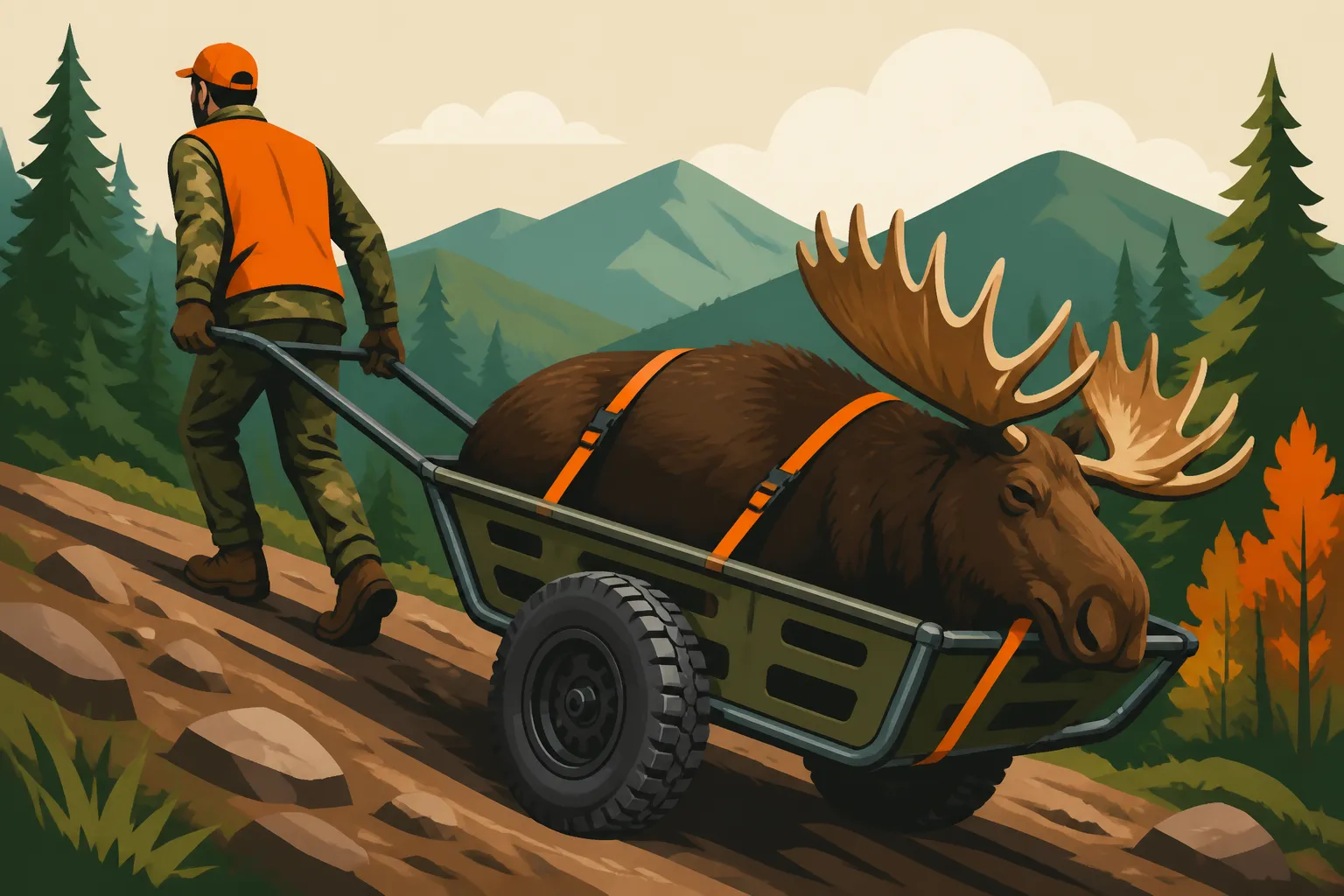
The wheels are the unsung heroes of any game cart, and for a moose cart, they are absolutely critical. You want large diameter wheels, typically 20 inches or more, that can roll over obstacles rather than getting stuck against them. Pneumatic (air-filled) tires are almost a must for absorbing shock and providing flotation over soft ground, mud, and roots. Solid rubber tires might be puncture-proof, but they offer zero give and make for a brutally rough ride on uneven terrain, transmitting every bump directly to you and the load.
Consider the tread pattern too. Aggressive, knobby treads will provide better traction on muddy trails and snowy ground than smooth, turf-style tires. Wider tires will also help distribute the weight, preventing the cart from sinking into soft earth. Some premium carts even feature bicycle-style wheels with spokes, designed for extreme durability and reduced weight, making them surprisingly effective even for large loads. If you're pulling a moose out of a deep bog, those wheel characteristics will make or break your effort.
Frame Durability and Construction Materials
The frame is the backbone of your game cart, and it needs to be incredibly strong to withstand the immense forces involved in hauling a moose. Look for frames made from heavy-gauge steel or aircraft-grade aluminum. Steel is heavier but often more rigid and less prone to bending, while aluminum offers a lighter solution but needs to be thicker and well-braced to achieve similar strength.
Pay attention to the welds and connection points. Are they robust? Are there gussets or reinforcements in high-stress areas? A cheap cart might have thin-walled tubing that buckles under pressure, or weak welds that snap. For a moose-worthy cart, the frame should feel solid, with minimal flex even when empty. Consider the finish as well; a powder-coated or galvanized finish will protect against rust and corrosion, extending the life of your investment through countless Vermont seasons. Think about how much abuse this cart will take, especially if you're pulling it through a steep ravine or over a rocky path.
Types of Game Carts Suitable for Moose Recovery
While the market is flooded with various game carts, only a select few are truly designed with the demands of moose recovery in mind. Knowing the differences can help you choose the right tool for your specific hunting scenario and the kind of terrain you anticipate.
Traditional Single-Axle Carts
These are the most common type of game cart, featuring a single axle with two wheels and a flatbed or basket for the load. For moose, you need the heavy-duty versions. These typically have larger diameter wheels, a robust steel frame, and a longer, wider bed. They are often designed to be pulled by one or two people using handles at the front, or sometimes even hitched to an ATV for designated trails.
Pros:
- Maneuverability: Generally easier to navigate tight turns and winding trails than a four-wheeled wagon.
- Simplicity: Fewer moving parts means less to break.
- Balance: When properly loaded, the center of gravity can be managed effectively.
Cons:
- Weight on the User: While the wheels bear most of the load, the user still carries some of the weight, especially on inclines or uneven ground, which can be exhausting with a moose quarter.
- Stability: Can be prone to tipping on steep sidehills if not loaded and balanced carefully.
- Capacity Limits: Even heavy-duty models might require multiple trips for a whole moose, or careful quartering to fit the largest pieces.
A high-quality single-axle cart can be excellent for getting moose quarters out of moderately challenging terrain, especially if you have a hunting partner or two to help with the pulling. Many hunters, when planning their season, use resources like GoHunt to scout digital maps for potential cart-friendly routes and egress points, which is a smart move when considering these carts.
Two-Wheeled Barrows and Heavy-Duty Wagons
Some specialized carts resemble heavy-duty garden barrows or wagons, sometimes with larger wheels and reinforced frames. These often have a lower center of gravity and can sometimes be pulled or pushed. Wagons, with four wheels, offer more stability but can be harder to maneuver in tight spots.
Pros:
- Stability: Four-wheeled wagons offer superior stability on relatively flat, even ground, reducing the risk of tipping.
- Capacity: Often designed with larger beds, allowing for more meat per trip.
- Less Weight on User (Wagons): The cart bears all the weight, meaning the user is primarily providing propulsion.
Cons:
- Maneuverability: Four-wheeled wagons can be cumbersome on narrow, winding trails or through dense brush. Turning radius is often wide.
- Weight: Can be quite heavy themselves, making them harder to get to the kill site initially.
- Terrain Limitations: While stable, they can struggle on very rocky or steep terrain where a single-axle cart might "flex" more.
These types of carts can be a great option if you anticipate relatively clear, wide trails or old logging roads for your Getting a Moose Out on a Logging Road strategy. They shine when you need to move maximum weight with minimal effort over somewhat predictable ground.
Considerations for Powered Carts
In recent years, powered game carts, often battery-operated, have emerged on the market. These are essentially motorized wheelbarrows or carts that take much of the physical strain out of hauling.
Pros:
- Effortless Hauling: They do the work for you, significantly reducing physical exertion.
- Steep Incline Performance: Many are designed to tackle steep hills with heavy loads that would be impossible manually.
- High Capacity: Often built to carry substantial weight.
Cons:
- Cost: Significantly more expensive than manual carts.
- Weight and Bulk: The units themselves are heavy and bulky, making them difficult to transport to remote areas.
- Battery Life: Limited by battery charge; you don't want to run out of juice halfway back to the truck.
- Noise: The motor can be noisy, which isn't ideal for stealth, though not an issue post-harvest.
- Regulations: Check specific Vermont regulations regarding motorized vehicles on public lands. Many areas, especially within the Green Mountain National Forest, restrict motorized access to designated trails only.
A powered cart is a serious investment and requires careful consideration of access points and regulations. They are ideal for hunters who have secured access to land with suitable roads or trails that allow motorized transport, especially if physical limitations are a concern.
Pre-Hunt Considerations and Field Strategies
The best game cart in the world won't do you much good if you haven't thought about how you'll use it before the shot. Successful moose recovery starts long before you even leave your truck.
Scouting Access Routes with a Cart in Mind
This is perhaps the most critical step. When you're Scouting Vermont Public Land Before Season, or even if you're lucky enough to have private land access, you need to identify potential egress routes for a moose. Look for old logging roads, ATV trails (if legal to use), or even relatively flat, open timber where a heavy-duty cart could be pulled.
Think about the elevation changes. Are there any natural funnels or saddles that could offer a less strenuous path? Pay attention to water crossings – can your cart handle a stream, or will you need to find a bypass? Use satellite imagery and topographic maps in conjunction with your boots on the ground. Tools like GoHunt or other mapping apps can be invaluable for identifying these routes, marking potential kill zones, and planning your extraction strategy well in advance. Consider where the animal is most likely to be when you shoot it, and what the closest, most manageable path back to a vehicle might be. Sometimes, a slightly longer route that's flatter and clearer is far better than a shorter, steeper, and rockier one.
Quartering a Moose for Easier Transport
Even with the best game cart, moving a whole moose is usually impractical and almost always illegal in Vermont due to CWD prevention rules regarding carcass movement. The best strategy, therefore, is to quarter the animal in the field. This not only makes the meat easier to handle and cool quickly but also significantly reduces the load for each trip with your game cart.
Practice your field dressing and quartering skills before the hunt. You'll want to remove the legs, separate the meat from the bone where possible, and break the animal down into manageable, heavy pieces. The two front quarters, two hindquarters, backstraps, tenderloins, neck meat, and rib meat will all need to be packed out. If you're keeping the head and cape for a mount, that's another substantial load. Packing Meat Out of a Steep Ravine or dense timber is tough enough; trying to drag a whole carcass is a recipe for exhaustion and spoiled meat.
The Team Effort: When to Call for Help
Don't be a hero. Hauling a moose, even quartered, out of the Vermont backcountry is a monumental task. If you're fortunate enough to draw a Vermont Moose Permit Lottery tag, make sure you have a plan for assistance. Hunting with a partner or a small group isn't just about enjoying the experience together; it's about sharing the load when it comes to recovery.
Two or three people can make an incredible difference in pulling a heavily loaded game cart. One person can pull the front, while another pushes from the back, especially on inclines. Having an extra set of hands for lifting quarters onto the cart, navigating obstacles, or even just clearing brush from the path can save hours of grueling work and prevent injury. Communicate your plan clearly beforehand, and ensure everyone knows their role in the recovery process. This teamwork is crucial for a successful and safe retrieve, getting your hard-earned venison back to civilization.
Maintenance and Longevity of Your Moose Cart
A high-quality game cart for moose is an investment. Just like your rifle or bow, it needs proper care and maintenance to ensure it performs flawlessly when you need it most, season after season. Neglecting it after one successful haul can lead to equipment failure when you least expect it.
Post-Hunt Cleaning and Storage
After a moose recovery, your game cart will likely be caked with mud, blood, and whatever else the Vermont woods threw at it. Don't just toss it in the back of the shed.
- Rinse it thoroughly: Use a hose with a strong nozzle or even a pressure washer (carefully, avoiding direct spray on bearings if exposed) to remove all mud, dirt, and biological material. This is crucial for hygiene and preventing the spread of diseases.
- Scrub away residue: Use a stiff brush and some mild soap to clean off any stubborn blood or grime. Ensure all crevices are clean.
- Dry completely: Allow the cart to air dry fully before storing. If possible, wipe down metal components with a towel to prevent water spots and inhibit rust.
- Lubricate: Apply a light coat of lubricant to any moving parts like axle bearings (if applicable) or pivot points.
Proper cleaning not only maintains the cart's appearance but also prevents premature wear and tear. Store it in a dry place, out of direct sunlight and harsh weather, ideally hanging it or standing it upright to save space.
Routine Inspections and Repairs
Before and after each hunting season, give your moose cart a thorough inspection.
- Check the tires: Look for any punctures, cracks in the sidewalls, or signs of dry rot. Ensure the tire pressure is correct. Keep a spare tube and a small pump handy, especially if you plan on going deep into the backcountry.
- Inspect the frame: Look for any bent tubing, cracked welds, or loose fasteners. Tighten any bolts or nuts that may have worked their way loose. Small cracks can grow into major failures under a heavy load.
- Examine the axle and wheels: Check for any wobbles in the wheels, indicating worn bearings or a bent axle. Smooth operation is key.
- Handles and grips: Ensure handles are secure and comfortable. Replace any worn or damaged grips for better control and comfort.
Addressing small issues promptly can prevent them from becoming dangerous problems during a critical recovery. Having a well-maintained, reliable game cart is just as important as having a sharp knife or a reliable firearm when you're hunting big game in Vermont. It's an indispensable piece of gear that will pay dividends in effort and efficiency, helping you transform a successful hunt into a successful harvest.
| Feature / Cart Type | Heavy-Duty Single-Axle | Heavy-Duty Four-Wheeled Wagon | Powered Cart (e.g., Electric Wheelbarrow) |
|---|---|---|---|
| Max Load (approx.) | 300-600 lbs | 500-1000 lbs | 500-1000 lbs+ |
| Wheel Size (in) | 20+" pneumatic | 16-26+" pneumatic | 16-24+" pneumatic, heavy tread |
| Frame Material | Steel/Aluminum (heavy gauge) | Steel (heavy gauge) | Steel (very heavy gauge) |
| Best Terrain | Moderate hills, rough trails | Flat to gentle slopes, wide trails | Steep hills, rough trails, variable |
| Maneuverability | Good, especially in tight spots | Fair, wide turning radius | Excellent (motorized assist) |
| User Effort | High (pull/push) | Moderate (pull/push) | Low (motorized) |
| Portability | Often foldable/disassembles | Bulky, less portable | Very heavy, not easily portable |
| Cost | Moderate to High | High | Very High |
Disclaimer
This article is for general informational purposes only and does not constitute professional advice. Laws, prices and regulations vary by location and change over time. Consult a qualified professional for guidance on your specific situation.