Best Bow Sight for Vermont Archery Season
Navigating Vermont's diverse archery landscape, from the dense Green Mountain hardwoods to open Champlain Valley agricultural fields, presents a unique set of challenges for bowhunters when it comes to gear. A bow sight isn't just an accessory; it's your primary aiming tool, and choosing the right one can dramatically impact your accuracy and success, especially when a fleeting shot opportunity arises in low light or tricky terrain. This guide will walk you through the essential considerations for selecting the best bow sight tailored to the specific demands of Vermont's archery season, helping you make an informed decision that will serve you well in the field.
Understanding Vermont's Archery Environment
Vermont’s natural beauty is undeniable, but it's also a rugged and demanding place to hunt with a bow. The terrain and weather can change in an instant, and deer often move through areas with vastly different cover types within a single morning. Your bow sight needs to be able to handle these fluctuations gracefully, providing clear, reliable aiming points regardless of what Mother Nature or the local deer herd throws at you.
Terrain and Cover Considerations
When you think about bowhunting in Vermont, images of vast, undulating hardwood ridges and dark, thick softwood swamps probably come to mind. And they should! These are common landscapes you'll encounter. In the deep woods, shot distances are often intimate, but the light can be incredibly dim, especially under a canopy of dense pine or hemlock. You might be tucked into a small saddle, waiting for a buck to cruise by, and suddenly he appears at 20 yards, but the available light is barely enough to distinguish him from the shadows. Your sight needs to gather what little light there is and present a clear, bright pin.
Then, there are the edges—the transitions where a hardwood forest meets a clear-cut, or a cedar swamp gives way to an old apple orchard. Here, shot opportunities can be longer, perhaps 30 or 40 yards, but the background can be cluttered, and the deer might be moving quickly. A sight that allows for quick acquisition without excessive clutter is key. And let's not forget the more open country, like the Champlain Valley, where agricultural fields and small woodlots dominate. Here, you might be Hunting a Champlain Valley Dairy Farm Edge, and a deer could step out at 50 yards, requiring a different approach to your aiming system. The constant variable in Vermont is the terrain, which means your sight needs to be versatile enough to adapt.
Light Conditions and Shot Distances
Vermont's archery season stretches from early September, with its lush foliage and warm mornings, into late November and December, often bringing bitter cold, snow, and much shorter daylight hours. This means your bow sight must perform reliably across a huge spectrum of lighting conditions. Early season hunts might find you bathed in bright morning sun one moment, then engulfed in a thick cloud cover or driving rain the next. Later in the year, those crisp, sunny days can turn into gloomy, overcast affairs, where deer seem to materialize out of the grey. Your fiber optics need to be robust enough to channel even the faintest ambient light to your pins, without over-brightening to the point of haloing on a sunny day.
Furthermore, average shot distances in Vermont can vary wildly depending on your chosen hunting method and location. If you're Still-Hunting Green Mountain National Forest Timber in dense cover, your shots might consistently be under 25 yards, requiring only a few pins or a single, well-sighted one. However, if you're set up on a clear-cut edge or overlooking a larger food plot, a deer could be comfortably out at 40 or 50 yards. Your sight needs to accommodate this range effectively. The ability to quickly and accurately adjust for different yardages, especially in the fading light of dusk when deer are most active, is absolutely paramount for success in the Green Mountains.
Key Features of a Great Vermont Bow Sight
When you're out in the Vermont woods, battling unpredictable weather and waiting for that hard-earned opportunity, your gear needs to be reliable. Your bow sight, being the direct link between your eye and the target, demands particular attention. It’s not just about having pins; it’s about having the right pins, housed in a robust, adaptable system.
Pin Configuration and Brightness
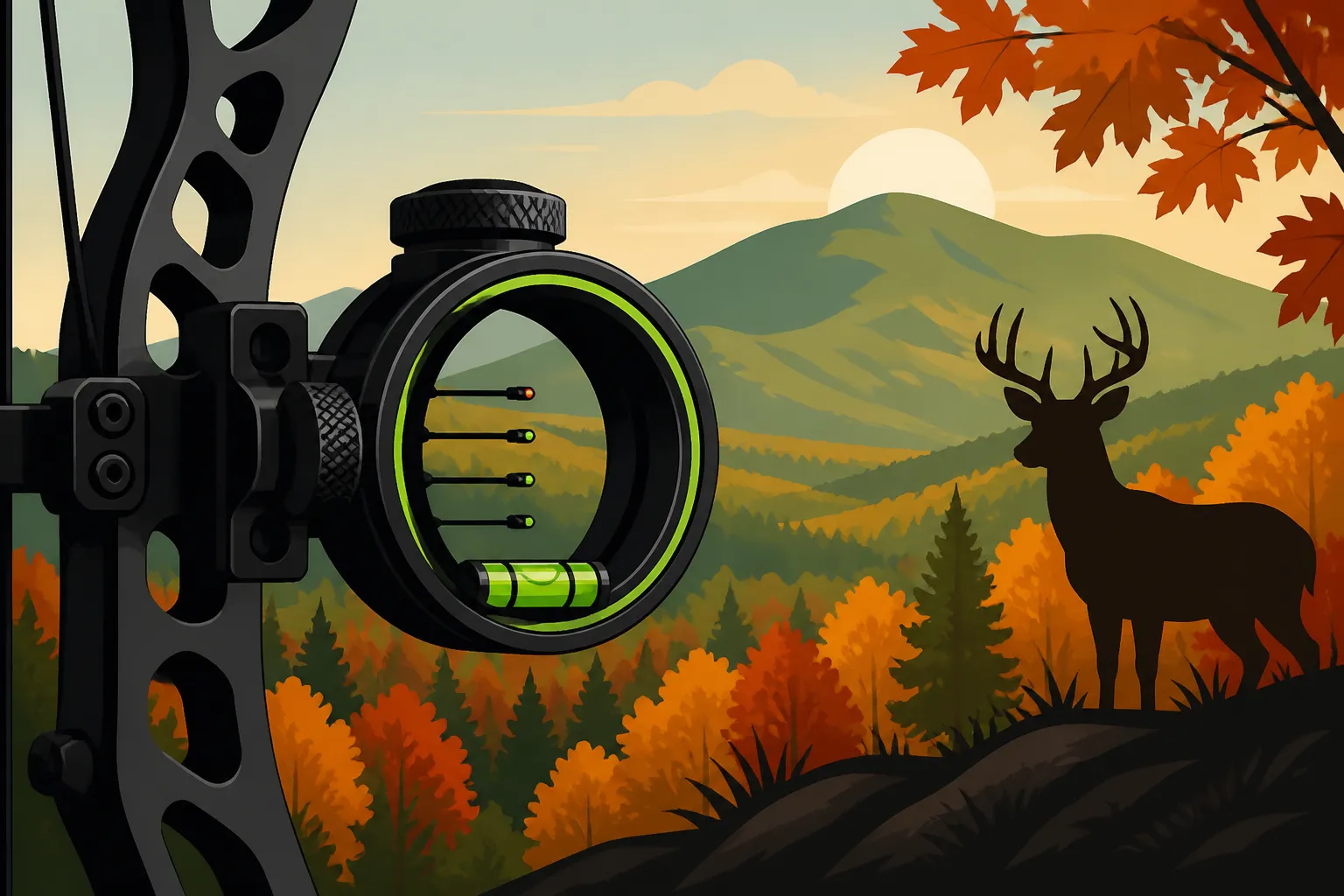
The core of any bow sight is its pins. For Vermont hunting, you'll generally choose between a multi-pin setup or a single-pin adjustable sight. Multi-pin sights, typically offering 3, 5, or 7 pins, are fantastic for quick ranging. Imagine a buck steps into a clearing at an unknown distance; with multiple pins, you can quickly estimate and pick the closest yardage pin without having to dial anything in. This is a huge advantage in fast-breaking scenarios or when a deer is quartering through varied terrain. The downside? More pins can sometimes clutter the sight picture, especially under stress or in very low light, making it harder to focus on a precise aiming point.
Single-pin adjustable sights, often called "sliders," offer a clean, uncluttered sight picture because you only see one aiming point. You range your target, then dial the sight to that exact yardage. This can lead to incredible precision, especially on longer shots. However, the trade-off is speed; if a deer closes the distance rapidly or moves to a different range, you have to adjust the dial, which can take precious seconds. Regardless of your choice, look for bright, durable fiber optics that gather light efficiently. Some sights offer rheostat lights to control pin brightness, which is invaluable for preventing haloing in bright sun or ensuring visibility in deep shadows. Micro-adjustments for both windage and elevation are also crucial for fine-tuning your accuracy, allowing you to dial in your setup perfectly for Vermont's varying conditions.
Durability and Weather Resistance
Vermont weather is notoriously fickle. You might start a morning hunt in crisp, cool air, only to have a rain shower roll in by mid-morning, followed by chilling winds, and then a dusting of snow by evening. Your bow sight needs to be built like a tank to withstand these conditions. Look for sights constructed from aircraft-grade aluminum or other robust, cold-weather-resistant materials. Plastic components, while lighter, can become brittle in freezing temperatures or crack under impact. A sight that can shrug off an accidental bump against a tree trunk or a fall in the snow is invaluable.
Weather resistance goes beyond just physical durability. Moisture is the enemy of optical clarity. Ensure the sight has sealed components to prevent water from fogging the pins or corroding the internal mechanisms. Some sights even feature anti-fog coatings on their lenses, though bow sights typically don't have lenses in the same way scopes do; rather, it refers to the protection over the fiber optics. When considering gear for Vermont, always think about how it will perform when wet and cold. It’s the same thought process you’d use for any critical piece of equipment, like making sure your Keeping a Muzzleloader Dry in Late-Fall Rain is possible with the right protection. A sight that fails because of a little rain or a bit of frost is worse than no sight at all.
Adjustability and Ease of Use
No matter how well you sight in your bow at home, field conditions can sometimes demand small tweaks. That’s why the adjustability of your sight is so important. Features like tool-less adjustments for windage and elevation are a godsend. Imagine being in your stand, noticing your arrow is consistently a touch left due to a subtle crosswind, and being able to make a quick, silent adjustment without fumbling for an Allen wrench. That's efficiency in action.
For single-pin sights, a smooth, precise dialing system for yardage adjustment is non-negotiable. It needs to operate quietly and consistently, allowing you to dial from 20 to 40 yards with confidence. Quick-detach mounting systems are also a benefit, allowing for easy removal for transport or storage without losing your zero. Ultimately, a great bow sight for Vermont hunting should feel like an extension of your bow – intuitive, responsive, and utterly dependable, minimizing any mental friction between spotting a deer and taking the shot.
Types of Bow Sights for Vermont Archers
Choosing the right type of bow sight is a deeply personal decision, influenced by your hunting style, the terrain you frequent, and even your vision. While the market offers a dizzying array of options, most boil down to a couple of core designs, each with distinct advantages for the Vermont bowhunter.
Multi-Pin Sights
Multi-pin sights are arguably the most popular choice among bowhunters, and for good reason. They provide a quick, intuitive way to estimate range and acquire your target. With multiple pins (typically 3, 5, or 7) preset to different yardages (e.g., 20, 30, 40, 50 yards), you can simply pick the pin that most closely matches your target's distance. This speed of acquisition is invaluable in situations where a deer might only offer a small window of opportunity, or when it's moving quickly through cover. If a buck pauses at an unexpected range, you don't have to fiddle with dials; you just select the appropriate pin.
For the Vermont hunter who encounters deer at a variety of distances, from close-quarters timber shots to longer crosses in open areas, a multi-pin sight offers robust versatility. A 3-pin sight might be perfect for tight, dense cover, keeping the sight picture clean. A 5-pin or even 7-pin offers more precise yardage markers for varied terrain or when trying to gauge distances across a wider field. Many multi-pin sights now incorporate micro-adjustments for each individual pin, allowing for extremely fine-tuned accuracy across all ranges. Brands that GoHunt often highlights frequently offer a variety of multi-pin sights, emphasizing their practical field applications and rugged construction suitable for active hunting.
Single-Pin Adjustable Sights
For those who prioritize a clean, uncluttered sight picture and extreme precision, a single-pin adjustable sight might be the answer. These sights feature just one aiming pin, which the hunter adjusts (often via a dial or lever) to the exact yardage of the target. This eliminates the confusion that can sometimes arise from multiple pins, allowing for a clearer focus on the bullseye. Because you can set the pin to the precise yardage, rather than an increment, some hunters find these sights offer superior accuracy, especially on longer shots where a few yards can make a significant difference.
Single-pin sights are excellent for situations where you have time to range your target and make an adjustment, such as when Hunting a Standing Apple Orchard or sitting in a treestand overlooking a food plot. The primary drawback, as mentioned, is the time it takes to adjust. If a deer appears unexpectedly close or moves rapidly, you might not have the seconds needed to dial your sight. However, for a patient Vermont hunter who values ultimate precision, the trade-off can be well worth it. Many single-pin models are incredibly durable and some even have multi-pin capabilities as a backup. When GoHunt reviews single-pin options, they often focus on the smoothness and reliability of the adjustment mechanism, which is key for consistent performance in the field.
Digital and Specialty Sights
The world of archery technology is always advancing, and that includes bow sights. Digital and specialty sights push the boundaries of what a bow sight can do, often incorporating rangefinding capabilities directly into the sight itself. Some even offer digital displays showing yardage, angle compensation, and other ballistic data. The obvious advantage here is convenience and a potential reduction in overall gear; you might not need a separate handheld rangefinder. For a hunter who wants every possible technological edge, these sights can be incredibly appealing.
However, with advanced technology comes considerations like cost, battery dependence, and sometimes, weight and bulk. More importantly for Vermont hunters, it's absolutely critical to be aware of and comply with all state regulations regarding electronic devices used for hunting. Vermont has specific rules about what constitutes a legal hunting aid, and you must verify that any specialty sight you consider is fully compliant before taking it into the woods. While the allure of cutting-edge tech is strong, reliability in harsh conditions and adherence to local laws should always be your top priority.
Choosing the Right Sight for Your Vermont Hunting Style
Ultimately, the "best" bow sight isn't a universal truth; it's the one that best suits your individual hunting style, the specific environments you frequent in Vermont, and your personal preferences. Thinking critically about how and where you typically hunt will guide you to the most effective choice.
Still-Hunting and Stalking
If your primary method involves covering ground, Working a Creek Bottom for Late-Season Deer, or navigating dense timber on foot, your needs will lean towards sights that are lightweight, rugged, and offer quick target acquisition. When you're still-hunting, opportunities can arise suddenly and often at close range, requiring you to draw and shoot quickly before the deer spooks. In these scenarios, a multi-pin sight often shines because you don't need to fiddle with adjustments; you simply pick the appropriate pin. A sight that’s compact and doesn't snag on branches is also a major plus.
Durability is paramount for stalkers. Your sight will inevitably take some bumps and scrapes as you push through thick cover. Look for robust, all-metal construction and securely protected fiber optics. An uncluttered sight picture is also beneficial, as you'll often be aiming through small windows in the foliage. A 3- or 5-pin sight might offer the perfect balance of quick ranging and minimal visual distraction for the active, on-the-move Vermont bowhunter.
Treestand and Ground Blind Hunting
For the patient hunter who prefers to spend hours in a stationary position, whether Hanging a Stand on a Champlain Valley Field Edge or Using a Ground Blind on Public Land, the criteria shift slightly. While quick acquisition is still important, there's often more time to make a precise shot. Here, the clarity of a single-pin adjustable sight can be a significant advantage, allowing you to dial in the exact yardage for the ultimate precision shot. With a clear sight picture, focusing on a small kill zone becomes easier, which is crucial for maximizing your chances from a static position.
Brightness of pins is still key, especially during those low-light magic hours of dawn and dusk when deer are most active around food sources or travel corridors. Micro-adjustments are also highly valued in this scenario, as you can take your time to fine-tune your setup for consistent accuracy over repeated sits. The overall weight might be less critical than for a mobile hunter, but durability and weather resistance remain essential for enduring long hours exposed to Vermont's elements.
Budget and Personal Preference
Let's be real: budget is always a factor for most of us. While high-end sights offer impressive features and robust construction, there are fantastic, reliable options available at every price point. Don't feel pressured to buy the most expensive sight; instead, focus on finding the best balance of features, durability, and adjustability that fits your budget and specific hunting needs. A quality mid-range sight, properly installed and sighted in, will almost always outperform a top-tier sight that isn't tuned or doesn't match the hunter's style.
Ultimately, the "best" bow sight is the one you have confidence in, the one that feels right in your hands, and the one that helps you make ethical, accurate shots. Spend time at the archery range trying out different types of sights if possible, or talk to experienced bowhunters about their preferences. Sites like GoHunt provide excellent reviews and comparisons of various gear, helping you weigh the pros and cons of different models. What works perfectly for one hunter might not be ideal for another. Trust your instincts, and choose a sight that you'll be happy to rely on when that moment of truth arrives in the Vermont woods.
Here’s a quick overview to help you compare:
| Feature/Type | Multi-Pin Sight | Single-Pin Adjustable Sight |
|---|---|---|
| Sight Picture | More cluttered (multiple pins) | Clean, uncluttered (one pin) |
| Target Acquisition | Very fast for unknown/multiple ranges | Slower, requires ranging and dialing |
| Precision | Good, but limited to preset pin ranges | Excellent, exact yardage adjustment |
| Best For | Still-hunting, stalking, dynamic hunting scenarios | Treestand hunting, ground blind, known distances |
| Vermont Scenarios | Dense timber, mixed cover, quick fleeting shots | Open fields, food plots, patient waits |
| Ease of Use | Point and shoot | Range, dial, shoot (more steps) |
| Durability | Varies by model, generally robust | Varies by model, adjustment mechanism needs protection |
| Light Conditions | Bright pins critical for visibility | Bright pin critical for precise aim |
Disclaimer
This article is for general informational purposes only and does not constitute professional advice. Laws, prices and regulations vary by location and change over time. Consult a qualified professional for guidance on your specific situation.