Hunting a Stone Wall Fence Line
Finding consistent deer movement in Vermont's diverse landscapes can feel like chasing a ghost, especially when the leaves are down and visibility is high. But if you're overlooking those old, moss-covered stone walls that crisscross our woods and fields, you're missing out on a serious secret weapon. This guide will dive deep into why these historic structures are absolute magnets for deer and how you can strategically hunt them for consistent success, turning those frustrating hunts into memorable experiences.
Why Stone Walls Are Deer Magnets in Vermont
Those old stone walls aren't just remnants of Vermont's farming past; they are living, breathing highways and hideouts for the deer herd. Our whitetails use them in myriad ways, making them prime locations to focus your hunting efforts. Understanding why deer gravitate to them is the first step in unlocking their potential.
Historical Context and Natural Funnels
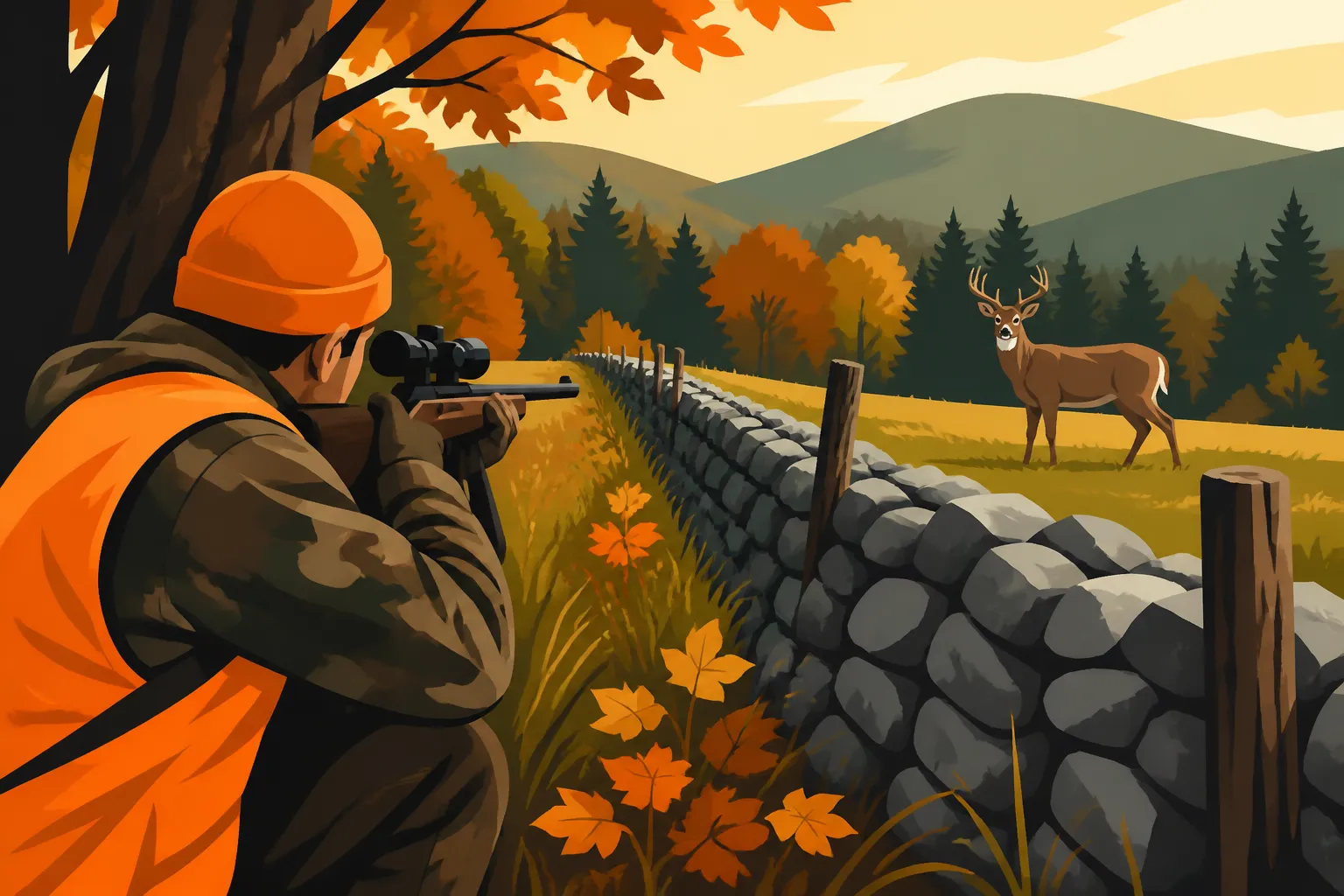
Picture Vermont centuries ago. Farmers cleared rocks from their fields, painstakingly stacking them into these iconic walls. Over generations, these walls became boundaries, often marking the edge of a cleared pasture and the dense forest. Today, those boundaries still stand, and deer have inherited them as their own. They don't see a barrier; they see a natural line of travel. Think of a long, rambling stone wall extending from a dense cedar swamp, across a woodlot, and into a patch of hardwoods with scattered apple trees. That wall instantly becomes a funnel, guiding deer from bedding to feeding, from one piece of cover to the next.
Deer will often travel parallel to these walls, especially if the vegetation along one side offers better concealment. It's like having a pre-built trail for them. In areas where the terrain is otherwise uniform, a stone wall provides a distinct linear feature that deer instinctively follow. They use it as a reference point, a pathway of least resistance, or a subtle barrier against the wind. When you're scouting, keep an eye out for these walls on your onX Hunt app, noting how they connect different habitat types. It’s amazing how often what looks like an insignificant line on a map translates into a major travel corridor on the ground.
Edge Habitat and Thermal Cover
Beyond being mere travel lanes, stone walls often create fantastic edge habitat and provide crucial thermal cover. Even a modest stone wall can create a subtle microclimate. In the late season, when the wind howls and temperatures plummet, deer will often seek refuge on the leeward side of a wall, soaking up any available sunlight. The rocks themselves can retain warmth, providing a degree of insulation.
Furthermore, the ground directly alongside these walls is often undisturbed by plows or heavy machinery, leading to a richer growth of natural browse. Brambles, young saplings, and various shrubs thrive there, providing both food and additional concealment. This creates a "double edge"—the edge of the wall itself and the edge of the denser vegetation it promotes. Deer love edges because they offer security and food simultaneously. A buck might bed down just inside a thicket, with a stone wall at its periphery, allowing him to use the wall as a vantage point or a quick escape route. Pay close attention to these thick growth zones right along the walls, especially where they intersect with heavier timber or a Green Mountain Deer Yard.
Reading the Signs Along a Stone Wall
Successfully hunting a stone wall isn't just about finding one on a map; it's about interpreting the story the deer are telling you on the ground. Every track, rub, and browse mark contributes to this narrative, guiding your setup and timing.
Tracks, Scrapes, and Rubs
When you walk a stone wall, keep your eyes peeled for fresh sign. Tracks are your first clue. Are they crossing the wall, or running parallel to it? A distinct trail running along the wall suggests a regular travel corridor. If you find tracks crossing the wall, note the height and condition of the wall at that point – deer often have preferred crossing points, which might be lower sections or areas with a natural break.
During the pre-rut and rut, stone walls can become major scrape lines and rub routes. Bucks use these linear features to define their territory and communicate with does. Imagine a buck walking the length of a stone wall, periodically stopping to make a rub on a sapling just off the wall, or pawing out a scrape directly adjacent to it. These are high-traffic areas during Hunting the Rut in Early-to-Mid November. Finding multiple rubs or scrapes along a section of wall is like finding a giant neon sign pointing to buck activity. These are the spots where you absolutely want to set up a stand or blind.
Feeding Areas Nearby
While deer might travel along a stone wall, they're often headed somewhere to eat, or they're browsing opportunistically along the way. Look for signs of feeding activity in conjunction with the wall. Are there acorn trees or beech nuts scattered near the wall? Are saplings along its length heavily browsed? Is there a transition to a field of standing corn or a neglected apple orchard nearby?
A stone wall that serves as a border to a good food source is gold. Deer will emerge from cover, follow the security of the wall, and then slip into the feeding area. Conversely, after feeding, they'll often retreat back into thicker cover, using the wall again as their protected route. This pattern creates predictable movement. Consider how a wall connects to a Hunting a Standing Apple Orchard or a Working a Champlain Valley Cornfield Edge. Understanding these connections is key. A wall might not be the feeding area itself, but it’s often the entryway or exit ramp.
Strategic Setups for Hunting Stone Walls
Once you've identified a promising stone wall and read the signs, the next challenge is to set up your stand or blind effectively. This involves considering visibility, wind, thermals, and your own approach.
Treestand vs. Ground Blind Placement
The choice between a treestand and a ground blind depends heavily on the surrounding cover and the specific characteristics of the wall you're hunting.
- Treestands: If there are mature trees providing good elevation and cover along the wall, a treestand offers excellent visibility. Position your stand slightly off the wall, perhaps 15-20 yards, allowing you to intercept deer traveling parallel to it, or those crossing it. Aim to place it where a natural break or curve in the wall might create a pinch point. The elevation helps you stay out of their direct line of sight and often provides a better shot angle into their vitals. Just remember to use a safety harness – always. When hunting in November, considering Hunting a Bow During the Rifle Season Overlap, means extra attention to being seen by other hunters, not just deer.
- Ground Blinds: In areas with smaller trees or dense brush right up against the wall, a well-brushed-in ground blind can be incredibly effective. Deer are accustomed to seeing natural obstacles. By integrating your blind seamlessly into the existing cover, using branches and natural foliage, you can become virtually invisible. A ground blind is also excellent for hunting walls that border open fields, providing concealment at the edge. Just be mindful of your scent cone, as ground blinds don't offer the same elevation advantage for scent dispersal as treestands.
Wind, Thermals, and Approach Routes
This is where many hunts go sideways, especially in Vermont's varied terrain. Deer rely heavily on their sense of smell, so playing the wind correctly is paramount.
- Wind: Always try to position yourself downwind of where you expect deer to approach or travel. If deer are using a wall as a travel corridor from north to south, and the wind is from the west, setting up on the east side of the wall allows your scent to blow away from their approach. Even a slight shift in wind can ruin a hunt. Check the forecast rigorously and have alternative stand locations ready for different wind directions.
- Thermals: In the hilly and mountainous terrain common across Vermont, thermals play a huge role, especially during morning and evening hunts. As the sun rises, thermals tend to rise up hillsides; as the sun sets, they fall. If you're hunting a stone wall running along a ridge or a valley, understand how these air currents will carry your scent. In the morning, you might need to be higher up to keep your scent from drifting into a valley where deer are feeding. In the evening, the reverse might be true. Learning to read Wind and Thermals in Steep Green Mountain Terrain is a skill that takes practice, but it's invaluable.
- Approach Routes: Your entry and exit to your stand are just as critical as the stand placement itself. Plan a route that keeps you out of sight and minimizes noise. Avoid walking directly along the stone wall you plan to hunt, especially if it’s an active travel corridor. Instead, come in from a direction that doesn't push deer, ideally using terrain features or heavy cover to mask your movement. Apps like GoHunt often have mapping features that can help you visualize elevation changes and optimal approach paths that keep you undetected.
Here's a quick summary of setup considerations:
| Setup Factor | Consideration | Best Practice |
|---|---|---|
| Visibility | How well can you see, and how well can deer see you? | Utilize natural cover, position for clear shots |
| Wind Direction | Where is your scent blowing? | Always set up downwind of expected deer travel |
| Thermals | How are air currents moving scent up/down slopes? | Adjust for rising/falling air, especially morning/evening |
| Cover | What hides you and helps you approach? | Use dense vegetation for blinds; elevated trees for stands |
| Approach/Exit | How can you get in/out without spooking deer? | Plan quiet routes, avoid disturbing the hunting area |
| Shot Lanes | Are there clear paths for an ethical shot? | Trim shooting lanes before season, if allowed |
Seasonal Considerations for Stone Wall Hunting
Deer behavior changes dramatically throughout the hunting season, driven by food availability, breeding instincts, and pressure. Understanding these shifts allows you to adapt your stone wall hunting strategy for maximum effectiveness.
Early Season to Rut Movement
In the early archery season, typically September and early October, deer are often still in their summer patterns, focused primarily on food. Stone walls that border productive agricultural fields, oak flats, or areas with Hunting a Standing Apple Orchard will be hot. Deer might use the wall to travel from their bedding areas in thicker cover to these food sources during dawn and dusk. This is a great time for an evening sit, especially if you’ve been doing your Scouting Vermont Public Land Before Season homework and know the deer's patterns.
As the pre-rut kicks in, usually late October and early November, bucks become more active, cruising for does. Stone walls, being linear features, become prime travel corridors for these searching bucks. If a wall connects two bedding areas, or a bedding area to a known doe hangout, you can bet a buck will use it. Rattling and Grunting Vermont Bucks can be very effective along these walls, as the sound will carry, and a buck traveling the wall might investigate, assuming another buck is nearby. This is also when rubs and scrapes will become most apparent, so focus on walls with fresh sign.
Late Season Food and Shelter
After the rut, and certainly into Vermont's December muzzleloader season, deer shift their focus back to survival: finding food and conserving energy. Late-Season Food Sources for Vermont Whitetails become critical, and stone walls play a different, but equally important, role.
In harsh winter conditions, deer seek thermal cover and easy travel routes. A south-facing stone wall that catches sunlight can be a favored bedding area, offering a reprieve from biting winds and cold. Deer might also browse heavily on any remaining vegetation along the wall that provides sustenance. If a wall leads to a standing cornfield that hasn't been completely harvested, or a persistent oak flat, deer will use it, often moving during midday hours to maximize warmth and minimize energy expenditure. This is a time to hunt these walls not just for travel, but for actual bedding or browsing close by. Don't be afraid to still-hunt along a wall slowly, especially if it leads into dense conifer cover where deer might be Where Vermont Bucks Bed in Thick Cover to escape the snow and cold.
The versatility of stone walls in Vermont's deer hunting landscape cannot be overstated. From ancient agricultural boundaries to modern-day deer highways, they offer consistent opportunities for observant hunters. Take the time to identify them on your maps, scout them thoroughly, and set up wisely.
Disclaimer
This article is for general informational purposes only and does not constitute professional advice. Laws, prices and regulations vary by location and change over time. Consult a qualified professional for guidance on your specific situation.