Judging a Legal Bear From a Sow With Cubs
One of the most profound challenges and ethical dilemmas a bear hunter in Vermont faces is the critical task of accurately distinguishing a solitary legal bear from a sow accompanied by her cubs. The adrenaline can be high, the light can be low, and a split second can mean the difference between a successful, ethical hunt and a devastating, illegal mistake. This comprehensive guide is designed to equip you with the knowledge, observation skills, and decision-making framework needed to confidently make that distinction, ensuring every bear you pursue is a legal and ethical harvest.
The Critical Importance of Proper Identification
Hunting black bears in Vermont offers an incredible experience, but it comes with immense responsibility. Our state has worked hard to foster a healthy, growing bear population, and our regulations are designed to protect that resource, especially the breeding females and their offspring. Misidentifying a sow with cubs is not only a serious legal infraction with significant penalties but also a profound ethical breach that impacts the future of the bear population.
Ethical and Legal Imperatives
Vermont's hunting regulations are crystal clear: it is illegal to harvest a sow with cubs. This rule isn't just a technicality; it's the cornerstone of sustainable bear management. Sows are the reproductive engine of the bear population. Protecting them ensures future generations of bears and continued hunting opportunities for us all. When you head out during Vermont's long bear season, whether you're baiting bears legally in Vermont or spot-and-stalk hunting Vermont ridges, your first and foremost duty is to be absolutely certain of your target. Beyond the written law, there’s a deeply ingrained ethical code among hunters: respect for the animal, respect for the resource, and a commitment to fair chase and responsible stewardship. Nobody wants to be the person who made an avoidable mistake.
Understanding Vermont's Bear Population Dynamics
Vermont's black bear population has seen remarkable growth and expansion over the past few decades, a testament to effective wildlife management and habitat availability. The Vermont Fish & Wildlife Department closely monitors the bear population estimate, harvest rates, and cub survival. This careful management ensures that hunting remains a sustainable activity. Sows typically breed every two years, and their cubs often stay with them through their first full year, sometimes even into their second year. This means that yearlings, though approaching adult size, are still dependent on their mother and are protected under the "sow with cubs" regulation. Understanding this natural cycle reinforces why careful identification is paramount. It’s not just about avoiding a fine; it’s about participating in the conservation success story that is Vermont’s black bear.
Key Visual Cues for Bear Identification
Distinguishing a sow from a lone bear, especially one with nearly full-grown yearlings, can be incredibly tricky. Bears can vary widely in size based on age, sex, and individual genetics. However, there are consistent visual cues that, when observed carefully and in combination, can guide your decision.
Size and Proportionality
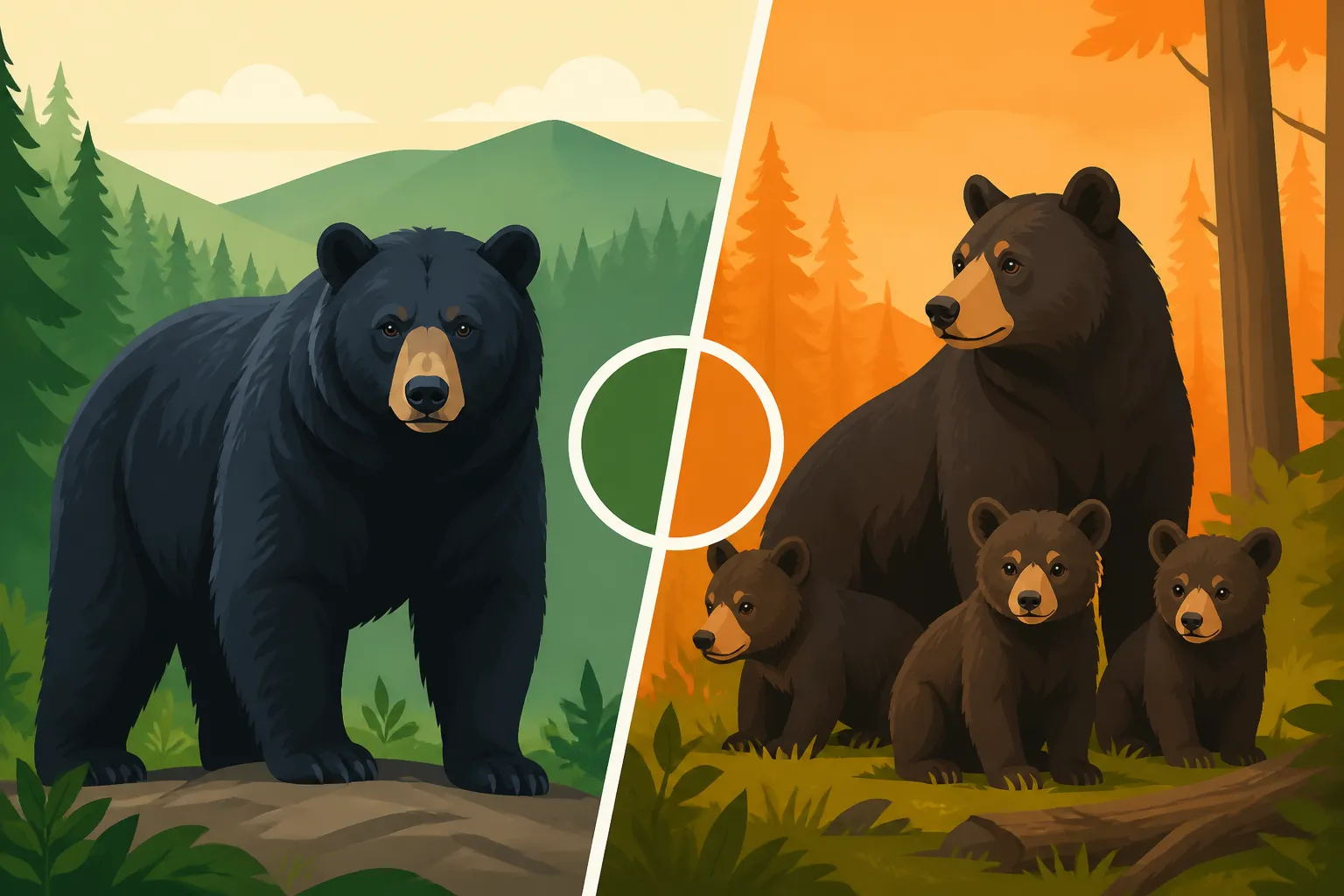
When you spot a bear, resist the urge to immediately focus on whether it's "big" or "small." Bears, like people, come in all shapes and sizes, and a large yearling can look surprisingly similar to a small adult. Instead, concentrate on proportionality. A mature boar or sow will generally have a larger, blockier head in relation to its body. Its ears will often appear smaller relative to its head. Young bears, including yearlings, tend to have heads that seem more proportional to their body, and their ears might appear larger or more prominent.
Consider the bear's overall build. Mature bears, especially older males, often have a heavier, more muscular build, particularly in the shoulders and neck. They might have a noticeable "hump" between their shoulders, though this is not always a definitive male characteristic. Yearlings, even if they've put on a good amount of fat, typically still have a lankier, more juvenile appearance. Their legs might seem longer, and their body less dense and powerful than a fully mature adult. Always compare the bear's perceived size to its surroundings – a fallen log, a rock, or a tree trunk can serve as an excellent visual reference.
Behavior Patterns
Behavior is often the most telling clue. Solitary bears, whether boars or lone sows, tend to move with a more purposeful, independent demeanor. They might be foraging, moving between bedding areas, or scent-checking. Their movements are often deliberate and unhurried unless they detect a threat.
Sows with cubs, however, exhibit distinct behaviors that revolve around their offspring. Their movements might be more cautious, often pausing to scan their surroundings, especially if the cubs are trailing. The cubs themselves will rarely be far from their mother. They will mimic her actions, following closely, playing nearby, or responding to her calls or cues. If you observe one bear and then another smaller bear pops out from behind a tree, or you see obvious playful interaction, alarm bells should be ringing.
A sow is inherently protective. If she senses danger or is aware of your presence, her behavior will immediately change to defensive or evasive actions, often positioning herself between you and her cubs. The cubs, in turn, will often display more skittish or dependent behavior, quickly retreating to the sow's side or attempting to hide. This behavioral dynamic is crucial. A lone bear might run, but a sow with cubs will often try to shepherd her young to safety.
Physical Markers of Cubs
While cubs can grow surprisingly large, especially yearlings that are nearly half the size of their mother, there are still key differentiators. Cubs are, by definition, smaller than the sow. Pay attention to their gait and movement. Cubs often have a somewhat awkward, less coordinated movement compared to a mature bear. Their heads might appear "too big" for their bodies, or their legs might seem a bit gangly.
Coloration can sometimes offer a hint, though it's not a foolproof method. While most black bears are indeed black, some can have brown or cinnamon phases. Occasionally, cubs might have a slightly different shade or a lighter muzzle compared to their mother, though this is highly variable. What's more important is seeing multiple bears of varying sizes together. If you see two, three, or even four bears in close proximity, and one is significantly larger than the others, it's highly probable you're looking at a sow and her cubs. Never assume multiple bears are just "multiple adult bears" unless there is irrefutable evidence of similar adult size and independent behavior.
Scenario-Based Learning and Decision Making
Real-world hunting scenarios are rarely textbook perfect. The light might be fading, the bear might be partially obscured, or the situation might unfold quickly. Developing a rigorous decision-making process is essential.
Observing Bears at a Distance
Patience is your greatest ally when observing bears. When you first spot a bear, immediately bring up your binoculars or, if the distance is significant, a spotting scope. High-quality optics, like those you might use when glassing a clear-cut for a bull moose, are indispensable for bear hunting. The objective is not just to see the bear, but to study it. Watch its movements. Does it appear alone? Does it stop and look back frequently, as if expecting something to follow? Does it pause to sniff the air, then continue, or does it hesitate and appear to communicate with unseen companions?
Take your time. If you’re hunting bear through the long September season, you likely have plenty of daylight. Use that time to confirm what you’re seeing. If you're utilizing a tool like GoHunt for scouting and identifying potential bear hotspots, you’ve already invested in better information. Now, apply that same diligence to on-the-ground identification. Sometimes, a cub will remain hidden behind its mother or in thick cover, only revealing itself after several minutes of observation. If you only see one bear, but its behavior suggests interaction or protectiveness, hold your shot.
Identifying Potential "Red Flags"
Certain observations should immediately trigger a "red flag" and cause you to back off, at least temporarily. These include:
- Any visual cue of a smaller bear nearby: Even if it's just a flicker of movement, a small black shape, or a different sized bear at a distance.
- Behavioral patterns of waiting or protecting: If the bear pauses and looks back into the timber, or stands guard while other smaller shapes move around.
- Unusual vocalizations: Bears are generally quiet, but a sow might make soft grunts or huffs to communicate with her cubs.
- Any uncertainty about size disparity: If you're looking at what appears to be a larger bear and a smaller one, but you can't definitively tell if the smaller one is a cub or just a small adult, the answer is always to err on the side of caution.
If you observe any of these red flags, do not even raise your weapon. Instead, lower your binoculars, reposition if necessary for a better vantage point, and continue observing. Remember, no bear is worth risking a mistake that could cost the life of a sow and orphans her cubs.
What to Do When in Doubt
This is the golden rule of ethical hunting: When in doubt, don't take the shot. It's a simple phrase, but incredibly powerful. The moment you question whether it's a sow with cubs, your finger should come off the trigger, your bow should be lowered, and the shot should be passed. There will always be another opportunity, another legal bear. The consequences of making the wrong choice are far too great. This principle applies whether you're hunting Vermont's November rifle season or during the December muzzleloader season.
A missed opportunity is just that – a missed opportunity. A wrongful harvest is a stain on your hunting record, a detriment to the bear population, and a heavy burden on your conscience. If the situation is ambiguous, simply enjoy the observation, learn from the encounter, and move on. The GoHunt platform emphasizes smart, ethical hunting, and passing on a questionable shot perfectly aligns with that philosophy.
Tools and Tactics for Confident Identification
Beyond keen eyesight and patience, specific tools and tactics can significantly enhance your ability to confidently identify a legal bear.
The Role of Optics
As mentioned, a good pair of binoculars is non-negotiable for bear hunting. Whether you're considering the best binoculars for a Northeast Kingdom bog or just a solid pair for general use, invest in quality. Look for optics with excellent light-gathering capabilities, especially important during dawn and dusk when bears are most active. A magnification of 8x or 10x is generally ideal for handheld use, providing enough detail without excessive shake.
A spotting scope can be incredibly useful if you're hunting open areas or glassing vast clear-cuts, allowing you to observe bears from extreme distances without disturbing them. This long-range observation is crucial for discerning subtle details and behavioral patterns before you even think about closing the distance. GoHunt often provides valuable mapping and scouting tools, and integrating that digital reconnaissance with quality physical optics creates a powerful combination for better decision-making in the field.
Patience and Observation
This can't be stressed enough. Bears are notoriously secretive animals, and quick, fleeting glimpses are common. However, the patient hunter who dedicates time to observation will be rewarded with crucial information. Set up where you have a good vantage point, potentially overlooking a known food source or travel corridor. If you're hunting a funnel between two woodlots or watching a standing apple orchard, find a comfortable position and simply watch.
Observe the bear's entire sequence of movements. Does it scratch itself on a tree? Does it sniff the ground? Does it seem to be listening or looking in a particular direction? These small behaviors, over time, can reveal whether it's truly a lone animal or if it's responding to or awaiting other bears. If you see a larger bear foraging intently, and then it suddenly raises its head and lets out a soft huff, it might be communicating with cubs that are out of sight in thick cover. Waiting can make all the difference.
Using Trail Cameras
Trail cameras are powerful scouting tools that can provide invaluable intelligence before you even step foot in your hunting spot. Placing trail camera placement on public land or a private parcel allows you to monitor bear activity over time, identifying regular visitors, their travel patterns, and, most importantly, whether sows with cubs frequent the area. If you consistently capture images of a sow and cubs on your camera, it's wise to either choose a different hunting location or exercise extreme caution when hunting that specific spot.
Modern cellular trail cameras, especially those with cellular camera coverage in remote Northeast Kingdom areas, can send real-time photos to your phone, giving you up-to-the-minute intelligence. This can be especially helpful if you're trying to determine if a specific bear has moved on, or if the cubs are still trailing their mother. Use this technology responsibly and ethically, as an aid to observation and identification, not as a shortcut to blind targeting.
| Feature / Trait | Lone Adult Bear (Boar or Lone Sow) | Sow with Cubs (Cubs may be Yearlings) |
|---|---|---|
| Overall Size | Variable, but generally appears solid, robust, and mature. | Sow typically mature size; cubs visibly smaller (even yearlings). |
| Head Proportionality | Head often appears larger, blockier relative to ears. | Sows' heads typical; cubs' heads may appear larger or gangly for body. |
| Ear Size | Ears appear smaller relative to the head. | Cubs' ears may appear more prominent or larger relative to head. |
| Body Shape | Often a noticeable "hump" in shoulders (especially boars). | Sow's body typically lacks prominent hump; cubs are lankier. |
| Movement & Gait | Purposeful, independent, coordinated, deliberate. | Sow's movement often cautious, pausing to scan; cubs follow closely, less coordinated. |
| Social Behavior | Solitary; no interaction with other bears observed. | Multiple bears in close proximity; obvious interaction, play, or following. |
| Vocalizations | Generally silent unless startled or fighting. | Sow may emit soft grunts/huffs to communicate with cubs. |
| Alertness Level | Alert to surroundings, but less overtly protective. | Sow highly protective, often positioning herself between perceived threat and cubs. |
| Cub Presence | Absolutely no cubs observed, even after extended watch. | Cubs (any size) seen with the sow, or evidence of their presence (e.g., following tracks, fresh scat from multiple sizes). |
Disclaimer
Always consult the most current Vermont Fish & Wildlife Department regulations before engaging in any hunting activity. This guide is for informational purposes only and does not supersede official state hunting laws and regulations.