Hunting a Utility Corridor Right-of-Way
Finding overlooked hunting spots in Vermont can feel like an endless quest, especially when popular public lands see a lot of foot traffic. But sometimes, the most promising areas are those we drive past every day without a second thought. This guide delves into the often-underestimated potential of hunting utility corridors and right-of-ways in Vermont, offering strategies and insights to help you successfully target deer, turkey, and small game in these unique linear habitats.
Understanding Utility Corridors as Hunting Habitat
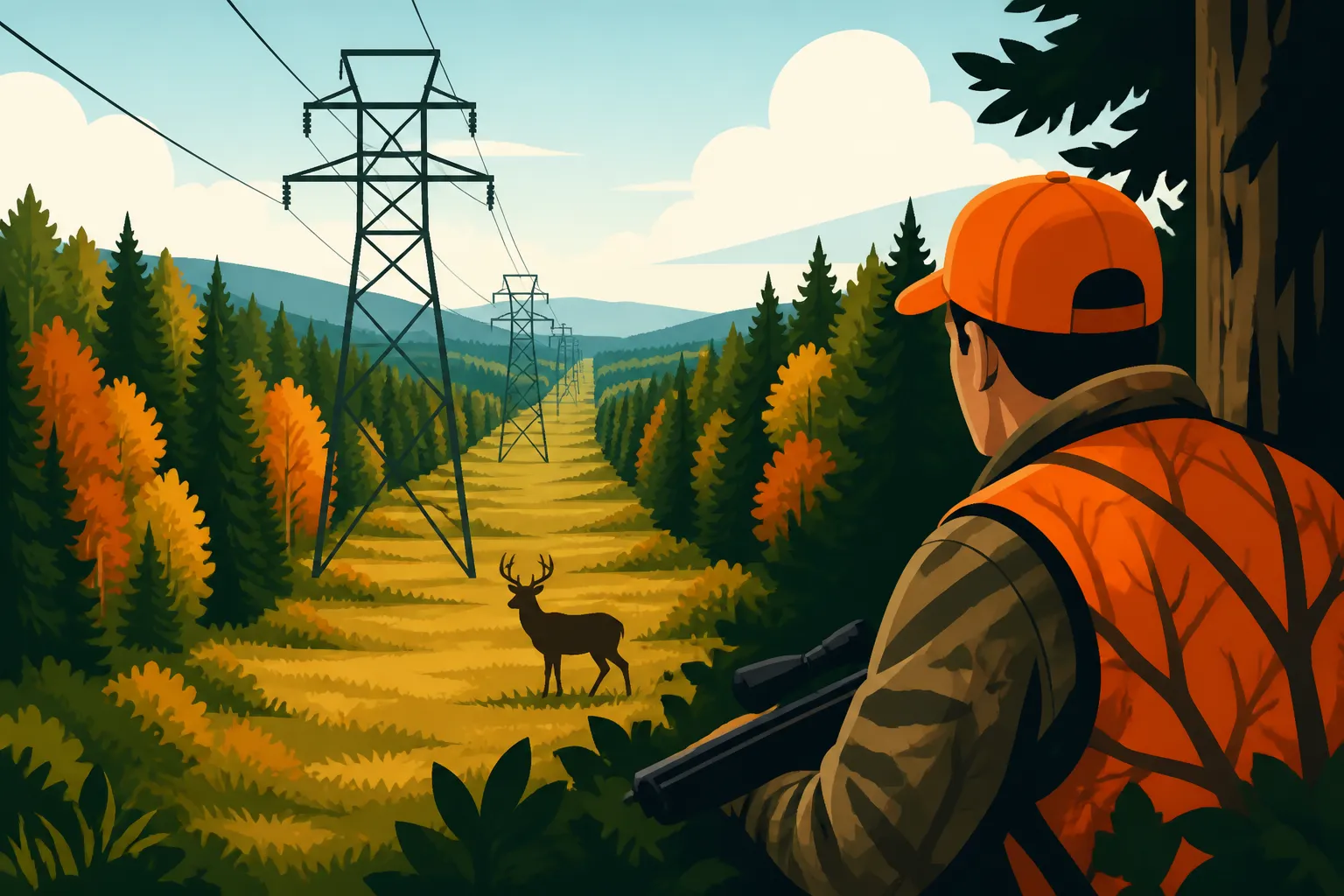
Utility corridors are those narrow or wide strips of cleared land that crisscross our Vermont landscape, often associated with power lines, gas pipelines, or old railroad beds. They might seem like barren, unnatural places, but for a keen hunter, they represent incredible opportunities. These areas are typically maintained to keep trees and tall vegetation clear, ensuring unimpeded access for maintenance crews and preventing interference with the utility infrastructure itself.
What Exactly is a Utility Corridor?
When we talk about utility corridors, think beyond just the towering power lines you see cutting through a mountain pass. It encompasses a range of infrastructure easements. There are the obvious high-tension power lines that might carve a wide swath through dense timber, creating an open-air highway for animals. Then there are smaller distribution lines, often paralleling roads, or even old pipeline easements that run underground but require a cleared surface right-of-way for access and inspection. Sometimes, abandoned railroad grades, now owned by utility companies or land trusts, can also function as these linear clearings, offering similar habitat characteristics. Each type has its own subtle nuances, but they all share a common theme: they interrupt continuous forest cover.
These corridors are not just random clearings; they're managed landscapes. The maintenance schedule, whether it's annual mowing, periodic herbicide treatment, or selective cutting, dictates the type of vegetation that can thrive there. This management, though primarily for utility purposes, inadvertently creates a dynamic environment that wildlife, particularly deer, often find incredibly appealing. Imagine a dense stand of pines on either side, then suddenly, a strip of waist-high goldenrod, berry bushes, and young saplings. It's a noticeable break in the monotonous canopy that deer are drawn to like a magnet.
Why These Areas Attract Wildlife
The reason utility corridors are so appealing to wildlife, especially deer, boils down to a concept known as "edge habitat" and the bounty of early successional growth they offer. Think of it: you've got dense, mature timber on either side providing security and bedding cover, and then right in the middle, you have this open, sun-drenched strip.
Firstly, these areas are often choked with early successional plants—think brambles, berry bushes, young saplings, and various grasses and forbs. These aren't just pretty roadside weeds; many are highly palatable browse for deer, offering a consistent food source throughout the season that might not be as readily available deep within the mature forest. Deer will often venture out of the thick woods to feed on this abundant growth, especially during morning and evening hours. This transition zone, where two different habitat types meet, is inherently productive. It's where the shy whitetail can grab a bite to eat while still being within a quick sprint of dense cover. Turkeys also love these edges for foraging insects and dusting, and small game like rabbits and grouse often thrive in the thick brush.
Secondly, utility corridors act as natural travel corridors. Deer, being creatures of efficiency, will often use these relatively clear paths to move between bedding areas and feeding grounds, or even just to traverse their home range without having to fight through dense underbrush. Imagine trying to push through a thick spruce stand versus walking a relatively open, mowed strip. They will often parallel these corridors just inside the timber, using the cover for security but always aware of the easier travel route nearby. A buck might use the corridor itself as a cruising lane during the rut, scent-checking the edges for does. Understanding these patterns is key to Reading Vermont Mud for Fresh Deer Movement.
Thirdly, these corridors can create thermal cover or sunning spots. In colder months, a sunny south-facing slope along a power line can be a welcome relief from the biting wind within the forest. Conversely, in warmer early season hunts, the shade provided by the taller trees on the edge can offer a cooler respite during midday. The diversity of vegetation also attracts a wide range of insects, which in turn brings in turkeys looking to scratch for a meal.
Legalities and Access for Hunting Vermont's Utility Corridors
Before you even think about hanging a stand or still-hunting a utility corridor, it's absolutely crucial to understand the legalities surrounding access and hunting within these areas. This isn't just about respecting the law; it's about staying safe and ensuring you can continue to hunt these spots for years to come. Many hunters get excited by the prospect of "new" ground and forget that just because something looks like public access, doesn't mean it is.
Navigating Public vs. Private Ownership
This is where things get tricky, and it's perhaps the most important aspect of hunting utility corridors. A utility corridor, whether it's for power lines or a pipeline, is an easement. This means a utility company has the right to use that strip of land for their infrastructure, but they don't necessarily own the land beneath it outright. The underlying land ownership often remains private. So, while the power company has rights to maintain the corridor, a private landowner still owns the property, and their rules for public access apply.
This means you absolutely cannot assume that because there's a power line, it's public hunting ground. Most often, these corridors cross private property. This is precisely where modern mapping tools become your best friend. Apps like onX Hunt are indispensable. You can pull up a satellite view, zoom in on that intriguing power line, and instantly see the underlying property boundaries and landowner names. This technology has revolutionized scouting and access permission. Without it, you'd be guessing or relying on outdated paper maps.
If the onX Hunt map shows private ownership, you must obtain explicit permission from the landowner before stepping foot on that land to hunt. Knocking on doors and asking permission is a time-honored tradition in Vermont, and it's still the best way to secure access. Be respectful, be polite, and be clear about your intentions. Offer to share game, or help with chores—sometimes a friendly face and a helping hand are all it takes. Check out Knocking on Doors in Champlain Valley Farm Country for more tips on this. Sometimes, utility companies themselves might own small sections or larger parcels, but that's less common for the linear corridors cutting through diverse landscapes. Don't be afraid to do your homework and make those phone calls or visits.
Rules and Regulations Specific to Corridors
Beyond general land ownership, utility corridors can have their own unique set of rules.
Firstly, safety zones around buildings, roads, and other infrastructure are always in play. Even if you have permission to hunt on private land crossed by a corridor, you must still adhere to Vermont's firearm discharge setbacks. You cannot discharge a firearm within a certain distance of an occupied dwelling, school, or other public building without permission from the owner or occupant. This is especially relevant in more populated areas where corridors might pass close to homes. Always know your surroundings and your target's backdrop.
Secondly, some utility companies may have their own specific rules regarding hunter access, vehicle use on their access roads (which might be part of the corridor), or even the placement of treestands. While you've secured landowner permission, it's wise to be aware if the utility company has posted any specific regulations. Often, these are about liability and maintaining access for their crews. Treat their property and infrastructure with the utmost respect. Damage to a utility pole or other equipment could lead to significant problems.
Thirdly, consider what you can legally do in terms of habitat modification. You generally cannot cut vegetation or create new shooting lanes on someone else's property or within an easement without specific permission. Stick to using the natural clearings and edges available. Your primary focus should be on observing and adapting to the existing landscape.
| Aspect | Public Land Utility Corridor | Private Land Utility Corridor |
|---|---|---|
| Land Ownership | Owned by state or federal agency (e.g., Green Mountain National Forest, WMA) | Privately owned, utility company holds an easement |
| Hunting Access | Generally permitted, follow public land rules | Requires explicit landowner permission for hunting |
| Mapping Tools | Use onX Hunt or GoHunt to verify public boundaries |
Use onX Hunt to identify landowner for permission requests |
| Rules & Regs | General state hunting regs, specific public land rules apply | State hunting regs, landowner rules, and potential utility company policies |
| Treestand Placement | Follow public land regulations (e.g., no permanent stands) | Landowner's discretion, avoid attaching to utility structures |
| Vehicle Access | May be restricted to foot traffic or specific access points | Landowner's discretion, always ask for specific vehicle use |
| Blaze Orange | Mandatory during rifle/muzzleloader seasons, wise even when not required due to visibility | Mandatory during rifle/muzzleloader seasons, wise due to visibility |
Strategies for Hunting Utility Corridors
Hunting utility corridors successfully requires a blend of keen observation, strategic planning, and an understanding of how deer and other game utilize these unique linear features. It's not just about setting up where you think they might be; it's about letting the landscape tell you the story.
Scouting and Interpreting Sign
Effective scouting is paramount in these environments. Instead of vast timber blocks, you're looking at a linear feature. This often makes reading deer sign a bit more concentrated. Walk the length of the corridor, paying close attention to where deer enter and exit the treeline. Look for well-worn trails that cross the corridor or parallel it just inside the timber. These are your primary travel routes. Deer are creatures of habit, and they'll take the path of least resistance. You might find a single, strong trail cutting directly across a power line, indicating a major thoroughfare between bedding and feeding areas.
Focus on the transition zones, that critical edge where the cleared right-of-way meets the dense woods. This is where you'll find rubs on saplings along the edge, indicating a buck working his way through. Scrapes might pop up on the edge of the corridor, particularly near a low-hanging limb, serving as a signpost during the rut. Pay attention to droppings and fresh tracks in any soft earth or mud. Even though these corridors are "open," deer still prefer to stick to thicker cover when possible. If the corridor itself has thick pockets of brush or tall grass, those spots often serve as daytime bedding areas, especially during the archery season when deer are less pressured.
Use mapping tools like onX Hunt to help identify pinch points or funnels created by the corridor's interaction with natural topography. Does the corridor narrow at one point? Does it cross a saddle or a creek bottom? These are natural bottlenecks that concentrate deer movement. Overlaying aerial photos with topographic maps can reveal a lot before you even set foot in the woods. Reading Aerial Photos for Green Mountain Deer can really give you an advantage here.
Effective Hunting Tactics
Once you've identified key travel routes and areas of activity, it's time to decide on your hunting tactic.
- Stand Placement: For many, a treestand is the go-to. Position your stand just inside the timber, overlooking the edge of the corridor and any trails that enter or exit it. This gives you the advantage of concealment while still having a good view of the open space. Think about the prevailing wind direction for your chosen stand location. Since corridors are often open, winds can be tricky, swirling and eddying. Always try to set up with the wind in your favor, blowing your scent away from where you expect deer to approach. A mature maple or oak at the edge of the power line might be an ideal spot. You might also consider a ground blind, especially if there's enough natural brush within the corridor itself for concealment. Brushing In a Blind on a Field Edge offers similar principles.
- Still-Hunting/Stalking: Utility corridors can also be excellent for still-hunting or stalking, especially if there are undulations in the terrain or scattered pockets of cover within the right-of-way. The key is to move slowly, using any available cover, and constantly scanning ahead. The edges of the corridor, where the brush is densest, are prime spots for a cautious stalk. During the rut, a buck might be cruising these edges, and a slow, methodical approach can sometimes catch them off guard. This is a tactic that requires patience and a good understanding of Wind and Thermals in Steep Green Mountain Terrain if your corridor runs up or down a hillside.
- Ambushing Funnels: As mentioned, if the corridor creates a natural funnel, these are excellent ambush points. A small creek crossing, a dip in the terrain, or a narrow section where the timber encroaches can force deer into a predictable path. Set up downwind and be ready.
- Calling: Don't forget your calls! During the rut, rattling and grunting can be highly effective in these more open environments, as the sound travels well. Rattling and Grunting Vermont Bucks can lure curious deer out of the timber and into view. For turkeys, the open nature of the corridor can allow your calls to carry further, potentially pulling a gobbler out of the woods to investigate.
Safety Considerations
Hunting in utility corridors comes with specific safety considerations that cannot be overlooked.
- Visibility: These areas can sometimes attract other outdoor enthusiasts, from hikers to ATV riders (if permitted). Always wear sufficient blaze orange, especially during rifle and muzzleloader seasons. Even if bowhunting, a blaze orange hat or vest while moving to and from your stand is a smart choice. How Much Blaze Orange Vermont Requires is a good refresher.
- Lines of Fire: Because corridors are open, it's easy to get complacent about your backdrop. Always be hyper-aware of what is beyond your target. Never take a shot unless you are absolutely certain of your target and what lies beyond it. This is even more critical in areas where the corridor might cross roads or be near dwellings.
- Utility Infrastructure: Never shoot at or near utility poles, transformers, or other equipment. Not only is this extremely dangerous and potentially illegal, but it can also lead to power outages and costly damage. Always maintain a safe distance and direct your shots away from any infrastructure.
- Other Hunters: While corridors can feel secluded, they might be known to other hunters. Assume you are not the only one. Always practice safe hunting habits, communicate if you see other hunters, and treat everyone with respect. It's a small state, and good relationships keep access open for everyone.
- Emergency Preparedness: Cell service can be spotty in many parts of rural Vermont. If you're heading into a more remote corridor, carry a fully charged phone, a first-aid kit, and consider a satellite communicator for emergencies. Tools like those mentioned by
GoHuntfor trip planning and safety features can be good resources for this. Let someone know where you're going and when you expect to be back. This is essential, whether you're hunting deer in a corridor or Still-Hunting Green Mountain National Forest Timber.
Hunting utility corridors offers a unique and often rewarding experience for the Vermont hunter. By understanding the habitat, respecting the legalities, employing smart tactics, and always prioritizing safety, you can unlock a whole new dimension to your hunting adventures right here in the Green Mountain State.
Disclaimer
This article is for general informational purposes only and does not constitute professional advice. Laws, prices and regulations vary by location and change over time. Consult a qualified professional for guidance on your specific situation.