Game Carts for Hauling a Moose Out
Drawing a Vermont moose permit is a truly once-in-a-lifetime opportunity for many of us, a dream come true after years of applying. But the sheer euphoria can quickly be tempered by the stark reality of what comes next: getting an animal that can weigh upwards of 1,000 pounds out of the remote Northeast Kingdom or other drawn zones. It's a colossal task, and if you haven't thought beyond the shot, you're setting yourself up for an epic struggle. This guide is all about one of the most under-appreciated tools in a moose hunter's arsenal: the game cart. Forget what you think you know about those little deer carts; we're talking about heavy-duty solutions designed to make the impossible, or at least the incredibly difficult, manageable when it comes to recovering a Vermont moose.
The Unavoidable Reality of a Vermont Moose Harvest
Let's be honest, dreaming about dropping a giant bull in the remote backcountry of Vermont is one thing. Actually doing it, and then figuring out how to move that mountain of muscle and bone, is an entirely different beast. Many hunters, especially those new to moose hunting, underestimate the sheer logistical challenge. It's not just a bigger deer; it's a completely different scale of operation.
The Sheer Size and Weight of a Vermont Moose
A mature bull moose in Vermont can easily weigh between 700 and 1,200 pounds, and a large cow isn't far behind. That's a staggering amount of weight to contend with, often in difficult terrain. Imagine trying to drag something equivalent to a small riding lawnmower, if that lawnmower was prone to snagging on every root and rock, through thick woods. Even quartered, each piece can weigh hundreds of pounds. This isn't a job for one person, or even two, without the right equipment. The sheer bulk and awkwardness of the animal mean that even a short drag can feel like an all-day ordeal, draining your energy and putting your physical well-being at risk. Hunters often experience a significant drop in body temperature and exhaustion after the adrenaline of the shot wears off, making the physical demands of recovery even more challenging.
The Challenge of Remote Terrain and Logging Roads
Vermont's moose habitat, particularly in the Northeast Kingdom where many permits are allocated, is often characterized by thick spruce-fir stands, alder swamps, steep hills, and remote logging roads that might not be suitable for vehicles. Hunting a Drawn Moose Zone in the Northeast Kingdom means you're likely going to be a long way from easy access. Even if you manage to drop your moose near a logging road, those roads can be miles from your truck, and often they're soft, muddy, or strewn with rocks and debris. It's not like field-dressing a deer by the edge of a cornfield. You're dealing with backcountry conditions, which means every piece of equipment, every strategy, needs to be robust and well-thought-out. The elevation changes, the wet ground, and the dense cover all conspire to make a difficult task even harder, highlighting the need for efficient and effective hauling solutions.
Why a Game Cart Isn't Just for Deer When It Comes to Moose
Many hunters associate game carts with deer, using them to pull a whole whitetail out of a woodlot. And while they excel at that, their utility for moose recovery is exponentially greater. Thinking you can just "muscle it out" with a moose is often a recipe for injury, exhaustion, and potentially spoiled meat if you can't get it out quickly enough.
The Limits of Backpacking Quartered Moose Meat
Yes, quartering a moose is almost always the first step for anyone facing a backcountry recovery. Field Dressing a Moose in the Northeast Kingdom is a critical skill for this exact reason. You simply cannot move a whole moose unless it dies right on a paved road. However, even with the animal broken down into manageable quarters, skull, and hide, you're still looking at incredibly heavy loads. A single hindquarter from a large bull can easily weigh 150-200 pounds. Trying to pack that out, even with a purpose-built frame pack like the ones we've discussed for Best Pack for a Northeast Kingdom Moose Hunt or Best Backpack Frame for a Quartered Moose, is brutal. Multiple trips, each one taxing, can quickly lead to exhaustion, especially if you're not in peak physical condition or the weather turns. While backpacking is certainly necessary for the initial move from the kill site to an accessible point, relying solely on packs for miles of rough terrain is often inefficient and unsafe.
When a Cart Outperforms Human Power Alone
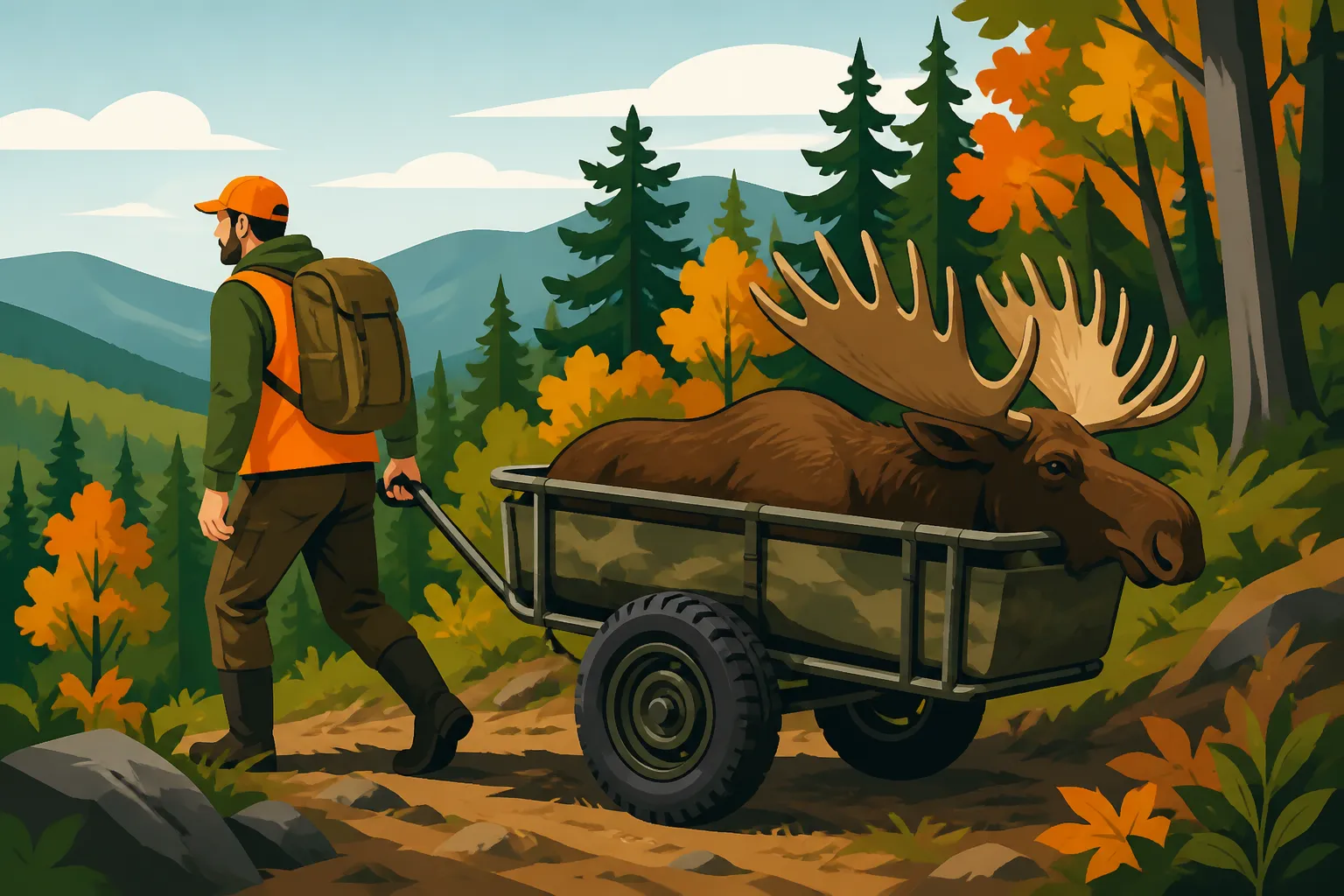
This is where a heavy-duty game cart truly shines. Once you've quartered your moose and possibly moved the heaviest pieces a short distance by pack, you can consolidate the load onto a game cart. Even if you're pulling only one or two quarters at a time, the cart takes the weight off your back and transfers it to wheels. This simple principle dramatically increases your efficiency and reduces the physical strain. Instead of your knees, back, and shoulders bearing the brunt of the weight, the cart's frame and tires do the heavy lifting. This means fewer trips, faster recovery, and more energy saved for the actual work of processing the animal once it's out. For example, navigating a moderately graded old logging road or even a well-worn ATV trail becomes significantly more feasible with a cart than trying to carry 300+ pounds of meat on your back. It’s about leveraging mechanical advantage to conserve your most valuable resource: your own strength and endurance.
Types of Game Carts Suitable for Vermont's Northeast Kingdom Moose Terrain
Not all game carts are created equal, especially when it comes to the monumental task of hauling a Vermont moose. You need something built for serious work, not just a backyard deer drag. The terrain in Vermont's moose country demands robust construction and thoughtful design.
Single-Wheel Game Carts for Narrow Trails
Single-wheel game carts are often designed for maneuverability in tight spaces. They function somewhat like a wheelbarrow, with the weight balanced over a central wheel, and two handles for the user to push or pull.
Pros:
- Agility: They can navigate very narrow trails, dense brush, and thick timber where a two-wheel cart might get hung up or be too wide. If you're working through tight spruce thickets or around dense blowdowns, a single-wheel design can be a lifesaver.
- Balance: A well-balanced single-wheel cart can feel surprisingly light even with a heavy load, as the wheel bears most of the vertical weight.
- Simplicity: Fewer moving parts generally mean less to go wrong.
Cons:
- Stability: Can be challenging to keep upright on uneven side-slopes or very rocky terrain. Requires more strength and core stability from the user to prevent tipping, especially with an unwieldy load like a moose quarter.
- Load Distribution: While they carry weight well vertically, the balancing act means that unevenly distributed loads can make them very difficult to manage.
- Capacity: Often have a slightly lower perceived weight capacity compared to their two-wheeled counterparts, though robust models can still handle significant weight.
These carts can be excellent for the initial phase of getting a heavy quarter from a deep kill site to a more open trail. Some specialized single-wheel carts, like those from Pak-Boats or certain other outdoor brands, are specifically designed for heavy loads and rough terrain, offering wider tires and more robust frames than typical deer carts. They demand a good deal of physical effort but can access places other carts simply cannot.
Two-Wheel Game Carts for Stability and Heavier Loads
Two-wheel game carts are perhaps the most common type you'll see, but for moose, you need a heavy-duty version. These carts provide inherent stability due to their dual points of contact with the ground.
Pros:
- Stability: Much more stable on uneven ground, reducing the risk of tipping and making it easier to manage heavy, awkward loads. This is a huge advantage when you're exhausted and dealing with hundreds of pounds of moose meat.
- Weight Capacity: Generally designed to carry heavier loads with less direct effort from the user to maintain balance. The weight is distributed across two wheels and the frame, making them ideal for large moose quarters.
- Ease of Use: Easier to pull or push for extended distances on relatively open terrain, such as old logging roads, ATV trails, or less dense woods.
Cons:
- Width: Can be wider than single-wheel carts, making them less suitable for extremely narrow trails or dense brush. They might require clearing a path in some areas.
- Maneuverability: Turning in tight spots can be more cumbersome, requiring more space than a single-wheel cart.
- Weight: The carts themselves can be heavier, making them a bit more work to get to the kill site if carried empty over rough terrain.
For most moose recovery scenarios in Vermont, a heavy-duty two-wheel cart will be your best bet once you reach any kind of established trail. Brands like Tipke, though often associated with garden utility, produce some very robust utility carts that hunters have adapted for game. Dedicated hunting brands also offer excellent options designed for heavy loads. Always check the stated weight capacity; if it says 200 pounds, it's a deer cart. You're looking for something that boasts 500+ pounds.
Heavy-Duty Carts and ATV/UTV-Towable Options
Beyond the standard push/pull game carts, there are specialized heavy-duty options, some of which are designed to be towed by an ATV or UTV.
Heavy-Duty Hand Carts: These are essentially reinforced two-wheel carts with larger, more durable tires, industrial-grade frames, and often suspension systems. They are built for extreme conditions and maximum load capacity, often exceeding 700-800 pounds. They are still manually operated but distribute weight even more efficiently. Think of a super-sized, super-rugged version of a standard two-wheel cart. They can be incredibly helpful when Getting a Moose Out on a Logging Road that is too rough for a truck but navigable by a cart.
ATV/UTV-Towable Trailers: If you have ATV or UTV access, this is often the fastest and least strenuous way to extract a moose. These are essentially small utility trailers with off-road tires, designed to hitch to a recreational vehicle.
Pros:
- Maximum Capacity: Can carry the entire moose (quartered) or multiple large quarters in a single trip.
- Minimal Human Effort: Once loaded, the ATV/UTV does all the work, saving immense physical exertion.
- Speed: Significantly reduces recovery time, which is critical for meat preservation, especially in warmer early-season conditions.
Cons:
- Access: Limited to areas where ATV/UTV access is permitted and physically possible. Many remote areas in the Green Mountain National Forest or certain WMAs won't allow motorized vehicles off designated trails. Always check regulations!
- Cost: The trailer itself is an additional expense on top of the ATV/UTV.
- Maneuverability: Can be difficult to navigate in very tight or extremely steep sections, and turning radius is often limited.
For many Vermont hunters who have ATV access on private land or specific permitted logging roads, an ATV-towable trailer is the ultimate solution. However, for true backcountry hunts where motorized access is restricted or impossible, a heavy-duty hand cart will be your best friend. Planning your hunt, potentially using tools like GoHunt's mapping features, to understand potential access points for these types of carts or vehicles is absolutely critical.
Key Features to Look for in a Moose-Ready Game Cart
Choosing the right game cart for a Vermont moose hunt isn't about picking the cheapest option. It's about investing in equipment that won't fail when you need it most. This means scrutinizing construction, wheels, and how well it secures your precious cargo.
Frame Construction and Weight Capacity
The frame is the backbone of your game cart. For a moose, you need industrial-grade strength.
- Material: Look for heavy-gauge steel or aluminum. Steel offers superior strength and durability, though it's heavier. Aluminum provides a lighter cart, which can be a huge advantage when hauling it to the kill site, but it must be robustly built and welded to withstand moose-level loads. Avoid anything with thin, flimsy tubing. Square or rectangular tubing tends to be more rigid than round tubing.
- Welds and Fasteners: Inspect all welds for quality and completeness. Are they clean and robust, or do they look like quick tack-welds? Ensure all fasteners (bolts, pins) are heavy-duty and secure, ideally with cotter pins or locking mechanisms to prevent accidental detachment on rough ground.
- Weight Capacity: This is paramount. As mentioned, a "deer cart" might boast a 200-300 lb capacity. For moose, you need a cart rated for at least 500 lbs, and ideally, 700-1000 lbs if you plan to move multiple quarters or a significant portion of the animal in one go. Don't skimp here; overloading a cart will bend the frame, break welds, or damage the wheels, leaving you stranded with hundreds of pounds of meat. Many manufacturers will provide this rating, so check the specifications carefully before purchasing.
Wheel Type and Tire Durability for Rough Terrain
The wheels are where the rubber meets the trail, literally. They determine how well your cart can navigate Vermont's unforgiving terrain.
- Tire Type:
- Pneumatic (Air-Filled) Tires: These offer excellent shock absorption, crucial for cushioning your load over rocks and roots. They provide a smoother ride and better traction. Look for larger diameter tires (16-20 inches) with aggressive treads, similar to mountain bike tires or small ATV tires. The larger diameter helps the cart roll over obstacles rather than getting hung up. However, they can get flats. Always carry a small tire repair kit or at least a patch kit and pump.
- Solid (No-Flat) Tires: These eliminate the worry of punctures, which is a huge peace of mind in the backcountry. However, they offer less shock absorption, leading to a bumpier ride, and generally less traction on very soft or muddy ground. For moose, pneumatic tires with good tread are generally preferred for their performance, assuming you are prepared for potential flats.
- Axle Strength: The axle must be stout enough to support the entire load. A thin, bent axle will quickly bring your extraction to a halt. Look for a solid steel axle of generous diameter.
- Wheel Bearings: High-quality, sealed bearings will roll smoothly and resist dirt and moisture, prolonging the life of your wheels and reducing rolling resistance. Cheap, unsealed bearings will seize up quickly in muddy, wet Vermont conditions.
Load Securing Mechanisms and Cargo Space
Once you get that heavy moose meat on the cart, you need to ensure it stays put. A shifting load can cause the cart to tip, damage the meat, or even injure you.
- Cargo Space: Consider the dimensions of the cart's bed or frame. Can it accommodate a moose hindquarter without excessive overhang? Some carts have expandable frames or modular designs that allow you to adjust the length or width.
- Tie-Down Points: Look for multiple, strong tie-down points (loops, D-rings, bars) on the cart's frame. These are essential for securely strapping down quarters, the head, or the hide.
- Straps: Invest in heavy-duty cam buckle or ratchet straps. Bungee cords are not sufficient for securing moose meat; they stretch too much and can snap under tension. You want straps that will cinch down tightly and hold the load rigidly in place, preventing any shifting during transport. Good quality nylon or polyester straps, at least 1 inch wide, are crucial.
- Side Rails/Panels: Some carts come with folding side rails or removable panels. These can help contain the load and prevent smaller pieces (like backstraps or tenderloins) from falling off, especially when navigating rough terrain.
Here's a quick comparison of general game cart types for heavy game:
| Feature | Single-Wheel Cart | Two-Wheel Heavy-Duty Cart | ATV/UTV-Towable Trailer |
|---|---|---|---|
| Maneuverability | Excellent in tight spots, narrow trails | Good on wider trails, logging roads | Limited to ATV/UTV access roads |
| Stability | Requires active user balance | Very stable, less user effort | Highly stable, vehicle does work |
| Weight Capacity | Moderate-High (needs robust design) | High (500-1000 lbs typically) | Very High (multiple moose possible) |
| Terrain Suitability | Very rough, dense woods | Rough to moderate trails, old roads | ATV/UTV accessible roads, clearings |
| Effort Required | High, requires physical strength | Moderate-High (can be a two-person job) | Low (vehicle does the work) |
| Cost | Moderate-High | Moderate-High | High (trailer plus vehicle) |
| Portability | Often foldable, relatively light | Many fold, heavier | Heavy, requires vehicle transport |
Thinking through these features will help you make a smart investment. For a long-term strategy, especially if you plan to apply for a permit again through the Vermont Moose Lottery Application Process or even hunt other large game, a quality game cart is invaluable.
Strategies for Using Your Game Cart on a Vermont Moose Recovery
Having the right game cart is only half the battle; knowing how to use it effectively in the challenging environment of a Vermont moose hunt is the other. This isn't just about loading it up and pulling; it involves strategic field dressing, smart navigation, and often, teamwork.
Field Dressing and Quartering for Cart Transport
The way you field dress and quarter your moose will directly impact how easily you can load and transport it with a game cart. The goal is to break the animal down into manageable, cart-friendly pieces.
- Initial Field Dress: Perform a thorough field dress immediately after the kill to begin cooling the meat. Get those entrails out as quickly as possible. This also significantly reduces the overall weight of the animal, making any subsequent movement easier. Don't forget to collect the heart and liver!
- Strategic Quartering: For most game carts, you'll want to quarter the moose. This means separating the front shoulders, hindquarters, backstraps, tenderloins, neck meat, and the skull/antlers if you're taking them. Aim for pieces that are as compact as possible. Some hunters will even bone out the meat to further reduce weight and bulk, but this is a time-consuming process often best done at a more permanent camp or processing facility. For a cart, bone-in quarters are usually fine as long as they fit.
- Bone-in vs. Boneless: While boning out drastically reduces weight, it adds significant time to your field processing. For cart transport, bone-in quarters are often preferred for their structural integrity, making them easier to load and secure. However, if you are really pushing the limits of your cart's capacity or dealing with exceptionally long distances, boning out might be necessary to reduce total mass.
- Packing for the Cart: Use sturdy game bags for each quarter. Not only do they keep the meat clean and protect it from flies, but they also make the quarters easier to handle and load onto the cart. It's much easier to grip a bagged quarter than a slippery, heavy piece of raw meat. Consider specialized synthetic game bags that are breathable and durable, like those offered by brands you might discover through GoHunt as you plan your gear strategy.
The aim is to create distinct, relatively uniform packages that can be efficiently stacked and secured on your cart.
Navigating Uphill Climbs and Steep Descents
Vermont's terrain is rarely flat. You'll encounter ascents and descents that can be treacherous with a heavy game cart. This is where proper technique and often, more than one person, become essential.
- Uphill Climbs:
- Teamwork is Key: For significant uphills, a two-person team is almost mandatory. One person pulls from the front using the cart's handles or a separate harness, while the other pushes from the rear, providing continuous propulsion and preventing the cart from rolling backward.
- Short, Controlled Bursts: Don't try to power through a long climb in one go. Move in short, controlled bursts, resting frequently. This conserves energy and prevents burnout.
- Rope Assistance: A long, strong rope can be invaluable. Loop it around the front handles and have a second person pull from a distance, or even wrap it around a tree for leverage on extremely steep sections (though this can be tricky and requires careful planning).
- Switchbacks: If possible, use any natural switchbacks or contours in the land to reduce the grade. Don't try to go straight up a steep slope.
- Steep Descents:
- Control is Paramount: On downhills, the cart's weight can quickly get away from you. The person at the front should guide and resist, while the person at the back provides braking action, slowing the descent.
- Rope Braking: For very steep or slippery descents, a rope can be run through the front axle or frame and held by someone from behind the cart, acting as a brake. This allows the person at the handles to focus on steering and preventing tipping.
- Low Center of Gravity: Ensure the heaviest parts of your load are at the bottom of the cart to maintain a low center of gravity, making it less prone to tipping.
Remember, safety first. Losing control of a heavily loaded game cart on a steep slope can lead to serious injury or damage to your valuable meat.
Teamwork and Techniques for Difficult Sections
Moose recovery is almost never a solo mission, especially with a game cart. The more hands you have, the smoother and safer the process will be.
- Communication: Constant and clear communication among your hunting party is vital. Call out obstacles, signal when to push or pull, and always agree on a stopping point before tackling a difficult section.
- Obstacle Negotiation:
- Logs and Rocks: For large logs or rocks, lift the cart over the obstacle in a coordinated effort. The person in front lifts the front wheels, the person in back lifts the rear, and you all step over together. Never try to brute force it; you'll damage the cart or injure yourselves.
- Mud and Bogs: Vermont has its fair share of muddy trails and bogs. If the wheels sink, don't just pull harder. Try to lift and move the cart sideways to firmer ground, or lay down branches and small logs to create a temporary "road" for the wheels to roll on. Wide, aggressive tires will help here, but even the best tires can get stuck.
- Water Crossings: For shallow streams, ensure the load is secured tightly and slowly push or pull the cart through. For deeper crossings, you might need to carry the quarters across separately, then carry the empty cart, or use ropes to guide it across while others wade alongside.
- Rest and Rehydrate: Moose recovery is physically demanding. Schedule regular breaks, even short ones, to rest muscles and rehydrate. Fatigue leads to mistakes and injuries.
- Navigation Tools: Keep your GPS or mapping app handy. Knowing your exact location, the terrain ahead, and the quickest route to vehicle access is crucial. An app like GoHunt with its offline mapping capabilities can be a lifesaver in areas with no cell service in the Northeast Kingdom. This helps you avoid dead ends or unnecessarily difficult terrain. Having scouting done beforehand can also tell you where the best routes are for extraction. Scouting Vermont Public Land Before Season is not just for finding game, but for finding exit routes as well!
By approaching the recovery with a well-thought-out plan, the right gear, and good teamwork, you can turn a potentially overwhelming task into a manageable one.
Maintenance and Preparedness for Your Moose Hauling Equipment
A game cart is an investment, especially a heavy-duty one capable of handling a moose. Like any piece of essential hunting gear, it requires proper maintenance and pre-hunt preparation to ensure it performs flawlessly when you need it most. Imagine the frustration of a wheel seizing up miles from the truck with hundreds of pounds of moose meat in tow.
Pre-Hunt Inspection and Trailside Repairs
Before you even head into the woods for your moose hunt, perform a thorough inspection of your game cart. This preventative maintenance can save you hours of heartache and backache down the line.
- Frame Check: Visually inspect the entire frame for any signs of cracks, bends, or loose welds. Pay particular attention to stress points where tubing connects or pivots. If you find any issues, address them before the hunt. Small cracks can become catastrophic breaks under a heavy load.
- Wheel and Tire Assessment:
- Tire Pressure: For pneumatic tires, check the air pressure and inflate to the manufacturer's recommended PSI. Low pressure increases rolling resistance and makes flats more likely.
- Tread Wear: Examine the tire treads. Are they still robust enough for traction on slippery terrain? Worn treads will struggle in mud or over wet roots.
- Puncture Check: Look for any embedded thorns, sharp rocks, or previous patch jobs that might be failing.
- Axle and Bearings: Spin the wheels. Do they rotate freely and smoothly, or is there any grinding or wobbling? Check for excessive play in the bearings. Apply a small amount of grease to any non-sealed bearings if necessary. Ensure the axle is straight and securely fastened.
- Fasteners and Connections: Tighten all nuts, bolts, and pins. Replace any cotter pins that look bent or worn. Ensure any folding mechanisms or quick-release pins operate smoothly and securely lock into place.
- Load Straps: Inspect your tie-down straps for fraying, cuts, or damaged buckles. Replace any compromised straps. You can never have too many good, heavy-duty straps when dealing with a moose.
- Emergency Repair Kit: Always carry a small emergency repair kit with your cart. This should include:
- A small multi-tool or wrench set for tightening bolts.
- Tire patch kit and a small hand pump for pneumatic tires.
- A few extra cotter pins and bolts of common sizes on your cart.
- Duct tape or heavy-duty zip ties for temporary fixes.
- A strong, extra rope.
This pre-hunt ritual is as important as checking your rifle or sharpening your broadheads. It’s part of your overall Packing for a Northeast Kingdom Moose Hunt strategy.
Proper Storage and Long-Term Care
Once the season is over and your moose meat is safely in the freezer, don't just toss your game cart into the corner of the garage. Proper post-hunt care ensures your investment lasts for years and is ready for the next adventure.
- Cleaning: Thoroughly clean the entire cart. Remove all mud, dirt, blood, and any meat residue. A hose and stiff brush usually work best. For stubborn grime, a mild soap and water solution can be used. Ensure all parts, especially hinges and folding mechanisms, are clean of debris.
- Drying: Allow the cart to dry completely before storing. Moisture trapped in crevices or around bearings can lead to rust and corrosion, significantly shortening the lifespan of your cart.
- Lubrication: Apply a light coating of lubricant (like a silicone spray or light oil) to any moving parts, such as wheel bearings (if they're not sealed), hinges, and quick-release pins. This protects against rust and ensures smooth operation.
- Rust Prevention: If your cart has exposed steel components, consider applying a thin layer of rust-preventative spray, especially in areas where paint might have chipped off.
- Storage: Store your game cart in a dry, covered area, away from direct sunlight and extreme temperatures. If it's a folding model, fold it down to save space. If you have pneumatic tires, it’s a good idea to slightly over-inflate them (within safe limits) to prevent flat spots from forming during long-term storage, which can compromise the tire's integrity.
- Accessory Check: Clean and store all your ropes and straps separately. Ensure they are dry and free of tangles. Repair or replace any damaged accessories so they are ready when you next need them.
By treating your game cart as the essential piece of equipment it is, you're not just preserving gear; you're preserving your physical well-being and ensuring successful future hunting seasons. Whether you're tracking a whitetail during Vermont's November Rifle Season or hoping for another Moose Hunting Vermont's Northeast Kingdom opportunity, a well-maintained game cart is an invaluable asset.
Disclaimer
This article is for general informational purposes only and does not constitute professional advice. Laws, prices and regulations vary by location and change over time. Consult a qualified professional for guidance on your specific situation.