Fixed Versus Mechanical Broadheads in Timber
One of the most intense debates among Vermont bowhunters revolves around broadhead choice: do you stick with the time-tested fixed blade, or do you opt for the sleek, modern mechanical? It’s a real dilemma, especially when you consider the varied and often unforgiving terrain of our Green Mountain State. The wrong choice can mean the difference between recovering a deer quickly and a long, frustrating blood trail, or worse, a lost animal. This guide is here to unravel the complexities of fixed versus mechanical broadheads, helping you make an informed decision for your next hunt in Vermont's diverse timber.
The Core Broadhead Debate: Fixed vs. Mechanical
Stepping into any archery shop or online forum, you'll quickly hear the impassioned arguments for both fixed and mechanical broadheads. Both camps have loyal adherents, and for good reason—each design offers distinct advantages and disadvantages, particularly when you're thinking about the kind of shots you might get in our Vermont woods. It’s not just about what looks cool; it’s about what performs under pressure when that buck finally steps into your shooting lane.
Understanding Fixed-Blade Broadheads
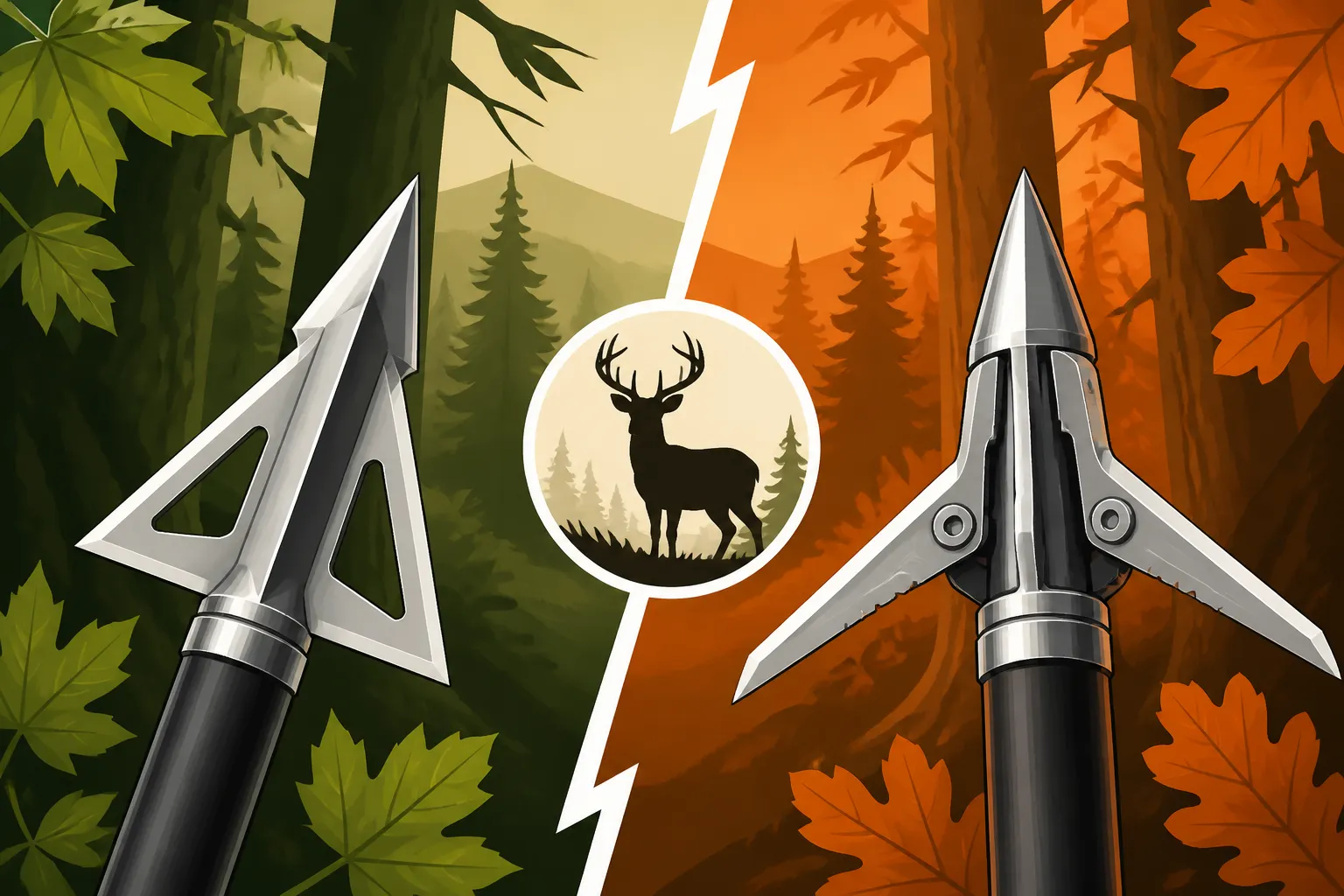
Fixed-blade broadheads are, in many ways, the traditional choice. They consist of a ferrule with blades that are permanently attached and don't move. Think of them as miniature, razor-sharp airplane wings designed to slice through flesh and bone. Their design is simple, robust, and has been proven effective for generations of bowhunters. They've put a lot of venison in freezers, and there's a certain comfort in that heritage.
In the thick cover of Vermont's forests, that simple, durable design can be a huge asset. These broadheads excel at maintaining their integrity when encountering unexpected resistance, whether that's a small twig you didn't see, heavy hide, or the shoulder bone of a mature whitetail. The blades are fixed, so there are no moving parts to fail or deploy incorrectly. This means that if your arrow hits something dense, the entire force of the shot is concentrated on driving those blades forward, maximizing penetration. For many, the confidence that comes from a broadhead that is essentially a miniature, sharpened spear is paramount. There’s no question about whether it will open, only whether you put it in the right spot.
However, fixed blades aren't without their quirks. Their larger blade surface area can sometimes act like a rudder in flight, especially with faster bows or arrows that aren't perfectly tuned. This can lead to broadhead planning, where the arrow deviates from its intended path. Achieving "field point accuracy" with fixed blades often requires meticulous bow tuning—paper tuning, bare shaft tuning, and a lot of practice shots to ensure your fixed blades fly precisely where your field points do. For a new hunter, or someone short on range time, this can feel like a steep learning curve. But for those willing to put in the effort, the reward is a highly reliable and incredibly deadly projectile.
Understanding Mechanical Broadheads
Mechanical broadheads, often called "expansibles," are a more modern innovation designed to address some of the flight challenges of fixed blades. Their key feature is that the blades are retracted or folded against the ferrule during flight, making them fly more like a field point. Upon impact, the blades deploy, typically through a spring mechanism or an O-ring system, expanding to create a much larger cutting diameter. This larger cutting diameter is a major draw for many hunters.
The primary appeal of mechanical broadheads, especially for those hunting in timber where shots can be tricky, is their advertised field-point accuracy. Because their profile is so small in flight, they are less susceptible to wind drift or planning issues. This means less time spent meticulously tuning your bow to achieve perfect broadhead flight, which can be a huge relief if your practice time is limited. Imagine sighting in your bow with field points and then being able to screw on a mechanical broadhead and expect the same point of impact – that’s the dream mechanicals sell, and often deliver, within reasonable distances. When you’re trying to thread an arrow through a small gap in the hardwoods, that consistent flight can give you a lot of confidence.
Yet, this innovative design introduces its own set of potential drawbacks. The very mechanism that makes them fly well can also be their Achilles' heel. Blade deployment must be flawless to ensure an ethical harvest. If a blade doesn't open fully, or opens prematurely due to glancing contact with a branch, the cutting diameter is compromised, and penetration can be severely reduced. While modern mechanicals are incredibly well-engineered, there's always a slight chance of failure, whether it's frozen blades in frigid late-season conditions or a bent blade from an imperfect shot. Furthermore, the energy required to deploy the blades and then push them through the animal means some energy is lost compared to a fixed blade, which can sometimes impact overall penetration, particularly on tougher angles or heavier bone.
Performance in Vermont's Varied Timber Conditions
Vermont's hunting landscape is a tapestry of dense softwood thickets, open hardwood ridges, beaver swamps, and the occasional clear-cut. Each of these environments presents unique challenges and considerations for broadhead performance. Your broadhead needs to be able to handle whatever it encounters, from a deer quartering away in a cedar swamp to a straight-on shot in a mature beech stand.
Navigating Thick Softwood and Hardwood
When you're still-hunting through a dense spruce plantation in the Northeast Kingdom or setting up a stand overlooking a tangled blowdown in the Green Mountains, your arrow is likely to encounter some kind of vegetation before it reaches its target. This is where the fixed-blade broadhead often shines. Its unyielding, sturdy construction means that if it clips a small twig or brush on the way to the deer, it's far less likely to be deflected significantly or suffer blade damage. The blades are fixed, designed to push through rather than fold or bend. This makes them a more forgiving option when you're shooting through tight windows or in areas where a clean shot path isn't absolutely guaranteed. This kind of resilience gives a hunter peace of mind in our unforgiving cover. Many seasoned Vermont hunters will tell you tales of fixed blades passing cleanly through incidental brush and still making a lethal hit.
On the flip side, mechanical broadheads, with their moving parts, can be more susceptible to deflection or premature deployment if they hit anything other than the animal directly. Imagine your arrow brushing a small maple branch as it leaves the bow, and one of your mechanical blades deploys prematurely. That can completely ruin the arrow's flight, sending it far off target. Even worse, if it deploys only partially, it creates an imbalanced arrow that will fly erratically. While manufacturers have made incredible strides in designing "fail-safe" mechanicals, the risk, however small, is still there. In thick timber, where shots often need to be threaded through tight gaps, this is a significant consideration. It forces you to be even more precise with your shot placement and to clear your shooting lanes meticulously, which isn't always possible when a buck suddenly appears.
Penetration and Blood Trails on Vermont Whitetails
Ultimately, the goal of any broadhead is to create a quick, ethical kill. This hinges on two critical factors: penetration and the resulting blood trail. Penetration is all about kinetic energy transfer and blade efficiency. A fixed-blade broadhead, with its stout, unwavering design, typically offers excellent penetration. Its blades start cutting immediately upon impact and continue to cut cleanly through hide, muscle, and even bone. The energy of the arrow is focused entirely on driving those blades forward, often resulting in two holes—an entrance and an exit—which is ideal for a good blood trail. When you're facing a tough angle or a deer that's particularly heavy-boned, a fixed blade often provides the confidence that it will power through. For instance, if you're Tracking a Deer in Fresh Green Mountain Snow, a consistent, deep blood trail is absolutely invaluable.
Mechanical broadheads aim for maximum cutting diameter to create larger wound channels and, theoretically, better blood trails. When they deploy perfectly, they can indeed leave a truly devastating wound. A wider cutting diameter means more tissue damage, which can lead to a more profuse blood trail, making recovery easier, especially if you're trying to Blood Trailing After Dark in Vermont. However, this comes with a caveat: the energy expended to deploy those blades and push a wider cut means there's less energy available for penetration. On marginal shots, or if you hit a shoulder blade, a mechanical might struggle to achieve the same deep penetration as a fixed blade, potentially resulting in a single entry wound without an exit. A single entry wound makes finding and following a blood trail infinitely more difficult, particularly in the leaf litter and diverse terrain we have here in Vermont. The trade-off between cutting diameter and penetration is a constant balancing act that every hunter must weigh based on their specific setup and hunting style.
Tuning Your Bow for Optimal Broadhead Flight
No matter which broadhead you choose, proper bow tuning is absolutely non-negotiable for consistent accuracy and ethical hunting. You can have the sharpest blades and the best intentions, but if your arrow isn't flying true, it's all for naught. This is one area where the two broadhead types often present different challenges and rewards for the dedicated bowhunter.
Achieving Field-Point Accuracy with Fixed Blades
For many fixed-blade users, the idea of "field-point accuracy" feels like the holy grail. It means your broadheads hit the exact same spot as your practice field points, which makes sight calibration straightforward and provides immense confidence. However, achieving this with fixed blades often demands a more rigorous tuning process. Because fixed blades have a larger surface area that interacts with the air during flight, any subtle inconsistencies in your bow's tune—like cam lean, tiller issues, or an imperfect nocking point—will be amplified. The broadhead essentially acts as a mini-rudder, and if it's steering the arrow, it won't fly straight.
The most common methods for tuning fixed blades involve paper tuning and bare shaft tuning. With paper tuning, you shoot an arrow through a piece of paper a few yards away, and the tear in the paper tells you how your arrow is flying. An imperfect tear indicates a tuning issue that needs to be corrected, often by adjusting the rest, nock point, or cam timing. Bare shaft tuning takes this a step further; you shoot an arrow without fletchings alongside a fletched arrow, and if they hit differently, you know there's a tuning problem. It's a meticulous process, often involving small adjustments and many test shots. It can be frustrating, no doubt, but mastering it means your fixed blades will slice through the air with precision, giving you maximum confidence when that deer walks by. This level of precision is why many serious bowhunters swear by fixed blades – they know that once tuned, they are incredibly reliable. Don't forget, resources like GoHunt offer a wealth of articles and videos on advanced tuning techniques that can really help you dial in your setup.
The "Easier" Tuning Myth for Mechanicals
Mechanical broadheads are often marketed with the promise of "field-point accuracy right out of the box" or "no tuning required." And for many hunters, especially those new to archery or with limited tuning experience, this is incredibly appealing. Because their blades are tucked away during flight, mechanicals genuinely do fly much closer to field points than many fixed blades, especially at longer distances or with less-than-perfect bow tunes. The reduced drag and minimized steering effect mean that your arrow is less likely to drift or "plane" away from its intended target, which can certainly make the initial setup feel much simpler.
However, calling it "no tuning required" is a bit of a myth, or at least an oversimplification. While mechanicals are more forgiving of minor tuning issues, your bow still needs to be properly tuned for optimal performance. An improperly tuned bow will still send any arrow, mechanical or fixed, inaccurately downrange, especially at longer distances. Furthermore, mechanical broadheads, particularly those with heavier ferrules or larger blade mechanisms, can subtly affect the arrow's front-of-center (FOC) balance. While it might not be as noticeable as broadhead planning from fixed blades, a significant shift in FOC can alter the arrow's trajectory and stability, particularly in windy conditions. So, while you might not spend hours paper tuning for perfect flight with mechanicals, it's still crucial to ensure your bow is shooting consistently and that your mechanical broadheads hit true with your field points. Don't skip the practice, and always verify your broadhead's flight before heading into the woods.
Durability, Reliability, and Ethical Harvest
When you're out in the Vermont woods, especially during the colder months, the gear you rely on needs to be robust and dependable. Broadheads are no exception. The integrity of your broadhead directly impacts its effectiveness and, ultimately, your ability to make a clean, ethical harvest. This isn't just about recovering an animal; it's about respecting the game and ensuring a humane end.
The Robustness of Fixed Blades
Fixed-blade broadheads are typically built like tanks. Their design inherently lends itself to durability, with blades that are either integrally machined into the ferrule or securely fastened with screws or rivets. Materials often include hardened steel or aircraft-grade aluminum for the ferrule and extremely sharp, durable stainless steel blades. This robust construction means that a fixed blade can withstand significant impact without deforming or failing. If you hit a rib, a shoulder blade, or even unexpectedly strike a small bone in the leg, a quality fixed blade is designed to drive through it, maintaining its shape and cutting integrity. This reliability is why many choose them for large game or for hunting situations where penetration through tough material is a real possibility.
Beyond their initial impact performance, many fixed-blade broadheads are designed to be reusable. After a successful hunt, you can often clean them thoroughly, inspect them for damage, and then re-sharpen the blades. This reusability not only makes them a more economical choice in the long run but also speaks to their inherent strength and longevity. A well-maintained fixed blade can serve a hunter for many seasons, providing a consistent and trusted tool. This is a significant advantage in Vermont, where a successful deer hunt might involve dragging an animal through rough terrain, and you want to know your gear stood up to the test.
Mechanical Blade Integrity and Deployment
The primary concern for many mechanical broadhead users revolves around blade integrity and, most critically, flawless deployment. While modern mechanicals have come a long way in terms of design and reliability, the fact remains that they have moving parts. There’s always a possibility, however slight, that these parts could malfunction. Issues can range from blades failing to deploy fully upon impact, premature deployment if the broadhead glances off a small branch, or blades becoming bent or broken during penetration. Imagine the frustration of making what you thought was a perfect shot, only to find the blades never opened, or only partially opened, resulting in a superficial wound and a lost animal.
Manufacturers mitigate these risks with advanced engineering, using strong materials, robust retention systems (like rubber bands, O-rings, or pivot pins), and precise tolerances. Quality mechanical broadheads undergo rigorous testing to ensure consistent deployment and blade integrity. However, factors like extreme cold (which can affect O-rings or spring mechanisms), impacts with dense bone, or even improper storage can potentially compromise their performance. An ethical hunter needs to be confident that their broadhead will perform as intended every single time. This means choosing reputable brands, inspecting your broadheads before each hunt, and understanding the specific mechanics of your chosen model. The ethical responsibility to ensure a quick, humane kill should always guide your broadhead selection. Field Dressing a Deer in Cold Weather is a tough enough job without compounding it with an animal that took too long to expire due to broadhead failure.
Personal Preference and Confidence in the Field
Ultimately, choosing between fixed and mechanical broadheads often boils down to what gives you the most confidence when you're perched in a treestand or still-hunting through the quiet Vermont woods. Your broadhead is the business end of your arrow, the final piece of the puzzle that converts kinetic energy into a lethal wound. Feeling absolutely certain in its performance is paramount to making a good shot.
Matching Broadhead to Hunting Style and Setup
Your personal hunting style and bow setup play a huge role in determining which broadhead will serve you best. Are you a high-draw-weight shooter with a heavy arrow, built for maximum penetration? A stout fixed blade might be your ideal match, leveraging your setup's power to drive through anything. If your bow is on the lighter side in terms of draw weight, or you shoot a lighter arrow, a mechanical broadhead with a wide cutting diameter might be appealing to maximize the wound channel, though you'll need to be extra cautious about shot placement to avoid heavy bone.
Consider your typical shot scenarios in Vermont. If you mostly hunt from a stand, in carefully prepared lanes, and at moderate distances, the field-point accuracy of a mechanical broadhead might give you an edge, reducing the stress of minute tuning adjustments. However, if you're frequently Still-Hunting Green Mountain National Forest Timber or trying to make quick, reactive shots in dense cover, the robust nature and minimal deflection risk of a fixed blade could be more beneficial. The broadhead you choose should complement your entire system, from your release to your arrow setup. Think about how you like to hunt, the conditions you typically face, and what makes you feel most prepared for that critical moment. Whether you're Hunting a Funnel Between Two Woodlots or Sitting a Field Edge in Late Season, your broadhead needs to perform.
The Role of Practice and Preparation
No matter what broadhead you ultimately select, nothing, and I mean nothing, replaces diligent practice and thorough preparation. You could have the most expensive, highly rated broadhead on the market, but if you haven't shot it extensively from your bow, under various conditions, you're setting yourself up for disappointment. Practice is where you build confidence. It's where you discover if your fixed blades truly fly like your field points, or if your mechanicals deploy consistently and accurately.
Set up a broadhead target and shoot your hunting arrows with your chosen broadheads. Don't just shoot a few; shoot dozens, at different distances, from different angles you might encounter in the woods. Pay attention to how they fly, how they group, and the sound and feel of the shot. If something feels off, address it immediately. This is also where you can utilize valuable resources like GoHunt. Their platform offers extensive gear reviews, user forums, and articles that can help you research different broadhead models, learn tuning tips, and see how other hunters are performing with various setups. This kind of thorough preparation ensures that when the moment of truth arrives, you're not second-guessing your gear, but instead focusing entirely on making the best possible shot.
Making Your Decision for Vermont's Woods
Choosing between fixed and mechanical broadheads isn't a decision to be taken lightly. It's deeply personal, influenced by your bow, your skill, your hunting style, and the terrain you'll be navigating here in Vermont. There's no single "best" answer, but rather an optimal choice for you.
Pros and Cons Summary Table
To help you weigh the factors we've discussed, here’s a quick comparison of the key characteristics of fixed and mechanical broadheads:
| Feature | Fixed-Blade Broadheads | Mechanical Broadheads |
|---|---|---|
| Accuracy | Requires meticulous tuning for field-point accuracy. | Generally offers field-point accuracy with less tuning. |
| Penetration | Excellent, maximizes energy transfer, robust design. | Good, but energy used for blade deployment, wider cut. |
| Durability | Very high, minimal moving parts, resilient to impacts. | Good, but relies on deployment mechanism integrity. |
| Cutting Diameter | Typically smaller, consistent. | Generally larger, designed for maximum wound channel. |
| Flight in Wind/Brush | More susceptible to planning/deflection if untuned, but can power through brush. | Less susceptible to planning; risk of premature deployment on brush. |
| Reliability | Extremely high; no moving parts to fail. | High, but relies on flawless blade deployment. |
| Cost | Often reusable (if re-sharpenable), varying initial cost. | Blades may need replacement; generally higher cost per shot. |
| Tuning Effort | Higher initial effort for perfect flight. | Lower initial effort, but still requires verification. |
Final Thoughts and Recommendations for Vermont Hunters
As you can see, both broadhead types have strong merits. For many seasoned Vermont hunters who often find themselves in situations requiring tough penetration—think heavy hides, cold weather, or shots through dense muscle and bone—the sheer reliability and deep-penetrating power of a well-tuned fixed-blade broadhead are hard to beat. If you're willing to put in the time at the range to get your bow dialed in for fixed blades, you'll be rewarded with incredible confidence in their performance. They are often the choice for those who pursue larger game or want maximum penetration on quartering-away deer in the deep woods of the Northeast Kingdom.
However, if you prioritize ease of tuning, crave the largest possible cutting diameter for blood trails, and primarily take shots in well-cleared lanes, a high-quality mechanical broadhead can be an excellent choice. Modern mechanicals are incredibly effective, and their field-point accuracy can be a significant advantage, especially if you're not a dedicated bow tuner. Just remember to choose a reputable brand with a proven track record for reliable deployment, and rigorously test them yourself before heading afield. When hunting Why the Rifle Season Runs Just Two Weeks or Hunting the Rut in Early-to-Mid November, you want every advantage you can get.
Ultimately, the "best" broadhead for Vermont hunting is the one that you have absolute confidence in. It's the one that flies true from your bow, the one you've practiced with extensively, and the one you trust to make a clean, ethical harvest. Whether it's a fixed blade or a mechanical, your proficiency and shot placement will always be the most critical factors. Take your time, do your research, try a few options, and most importantly, practice, practice, practice. To learn more about specific models, check out Best Broadhead for Vermont Whitetails.
Disclaimer
This article is for general informational purposes only and does not constitute professional advice. Laws, prices and regulations vary by location and change over time. Consult a qualified professional for guidance on your specific situation.