Rattling and Grunting Vermont Bucks
Oh, the age-old dilemma of rattling and grunting for Vermont bucks! Many of us have been there, sitting in a stand, wondering if we should blow that grunt tube or clash those antlers, only to hesitate and second-guess ourselves, often leaving with that familiar "what if" feeling. It's a tricky business trying to speak the deer's language, especially with our notoriously cagey Green Mountain whitetails. This guide is all about demystifying those vocalizations and teaching you how to effectively use rattling and grunting to bring those elusive Vermont bucks into range, transforming your uncertain calls into confident conversations.
Understanding the Language of Vermont Bucks
Before you even think about pulling out your grunt tube or rattling antlers, it's crucial to understand why bucks make these sounds. It's not just random noise; it's a sophisticated communication system, particularly during the intensity of the rut. Ignoring this fundamental understanding is like trying to speak French without learning the alphabet – you'll just make noise and likely scare off what you're trying to attract.
Why Bucks Rattle and Grunt
Rattling and grunting are primarily expressions of dominance, challenge, and attraction during the breeding season. Bucks don't just "talk" for fun; they communicate intent, establish hierarchy, and search for mates. Rattling, for instance, mimics the sound of two bucks fighting. This could be a light sparring match between younger deer, or a full-blown knockdown drag-out brawl between mature bucks vying for breeding rights. When a buck hears a fight, his natural instinct is to investigate. He might be a dominant buck looking to assert himself, a subordinate buck hoping to pick up a doe in the aftermath, or simply a curious younger deer. Understanding these motivations is key to deciding when and how to rattle.
Grunting, on the other hand, is a more varied and nuanced vocalization. A "grunt" can signify a buck asserting his presence, searching for does, or even expressing aggression. Think of it as the general conversational tone of a buck. It's less confrontational than rattling but equally important. A tending grunt, for example, is often emitted by a buck trailing a doe in heat, a soft, guttural sound that signals his presence and ownership. Other grunts, like a "snort-wheeze," are pure aggression, a warning to other bucks to back off. Knowing the difference and being able to replicate them accurately can be a game-changer when you're trying to entice a buck out of thick cover or stop one in his tracks.
Reading Deer Body Language
It's not enough to just make the sounds; you need to be able to interpret the buck's response. Vermont deer, especially those on public land that have encountered hunters before, are masters of subtlety. Their reactions might be tiny twitches of the ear, a slight head turn, or a stiffening of their posture. A buck that is interested might stop, raise his head, and slowly turn his ears toward the sound. If he's wary, he might stomp his foot, flick his tail nervously, or slowly slink away with his head low.
A buck that's truly committed to coming in will often approach cautiously, using cover, circling downwind, or stopping frequently to scan the area. Pay close attention to these cues. If a buck hears your rattling sequence and immediately puts his head down to feed, he's likely not interested or has decided it's not worth the risk. But if he lifts his head, stares intently in your direction, and takes a tentative step, you've got his attention. Often, a slow, deliberate walk with his head held high, ears swiveling, indicates he's on alert but curious. Being able to read these subtle cues allows you to adjust your calling strategy on the fly, deciding whether to call more aggressively, lighten up, or simply be patient.
The Rut's Influence on Vocalizations
The timing of the rut is everything when it comes to rattling and grunting for Vermont bucks. While a certain level of communication happens year-round, the intensity skyrockets during the breeding season. Early in the season, before the peak rut, bucks are often establishing dominance hierarchies. This is a great time for "social" rattling – light sparring sessions that mimic younger bucks. You might catch a curious two-year-old, but a mature, dominant buck is less likely to commit to a full-blown fight when the does aren't quite ready.
As the pre-rut kicks in, usually around late October into early November, the big boys start getting antsy. They're making scrapes, rubbing trees, and actively searching for the first does to come into estrus. This is when rattling can be incredibly effective, mimicking a serious fight that might draw in a territorial buck. During the peak of the rut, roughly from the first to third week of November in much of Vermont, bucks are often locked down with does or actively chasing them. During this intense period, a well-placed tending grunt can be irresistible, pulling a buck away from a hot doe, or prompting him to investigate a rival's presence. Later in the rut, as does become scarce, a more desperate, drawn-out grunt or even a combination of soft rattling and grunting can sometimes entice a buck still looking for a receptive doe. For more on this crucial period, check out our guide on "Hunting the Rut in Early-to-Mid November".
Essential Rattling Strategies for Vermont's Terrain
Rattling can be one of the most exciting and effective ways to call in a buck, but it's also one of the easiest to mess up. Vermont's diverse landscape, from the dense spruce thickets of the Northeast Kingdom to the rolling hardwoods of the Green Mountains, demands a thoughtful approach. You can't just crash antlers together indiscriminately and expect results.
Choosing Your Rattling Antlers or Call
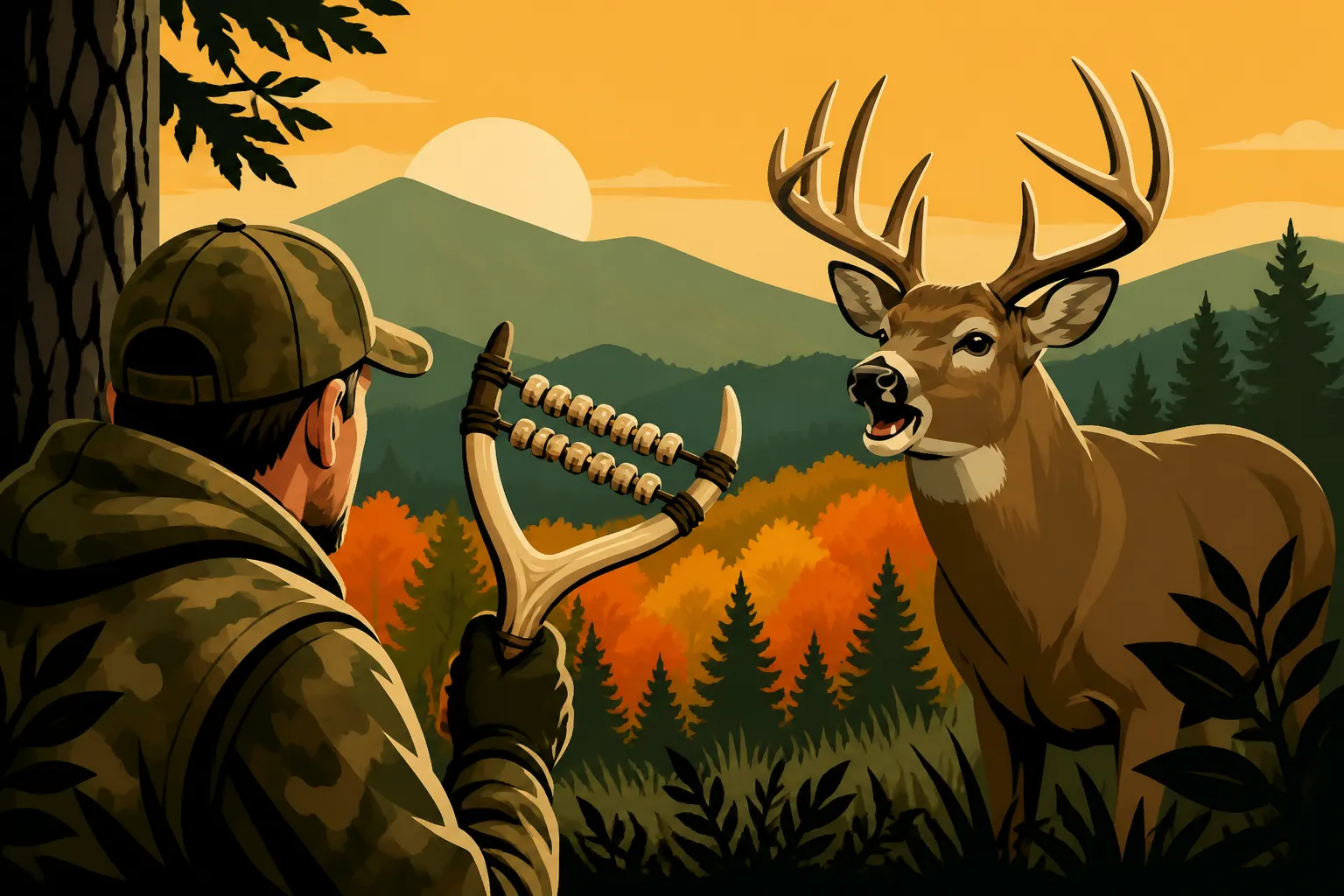
The market is flooded with rattling options, and each has its place. Real deer antlers, often shed antlers wired together, provide the most authentic sound. They can be bulky and noisy to carry, but they offer unparalleled realism in the timber. When clashing real antlers, you can replicate everything from the loud, sharp crack of tines hitting together to the more subtle grinding and raking sounds of bodies pushing.
Synthetic rattling bags or compact rattling calls are much more portable and quieter to carry to your stand. Brands like rattling bag options often produce surprisingly realistic sounds, especially in moderate wind or when you need to be discreet. The key is to practice with whatever you choose. Don't just rely on the sound it makes in your living room; take it outside and listen to how the sound carries and dissipates in different environments. Some calls excel at projecting sound across open fields, while others are better for simulating a subtle sparring match in thick brush. Consider also the size of the antlers you're imitating; larger antlers make a deeper, more resonant sound, suggesting a bigger, more dominant buck fight.
Mimicking Different Fight Scenarios
There isn't a single "right" way to rattle; you need to be versatile. A full-blown, aggressive battle sequence is often what people imagine, and it can be effective during the pre-rut or peak rut when bucks are feeling territorial. This involves loud crashing, grinding, and raking brush, lasting for 30-60 seconds, followed by a period of absolute silence. But don't underestimate the power of subtle rattling. Sometimes, a series of light clicks and clacks, mimicking two young bucks sparring, can draw in a curious, less dominant buck who might be intimidated by a loud, intense fight.
Consider the time of day and the specific rut phase. In the early pre-rut, a light sparring session might be more appropriate. During the peak of the rut, when competition is fiercest, a more aggressive fight sequence often gets a better reaction. Always incorporate realistic pauses. Bucks don't fight continuously; there are moments of pushing, shoving, and then backing off to catch their breath. Mimic these natural lulls, remaining absolutely still and scanning for movement during the silence. Sometimes the buck will come in during these quiet moments, expecting to see the fight still underway.
Adapting to Thick Cover and Openings
Vermont is renowned for its diverse terrain, from vast open hardwood ridges to incredibly dense softwood thickets and swamps. Your rattling approach needs to adapt to these environments. In thick cover, like the spruce-fir forests of the Northeast Kingdom or dense regenerating clear-cuts, sound doesn't travel far. Here, you need to call more frequently and more aggressively, but with less volume. The goal is to create a realistic, close-quarters fight that a buck nearby can't ignore. For some insight into calling in dense cover, read "Rattling Volume in Thick Softwood Cover". You're trying to convince him there's a fight happening just out of sight.
Conversely, in more open hardwood forests, like those often found higher up in the Green Mountains, sound carries much further. Here, you can afford to use more volume, but less frequency. A loud, drawn-out crash might travel 300-400 yards, giving a buck ample time to respond. However, be cautious not to overdo it, as an unnaturally loud or repetitive sequence can make even distant bucks wary. Always consider the wind. A stiff breeze can carry your sound a long way, but it can also carry your scent. Set up so that any buck coming to the sound will have to cross an area where you have the wind advantage. Scouting tools like GoHunt can be invaluable for analyzing topography and wind patterns, helping you choose the best calling locations.
Mastering Grunt Calls for Green Mountain Whitetails
While rattling often grabs immediate attention, grunting is the finesse play, the subtle persuasion that can seal the deal. Learning to speak the language of grunts is crucial for any serious Vermont deer hunter.
Types of Grunts and Their Meanings
Grunt calls are incredibly versatile and mimic a wide range of deer vocalizations. The most common is the basic "buck grunt," a short, guttural sound that signals a buck's presence and curiosity. This is often used to stop a walking buck or to draw in one that's out of sight but within hearing range. If you hear a distant deer, a simple buck grunt can sometimes get him to pause, giving you a chance to pinpoint his location or draw him closer.
Then there's the "tending grunt," a series of softer, more drawn-out grunts, often punctuated by light breathing sounds, that a buck makes when he's trailing a doe in estrus. This sound indicates a hot doe is nearby and can be incredibly effective at drawing in other bucks looking for love. Imagine a dominant buck tending a doe; other bucks hear this and know there's a potential breeding opportunity. Another aggressive call is the "snort-wheeze," a distinct sound of air being forced through the nostrils, often followed by a wheeze. This is a challenge, an expression of dominance, and should only be used if you're targeting a mature, aggressive buck and are ready for him to come in ready for a fight. Using it on a young buck or at the wrong time can easily scare them away. For more on this, our article on "Grunt Calls in Mature Vermont Hardwoods" delves deeper into these specific vocalizations.
Timing Your Grunt Sequences
Just like rattling, timing is critical for grunting. Early season, a few soft buck grunts can sometimes pique the curiosity of a younger buck, but generally, grunting becomes far more effective as the rut approaches and throughout its peak. During the pre-rut, a buck grunt can be used to stop a deer that's cruising or to make a buck that's already on the move alter his course towards you.
During the peak rut, tending grunts and even snort-wheezes become much more potent. When a buck is locked down with a doe, a tending grunt can imitate a rival buck trying to cut in, drawing the dominant buck away from his doe. If you see a buck actively chasing a doe, a quick series of tending grunts can sometimes stop the doe, which in turn might stop the buck in his tracks, giving you a shot. After a rattling sequence, a few soft buck grunts can simulate a buck standing around after a fight, further enticing a hesitant buck to investigate. Always remember to allow ample time after a calling sequence for a buck to respond, as they often approach slowly and cautiously.
Calling to Different Age Classes of Bucks
The way you grunt should change depending on the buck you're trying to attract. Younger bucks are generally more curious and less wary. A simple, medium-pitched buck grunt might be enough to draw them in. They're often looking to learn, to see what other bucks are doing. They might be drawn to a fight or a hot doe simply out of curiosity or a desire to get in on the action.
Mature, dominant bucks are a different breed. They've heard it all, and they're often more cautious and strategic. To call in a big, old Green Mountain bruiser, you might need a deeper, more guttural grunt that mimics a larger, more dominant deer. A snort-wheeze, used sparingly and confidently, can challenge a mature buck to come investigate. When a big buck hears a challenge, especially when he's actively seeking does, his territorial instincts kick in. However, if he's already tending a hot doe, a more subtle tending grunt might be more effective in drawing him away, as it sounds less like a direct threat and more like an opportunity. Understanding the nuanced differences in calls and how they relate to the buck's age and current behavior is a game of chess, not checkers.
Integrating Rattling and Grunting into Your Hunt Plan
Successful calling isn't just about making sounds; it's about integrating those sounds into a broader hunting strategy. It means careful planning, strategic setup, and knowing when to be aggressive and when to be subtle. Just like you wouldn't just wander into the woods without understanding "Scouting Vermont Public Land Before Season", you shouldn't call without a plan.
Scouting for Optimal Calling Locations
The best calls in the world won't work if you're in the wrong spot. Ideal calling locations are often natural funnels, pinch points, or areas of transition where deer naturally travel. Think about logging road intersections, saddles between ridges, creek bottoms, or the edges of dense bedding areas. These are places where a buck is already likely to be moving, increasing your chances of him hearing your call. Using tools like GoHunt to analyze topographical maps and satellite imagery can help identify these prime locations before you even step foot in the woods. Look for areas where the wind is consistent, allowing you to set up for a shot while keeping your scent out of the deer's approach path.
Another crucial aspect is visibility. You need to be able to see a buck coming, but also have enough cover to break up your silhouette. Setting up near a thicket, a cluster of cedars, or a blowdown can provide the visual break you need. Consider where a buck might approach from, often circling downwind to scent-check the area before committing. Plan your setup accordingly, ensuring you have clear shooting lanes in his likely approach corridors. Our article on "Hunting a Ridge-Top Saddle for Rutting Bucks" offers more insights into finding these high-traffic areas.
Combining Calls with Decoys and Scents
Rattling and grunting become even more potent when combined with other tactics. Decoys add a visual element that can be incredibly convincing, especially if you're mimicking a fight. A buck decoy, especially a posturing or sparring one, placed strategically downwind from your calling position, can draw a buck right into shooting range. He sees what he hears, validating the sounds you're making. Just be sure to place the decoy where an approaching buck will see it and focus on it, rather than on your position.
Similarly, deer scents can play a vital role. Using dominant buck urine or estrus doe scent in conjunction with your calls can heighten the realism. A few drops of estrus doe scent near your decoy, or on a scent wick hung strategically, can smell like the prize a buck is fighting for or a doe a buck is tending. However, always be mindful of Vermont's CWD prevention rules, which include a ban on natural deer urine-based lures. Synthetic lures are readily available and equally effective without the risk. The goal is to create a complete sensory experience: sight, sound, and smell, all working together to convince that buck to commit.
Setting Up for Success After a Call Sequence
Making the call is only half the battle; the other half is being ready when the buck responds. After a rattling or grunting sequence, immediately become motionless and scan the area intently. Bucks rarely come charging in; they typically approach cautiously, using every bit of available cover. They might stop, stare, and listen for several minutes before taking another step.
Your setup needs to account for this cautious approach. Choose a stand location or ground blind (if you're using a ground blind on public land) that offers both concealment and good visibility. Be aware of your shooting lanes. If a buck comes in silently or circles downwind, you need to be prepared to take a shot quickly and accurately. Have your bow or rifle ready, your release clipped on, or your safety off. Often, a buck will hang up just out of range, trying to pinpoint the source of the sound. This is where patience is key. Sometimes a very soft, subtle grunt or a light rattle can coax him those last few yards. A well-placed shooting lane might be the difference between a successful hunt and a missed opportunity when that buck finally steps into view.
Common Mistakes and How to Avoid Them
Even seasoned hunters can make mistakes when rattling and grunting. Vermont bucks are notoriously smart, and they’ve learned to be wary of anything that sounds unnatural or too good to be true. Avoiding these common pitfalls can significantly increase your success rate.
Over-Calling and Under-Calling
One of the biggest mistakes hunters make is either calling too much or not enough. Over-calling can sound unnatural and scare bucks away. Imagine two bucks fighting non-stop for five minutes; it just doesn't happen. A short, intense rattling sequence (30-60 seconds) followed by a long period of silence (5-15 minutes) is often more effective. This gives any approaching buck time to move in and gives you time to scan for movement. If nothing responds after 15-20 minutes, then consider another sequence. The silence is just as important as the sound, allowing the illusion to sink in and encouraging cautious investigation.
On the flip side, under-calling is also an issue. If you only rattle once or twice softly and then pack it up, you might not have given a distant buck enough time or motivation to respond. Sometimes, it takes a few sequences over an extended period to finally draw a buck out. The key is to find that balance, adapting your frequency and intensity to the specific situation and the deer behavior you're observing. If you're in prime rutting territory and haven't seen any deer for a while, a more aggressive calling approach might be warranted. If you're seeing cautious deer movement, a more subtle approach might be better.
Ignoring Wind and Thermals
This cannot be stressed enough: ignoring wind direction and thermals is a fatal mistake in calling. Bucks, especially mature ones, will almost always circle downwind of a sound to scent-check the area before exposing themselves. If your scent cone blows directly into where a buck is approaching from, he'll smell you long before you see him, and he'll be gone. Always position yourself so that your scent is blowing away from the likely approach path of the deer you're trying to call.
In Vermont's steep Green Mountain terrain, thermals play a massive role, especially in the mornings and evenings. As the sun rises, thermals typically draw scent uphill; as it sets, they pull scent downhill. This means a stand location that's perfect in the morning might be terrible in the afternoon. Always check the wind direction and consider the thermal currents before you start calling. Many hunters use a wind checker to observe wind currents throughout their hunt. For more detailed advice on this, our article on "Wind and Thermals in Steep Green Mountain Terrain" is a must-read.
Sounding Unnatural or Rushed
Practice, practice, practice! An unnatural-sounding call is often worse than no call at all. If your rattling sounds like two branches clanking together, or your grunt sounds more like a cough, a savvy buck will instantly peg it as fake. Listen to real deer vocalizations online or from reliable calls, and try to mimic them as closely as possible. Pay attention to the cadence, the intensity, and the duration.
Similarly, don't rush your sequences. Give the illusion that a real fight or conversation is taking place. Incorporate pauses, slight movements of the antlers, and varying intensity. After a sequence, remain absolutely silent and still. A buck might approach cautiously and expect to see deer. If he sees you fidgeting or calling again too quickly, the illusion is broken. Patience and realism are your best friends when trying to fool a wise old Vermont buck.
Advanced Tactics for Pressured Vermont Bucks
Calling in a buck is already a challenge, but calling in a pressured Vermont buck? That's next-level hunting. These deer have encountered hunters before, they're wary, and they've learned to associate certain sounds with danger. But with a few advanced tactics, you can still draw them in.
Soft Calling and Subtlety
When hunting heavily pressured areas, often found on popular public land, less is often more. Forget the aggressive, loud rattling sequences that work on unpressured deer. Instead, opt for soft, subtle calls. A few light clicks of antlers, mimicking two small bucks sparring, or a single soft buck grunt can sometimes pique a curious buck's interest without raising his alarm bells.
These subtle sounds don't travel far, so you need to be in an area where you know deer are already close by, perhaps in a bedding area or a feeding corridor. The idea is to make the buck think he's hearing natural deer activity just out of sight, rather than an obvious challenge. Follow up soft rattling with a single, soft tending grunt. This mimics a buck trailing a doe, a sound that can be hard for a rut-crazed buck to ignore, even if he's wary. Sometimes, a deer that wouldn't respond to a loud, aggressive call will investigate a quieter, more natural-sounding scenario.
Creative Calling Scenarios
Don't be afraid to think outside the box. Instead of always mimicking a buck fight, consider other scenarios. For example, if you're in an area where you know there are scrapes, try raking the ground vigorously with a stick, mimicking a buck making a fresh scrape, and then follow it up with a few soft grunts. This creates the impression of a buck working a scrape, a powerful attractant during the pre-rut.
Another creative tactic, especially effective during the peak rut, is to use doe bleats or estrus bleats in conjunction with your buck calls. A doe bleat, especially an estrus bleat, signals a receptive doe. Follow that up with a buck grunt or light rattling, and you create a scenario where a buck is with a hot doe, or fighting over one. This can be irresistible to a cruising buck. Remember, the goal is to paint a complete picture in the buck's mind, not just make noise. Using tools like GoHunt to analyze historical deer movement and popular areas can help you identify unique calling opportunities that others might overlook.
Post-Call Patience and Observation
This is where many hunters fail, especially with pressured deer. After any calling sequence, whether soft or aggressive, commit to remaining absolutely silent and still for a minimum of 15-20 minutes, sometimes even longer. Pressured bucks are incredibly cautious. They rarely come running in. They will often circle far downwind, take their time, and approach very slowly, using every piece of cover.
During this waiting period, your eyes and ears are your most important tools. Scan every inch of cover, especially downwind. Look for flicking ears, a slight movement in the brush, or a horizontal line that doesn't belong. A buck might appear from seemingly nowhere, having used the landscape to conceal his approach. If you fidget, check your phone, or move too soon, you'll blow your chance. This intense period of observation is crucial; it's when the magic often happens. Be ready for a shot at any moment, as a wary buck might only offer a brief window of opportunity before vanishing back into the Green Mountain timber.
| Grunt Type | Sound Description | Best Use Case | Rut Phase Effectiveness | Typical Buck Response |
|---|---|---|---|---|
| Buck Grunt | Short, guttural "errrp" | Stopping cruising deer, drawing curiosity | Pre-rut, Peak rut, Post-rut | Stops, turns head, slow approach |
| Tending Grunt | Softer, longer "urr-urr-urr" with pauses | Mimicking buck trailing a hot doe, enticing rivals | Peak rut | Cautious approach, seeks doe |
| Snort-Wheeze | Exhale with whistle, then sharp "pffft" | Challenging dominant bucks, aggressive | Peak rut | Aggressive approach, cautious challenge |
| Doe Bleat | High-pitched "maaaah" | Attracting does, drawing bucks looking for does | Pre-rut, Peak rut | Attracts both sexes, bucks seek doe |
| Estrus Bleat | Longer, drawn-out "maaaah-aaaaah" | Mimicking a doe in heat, highly attractive to bucks | Peak rut | Strong draw for bucks, often fast approach |
Disclaimer
Hunting is an inherently dangerous activity. Always prioritize safety, follow all Vermont Fish and Wildlife Department regulations, and obtain proper licenses and permits. The information provided here is for educational and informational purposes only and should not be taken as an endorsement of unsafe practices. Ensure you are familiar with your equipment and local hunting laws before entering the field.