Best Camo for Softwood Cover
It's a familiar scenario for many of us who hunt Vermont: you're easing through a dense stand of spruce or fir, convinced you're practically invisible, only to have a whitetail snort and bust out of a thicket just yards away. The truth is, while any camo is better than none, not all patterns are created equal, especially when you're deep in the unique, shadowed world of Vermont's softwood cover. This guide is all about helping you understand the distinct visual challenges these environments present and how to choose the best camouflage to truly disappear into their dark, tangled embrace.
Understanding Softwood Environments in Vermont
Hunting in Vermont means encountering a diverse landscape, from sprawling hardwood ridges to open agricultural fields. But for many of us, the real magic, and often the biggest challenge, lies in those dense stands of conifers. Whether you're stalking deer in a hemlock bottom along the Missisquoi River or still-hunting black bear through a spruce swamp in the Northeast Kingdom, the visual characteristics of these areas are vastly different from the more open woods.
The Visual Characteristics of Vermont Softwoods
When you step into a mature softwood stand in Vermont, the first thing that hits you is often the profound difference in light and color. We’re talking about a palette dominated by deep, often dark, greens that can appear almost black in shadow, punctuated by rich, dark browns of trunks and fallen needles. The ground, especially in older stands, is a carpet of deep, russet-colored needles, often damp and shadowed. Think of those towering white pines, fragrant balsam firs, and tight-knit red spruce thickets that seem to swallow sound and light. These environments aren't just green; they're a mosaic of muted, almost monochromatic hues, with very little bright contrast. The branches are typically dense, creating a heavy canopy that filters sunlight into a diffused, dappled pattern, if it penetrates at all. This creates a very different backdrop for concealment than, say, a sunlit maple ridge in October.
How Light Interacts with Conifer Canopies
The way light behaves in a softwood forest is crucial to understanding effective camouflage. Unlike the ever-changing, vibrant greens and yellows of hardwoods in spring, or the bright golds and reds of fall, softwood canopies create a world of deep, consistent shadows. Direct sunlight rarely penetrates to the forest floor in any significant patches. Instead, you'll find soft, ambient light filtering through the needle-laden branches, creating a mostly subdued and often dim environment. This means that patterns with lots of bright, open spaces or light-colored elements that might work in a more open, sun-drenched hardwood forest will stick out like a sore thumb here. The goal isn't to mimic bright sunlight and vivid leaves; it's to blend into perpetual twilight and the uniform darkness of dense needles. If you're going to be Still-Hunting Green Mountain National Forest Timber, you'll notice this light dynamic immediately, and it will inform how you move and what you wear. The deep shadows dictate that your camo should lean heavily into dark, muted tones to avoid any reflective glint or stark contrast against the natural gloom.
Key Camo Principles for Softwood Cover
So, if softwoods are all about deep greens, dark browns, and muted light, what does that mean for your choice of camouflage? It means shifting your mindset away from universal patterns and towards something more specialized. We're looking for patterns that don't just mimic a leaf or a branch but truly break up your outline in a shadowy, vertical, and often uniform environment.
Prioritizing Darker Tones and High Contrast
The biggest mistake many hunters make when heading into softwood is wearing patterns designed for open hardwoods or agricultural fields. These often feature lighter browns, grays, and open spaces that are completely out of place in a dense conifer stand. For Vermont's softwoods, you need to prioritize darker tones. Think charcoal grays, deep forest greens, rich espresso browns, and even hints of black to mimic the deep shadows. But it's not just about being dark; it's about breaking up your outline with high contrast within those darker tones. The contrast shouldn't be bright against dark, but rather dark against even darker, creating irregular shapes and patterns that fool the eye. A pattern that looks good on the rack might not cut it when you're trying to hide from a keen-eyed buck in a dark hemlock thicket. Your goal is to melt into the visual clutter, not become a distinct silhouette. This is especially true when you're nestled into a thicket, trying to remain undetected while Reading a Green Mountain Deer Yard.
Many of the so-called "universal" patterns, while versatile, can sometimes fail in the extreme low-light and uniform texture of softwood. They might have too much light-colored background or too many distinct, recognizable shapes that don't quite match the evergreen needles and bark. Instead, focus on patterns that utilize larger, irregular shapes that blend seamlessly into each other, creating depth and shadow rather than distinct, flat images. The human form is naturally blocky and symmetrical; effective softwood camo needs to make you appear as anything but. This disruption of the human outline is paramount.
The Role of Vertical and Irregular Patterns
Consider the visual environment of a softwood stand. You have numerous vertical elements: tree trunks, the upright growth of young trees, and the long, downward-casting shadows. Therefore, a camo pattern that incorporates vertical or highly irregular, amorphous elements can be incredibly effective. Patterns that mimic the streaks of bark, the dappled shadow of dense needles, or the random tangle of fallen branches will serve you well. Avoid anything that looks too horizontal or too orderly. Nature is rarely perfectly symmetrical, and your camo shouldn't be either.
The goal is to avoid the "blob effect." This happens when a camo pattern, despite its colors, creates a uniform mass that still looks like a solid object to an animal. Irregular, broken patterns, especially those with some vertical flow, disrupt that perception. Think about how a deer's eye perceives movement or an unusual shape against the natural backdrop. They're not looking for perfect leaf reproductions; they're looking for anything that breaks the natural flow of the forest. Patterns that feature stark, angular shapes that don't quite match the soft, rounded textures of conifer needles might not be as effective as those with more fluid, organic, and irregular forms. This is a subtle but important distinction that can make or break your concealment, particularly if you're executing a Cold-Weather Sitting Strategy in the Northeast Kingdom and need to remain motionless and undetected for extended periods.
Top Camo Patterns Suited for Vermont Softwoods
Now that we understand the visual demands of Vermont's softwood environments, let's talk about the types of patterns that really shine when you're deep in the pines, spruces, or hemlocks. It's not about brand names as much as it is about the underlying design philosophy that matches these unique conditions.
Patterns Excelling in Dense Conifer Stands
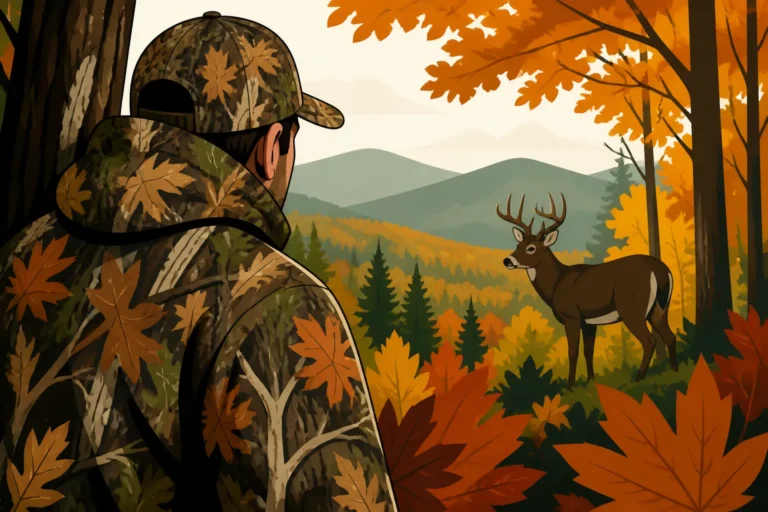
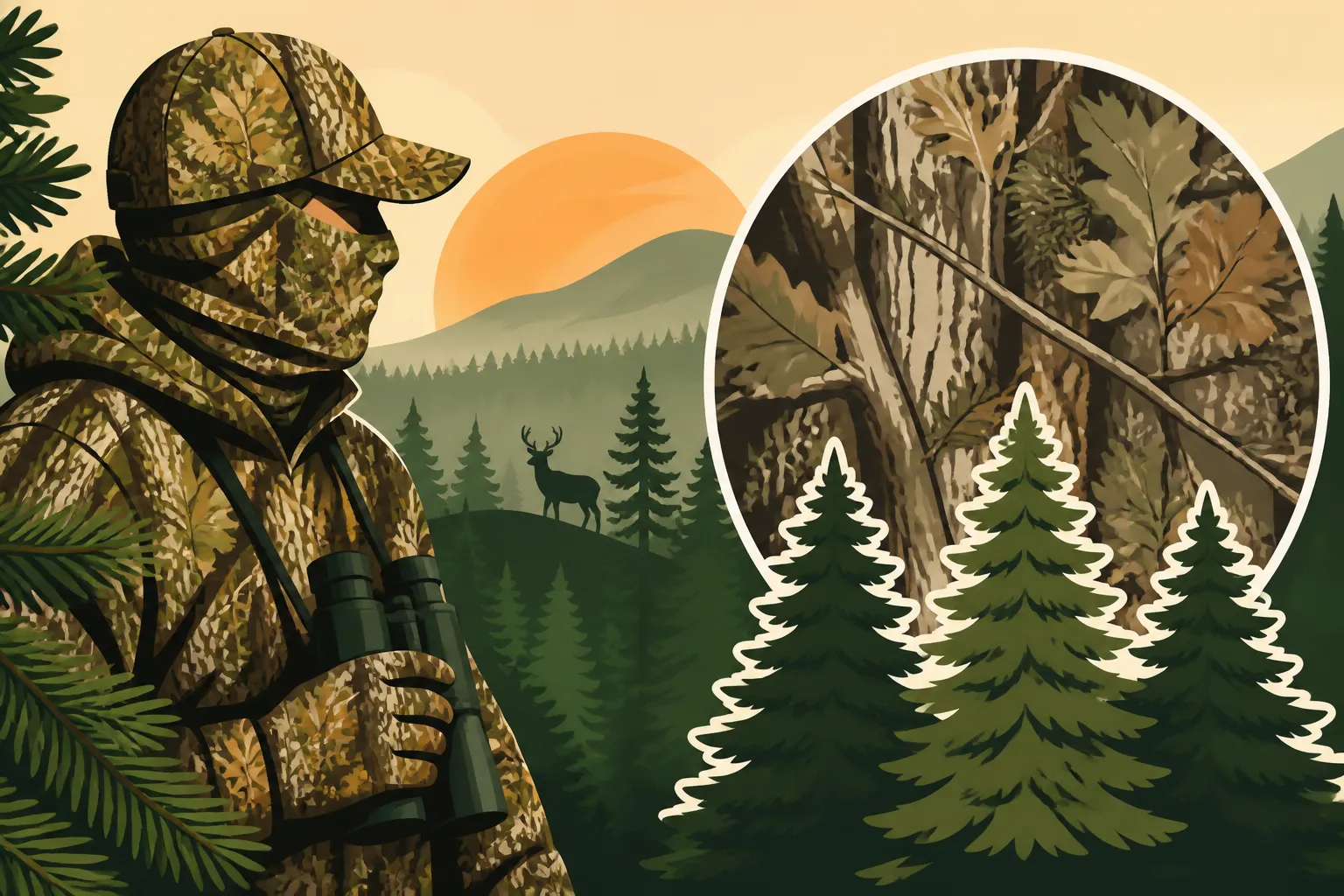
The best camouflage for dense conifer stands in Vermont will typically feature a heavy reliance on dark greens, deep browns, and black. Look for patterns with high-contrast, yet muted, shadow elements that create an illusion of depth and irregularity. Some patterns specifically designed as "deep forest" or "dark timber" variations often hit the mark. These designs tend to incorporate vertical tree bark elements, dark amorphous shapes, and subtle hints of green needles or moss, all against a dark, shadowy background. They avoid large patches of light color or bright, highly defined leaves that would instantly stand out.
Think about the feeling of being in a tight spruce thicket: it's dark, confined, and often visually chaotic with tangled branches and dense growth. Your camo needs to mirror that chaos, making your outline disappear into the layers of shadow and form. Patterns that focus on breaking up the human silhouette with large, indistinct shapes rather than trying to replicate individual leaves or branches are often superior. When you're researching options, it can be really helpful to look at reviews and photos of hunters actually in softwood environments. Sometimes, what looks great in a studio shot doesn't perform in the real world. A platform like GoHunt can be a fantastic resource here, as they often have user-submitted photos or detailed pattern breakdowns that help visualize how a pattern blends into different terrains. This kind of research can save you from a pattern that promises versatility but delivers poor concealment in the specific, dark conditions of a Vermont conifer stand.
Adapting to Mixed Conifer and Hardwood Edges
While it's ideal to have specialized camo, many hunts in Vermont will inevitably involve transitioning between softwood and hardwood. Maybe you're Hunting a Funnel Between Two Woodlots, one a dense cedar swamp and the other a mature oak flat. In these scenarios, versatility is key, but you should still lean towards patterns that prioritize the darker, more shadowed elements. Look for transitional patterns that still maintain a strong base of dark greens and browns but might incorporate some more varied bark textures or muted branch patterns that can perform adequately in slightly more open hardwood areas.
The trick is to find a pattern that doesn't completely abandon the principles of softwood concealment but offers just enough variety to avoid being glaringly obvious in hardwoods. This usually means avoiding the brightest, most vibrant "hardwood" patterns and instead opting for something that acts as a darker, more neutral bridge between the two environments. Some manufacturers offer "transitional forest" or "all-terrain dark" options that are designed for this very purpose. These patterns will typically have a greater mix of greens, browns, and grays, but with an overall darker tonal value than patterns purely for open hardwoods. They provide a decent compromise, ensuring you're not entirely exposed when you step out of the dense evergreens. Remember, being overly camouflaged for one environment is usually less detrimental than being under-camouflaged for another.
Practical Considerations for Softwood Camo in Vermont
Beyond the pattern itself, there are several other practical aspects to consider when selecting and utilizing camouflage for Vermont's softwood cover. The best pattern in the world won't do much good if it's noisy, uncomfortable, or leaves obvious gaps in your concealment.
Layering and Material Choices
Vermont hunting, especially when you're in the deep woods, demands smart layering. Softwood stands can feel much colder and damp, holding onto moisture and blocking sunlight. This means your camo system needs to accommodate warm base layers and insulating mid-layers underneath. The outer shell, your actual camo pattern, needs to be durable enough to withstand pushing through thick branches and quiet enough not to alert game. Fabric noise is a huge factor here. A pattern might look perfect, but if the material swishes and rustles every time you take a step or raise your bow, it's a non-starter. Look for quiet fabrics like brushed fleece, soft shell materials, or quiet blends that won't give you away. This is particularly important if you're trying to move stealthily.
Furthermore, consider the texture of the material itself. A rough, noisy fabric can snag on spruce needles, creating unwanted sounds and potentially leaving behind fabric fibers. Smooth, quiet, and somewhat snag-resistant materials are preferable. When you're wearing multiple layers, ensure that your outermost camo layer fits well enough that it doesn't bunch up awkwardly, creating unnatural shapes, but is loose enough to allow full range of motion. Finding the right balance between warmth, quietness, and durability within your Layering for Vermont's Long Hunting Season can be a game-changer when you're spending hours in those dense, dark woods. The texture of your garment can also enhance or detract from the pattern – a fuzzy fleece can soften hard lines, while a shiny rain shell can reflect light, ruining the effect of the best pattern.
| Camo Feature | Ideal for Softwood Cover | Less Ideal for Softwood Cover |
|---|---|---|
| Primary Colors | Deep Greens, Dark Browns, Black, Charcoal | Light Greens, Tans, Light Grays, Bright Earth Tones |
| Pattern Tone | Dark, Muted, Shadowy | Bright, High-Contrast (light vs. dark) |
| Pattern Shapes | Irregular, Amorphous, Vertical Elements | Horizontal, Uniform, Distinct Leaf/Branch Images |
| Contrast Level | High contrast within dark tones | High contrast with light background |
| Depth Illusion | Strong sense of layers and shadows | Flat, two-dimensional appearance |
| Material Noise | Very quiet, brushed, soft-shell | Crinkly, noisy, stiff fabrics |
| Movement | Blends with vertical lines of trees | Creates distinct blob or silhouette |
Accessorizing Your Softwood Camo
Your camouflage system isn't complete without addressing all visible skin and gear. A fantastic camo jacket means little if your face is bare and shining, or your hands are a stark white against a dark background. Face masks, gloves, and even camo paint or stick are essential for breaking up the discernible human shape. Choose a face mask in a pattern or solid color that matches your primary camo – again, darker greens, browns, and blacks. Gloves should also be in a matching pattern and ideally be thin enough to maintain dexterity but warm enough for the conditions. Don't forget the small details, like boot laces or boot covers, especially if your boots are a bright, contrasting color. You want to present an unbroken, irregular visual mass to the animal.
Even your accessories need to be considered. Your binoculars, rangefinder, and even your bow or rifle can glint or stand out. Many hunters apply camo tape to their equipment or use matte finishes to eliminate shine. Carrying a pack? Ensure it's also camouflaged or covered in a material that blends in. Every exposed surface is an opportunity for a deer's keen eyesight to pick you out. Using a mapping app like GoHunt on your phone, while incredibly useful for navigation and Scouting With the Vermont Fish and Wildlife App, should be done with care to minimize screen light, especially in low-light conditions when deep in softwood. By thinking through every element of your gear and making sure it contributes to your overall concealment, you significantly increase your chances of success in the dark, dense world of Vermont's softwood forests.
Disclaimer
This article is for general informational purposes only and does not constitute professional advice. Laws, prices and regulations vary by location and change over time. Consult a qualified professional for guidance on your specific situation.