Choosing a Rifle Twist Rate for Timber Shots
Hunting in Vermont’s dense timber can be a truly rewarding experience, but it also presents its own unique set of challenges. One of the less-talked-about, yet incredibly crucial, decisions you’ll face when setting up your rifle for these conditions is choosing the right barrel twist rate. Many of us focus on caliber or bullet weight, only to find our accuracy lacking when those tight, quick shots present themselves in the woods. This guide aims to demystify rifle twist rates and help you select the ideal setup for success in Vermont's thickest cover.
The Basics of Rifle Barrel Twist Rate: What It Means for Your Shot
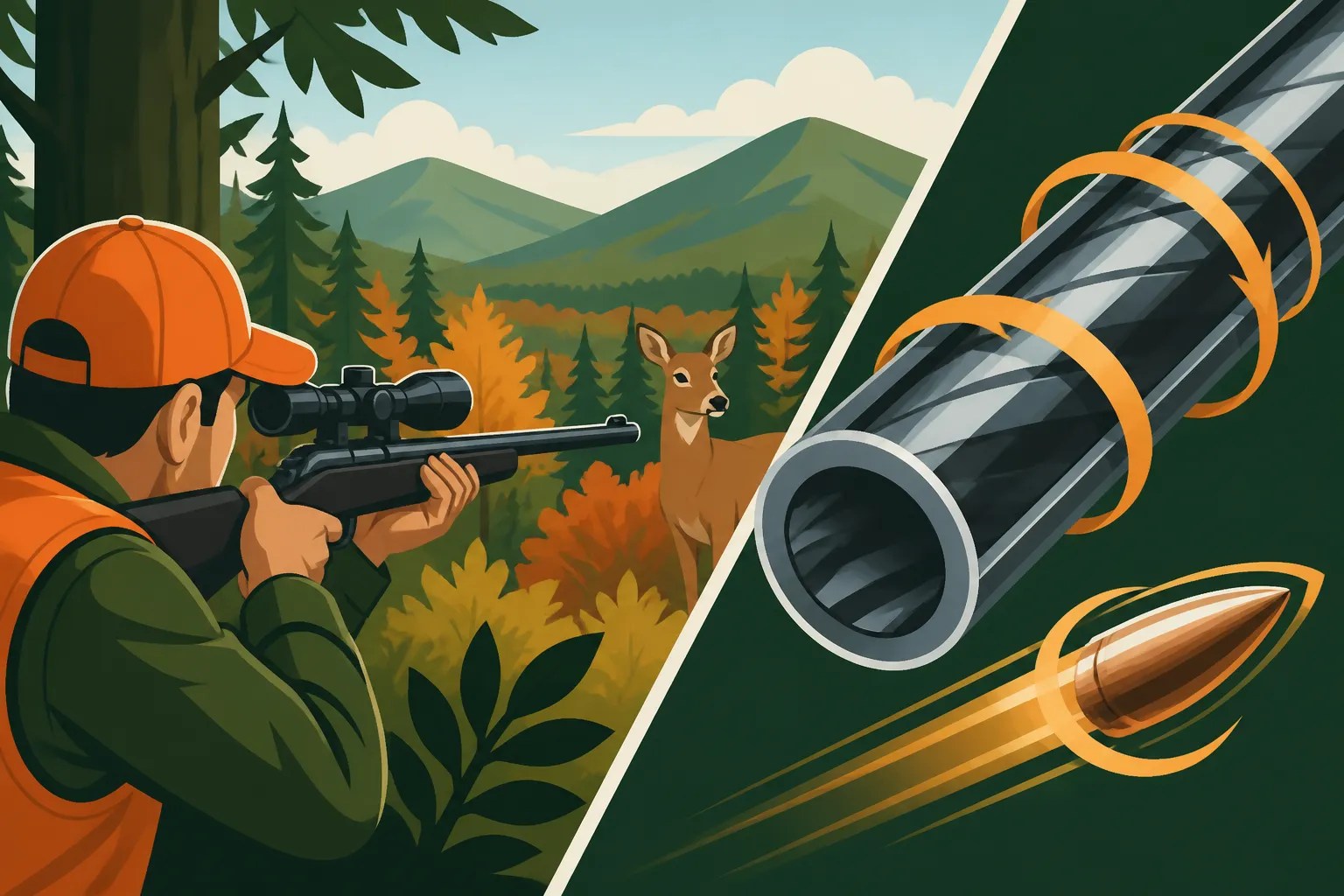
Before we dive into the nitty-gritty of hunting Vermont’s hardwoods, let’s make sure we're all on the same page about what a rifle twist rate actually is. When you look down the bore of a rifle barrel, you’ll notice that it isn't smooth; there are grooves spiraling down its length. This spiral is called rifling, and its purpose is to impart a spin to the bullet as it travels down the barrel. Think of a football quarterback throwing a perfect spiral – that spin is what stabilizes the ball in flight, preventing it from tumbling end-over-end. A rifle bullet needs that same kind of gyroscopic stability to fly true to its target.
The twist rate is simply a measurement of how quickly that rifling makes a full rotation. It’s typically expressed as a ratio, like 1:10” or 1:12”. This means that for every 10 or 12 inches the bullet travels down the barrel, the rifling completes one full rotation. So, a 1:10” twist rate means the rifling completes a full turn in 10 inches, which is considered a faster twist than a 1:12” rate, where it takes 12 inches for a full turn.
Why Rifling Matters for Bullet Stability
Without that spin, a bullet would wobble and tumble erratically, making accurate shooting impossible. The rifling ensures the bullet maintains a stable, nose-first trajectory, resisting air resistance and gravity more effectively. It’s the difference between throwing a perfectly spiraled football and just lobbing it end-over-end – one is predictable, the other is not.
When a bullet leaves the muzzle, it’s still spinning rapidly. This spin creates a gyroscopic effect, much like a spinning top, which keeps it oriented correctly as it cuts through the air. This stability is absolutely critical for maintaining accuracy, especially as distances increase. A stable bullet minimizes drag, retains energy better, and delivers more consistent impact on target. For us hunters, this means the difference between a clean, ethical shot and a frustrating miss or, worse, a wounded animal.
Fast vs. Slow Twist Rates: A Fundamental Difference
The terms "fast twist" and "slow twist" refer to the rate at which the rifling spins the bullet. A fast twist rate, like 1:8” or 1:9”, means the bullet gets more rotations in a shorter distance. A slow twist rate, such as 1:12” or 1:14”, means fewer rotations over the same distance.
Generally speaking, heavier, longer bullets require a faster twist rate to stabilize them. Think of it like a longer top – it needs more initial spin to stand up straight. Lighter, shorter bullets, on the other hand, require less spin and are often best stabilized by slower twist rates. If you use too slow a twist rate for a heavy bullet, it won't stabilize properly and will "keyhole" (hit the target sideways), leading to terrible accuracy. Conversely, too fast a twist for a light bullet can potentially over-stabilize it, though this is less common, or in extreme cases, even cause the bullet to shed its jacket due to the immense rotational forces. Understanding this fundamental relationship is the first step toward optimizing your rifle for White-Tailed Deer Across Vermont.
Why Twist Rate Becomes Critical in Vermont's Dense Timber
Hunting in Vermont is often about close-to-medium range shots in very dense cover. We’re not always talking about wide-open fields or long-range mountain vistas. More often than not, you're picking your way through thick softwoods, deep hardwoods, or along the edges of a beaver flowage. The shooting lanes are narrow, the targets can appear suddenly, and the shots are rarely beyond 150 yards for most of us.
This environment changes the calculus for rifle and ammunition selection, including twist rate. While extreme long-range stability might not be your primary concern, reliable, consistent accuracy at closer distances, even when pushing through brush, absolutely is.
The Dynamics of Shorter Shots in Thick Cover
In heavy timber, many hunters gravitate towards larger caliber, heavier bullets, or specific bullet designs that are known for their brush-bucking capabilities (though that's a whole other debate!). The thought is that a heavier, slower bullet might be less deflected by small twigs and branches. However, even at these shorter ranges, bullet stability is paramount. A bullet that starts to wobble even slightly because it's improperly stabilized by the twist rate will have its trajectory further compromised by any contact with foliage, leading to highly unpredictable results.
Imagine you're still-hunting a beech ridge in the Green Mountain National Forest. Suddenly, a nice buck steps into a small opening at 70 yards. You need that bullet to fly perfectly true, even if it has to graze a tiny twig you didn't see. A bullet that's marginally stabilized due to an incorrect twist rate is far more likely to be thrown off course by such a minor obstruction compared to one that is spinning optimally and cutting a clean path. Consistent accuracy, shot after shot, is the goal, and that starts with proper bullet stabilization right out of the barrel.
How Bullet Design Interacts with Twist in the Woods
Modern bullet designs are incredibly varied, from sleek, high-ballistic-coefficient (BC) projectiles designed for long range to robust, rapidly expanding bullets built for close-quarters terminal performance. In timber, many hunters lean towards bullets designed for quick, devastating expansion, often with a heavier-for-caliber construction to ensure penetration through dense muscle and bone.
This preference for heavier, often stoutly constructed bullets directly impacts the optimal twist rate. A bullet that's heavier and longer for its caliber will almost always require a faster twist rate to stabilize it effectively. For example, if you're shooting a classic .30-06 Springfield with 180-grain or even 200-grain bullets – which are excellent choices for big deer in thick cover – you'll want a barrel that can impart enough spin. Trying to push those heavier bullets through a slow 1:12” twist barrel might result in less-than-stellar accuracy, even at 100 yards. The bullet simply isn't getting enough rotational speed to maintain its nose-first attitude throughout its flight.
Conversely, if you're opting for lighter, faster bullets in a caliber like .243 Winchester or .270 Winchester – say, 85-grain or 130-grain respectively – a slightly slower twist rate might be perfectly adequate, or even preferable, for optimal stability without over-spinning. It's about finding that symbiotic relationship between the bullet's physical characteristics and the barrel's rotational capability.
Matching Your Bullet to Your Twist: Finding the Sweet Spot for Timber Shots
Alright, let’s get down to the practical application. You've got your rifle, you know your general hunting environment in Vermont's woods, now how do you pair it all up for maximum effectiveness? It's a balance, and understanding a few key principles will guide you.
The fundamental rule is this: Longer bullets require faster twist rates for stabilization, while shorter bullets require slower twist rates. Bullet weight is often a good proxy for length within a given caliber, as heavier bullets are generally longer.
Common Calibers and Their Ideal Twist Rates for Vermont Deer
Many popular deer hunting calibers come with standard factory twist rates that are designed to handle a broad range of bullet weights. However, if you're pushing the extremes of bullet weight for your caliber, or if you have a custom barrel, this information becomes vital. Let's look at some common calibers you might be using in Vermont:
| Caliber | Common Factory Twist Rates | Ideal for Lighter/Shorter Bullets | Ideal for Heavier/Longer Bullets | Typical Vermont Application |
|---|---|---|---|---|
| .243 Winchester | 1:9" – 1:10" | 80-95 gr | 100-105 gr | Smaller deer, open areas |
| .270 Winchester | 1:10" | 130 gr | 140-150 gr | All-around, diverse terrain |
| .30-06 Springfield | 1:10" | 150-165 gr | 180-200 gr | Versatile, timber to fields |
| .308 Winchester | 1:10" – 1:12" | 150-168 gr (1:12") | 175-180 gr (1:10") | Shorter ranges, dense cover |
| .30-30 Winchester | 1:10" – 1:12" | 150 gr | 170 gr | Classic timber, close range |
| .35 Remington | 1:16" | 180-200 gr | 200-220 gr | Dedicated timber, heavy brush |
| 6.5 Creedmoor | 1:8" – 1:8.5" | 120-130 gr | 140-150 gr | Modern, accurate, growing use |
Note: This table provides general guidelines. Always check your rifle's specific manufacturer specifications and test different bullet weights to confirm accuracy.
For hunting in Hunting Green Mountain National Forest Timber or hunting a Northeast Kingdom bog, where shots are often short and quick, many hunters lean towards a bit heavier-for-caliber bullet to maximize knockdown power and minimize deflection. For these scenarios, opting for a factory rifle with a slightly faster twist rate (e.g., a 1:10" in a .308 rather than a 1:12") will serve you better, as it will reliably stabilize those 165-grain or 180-grain bullets.
For example, a .308 Winchester with a 1:10” twist is a fantastic timber rifle. It will handle the common 150-grain bullets beautifully, but also give you the flexibility to move up to 165-grain or even 180-grain projectiles which can be a real asset when chasing a mature buck through tough cover.
Using Resources to Confirm Your Rifle's Twist Rate
Don't just guess what your rifle's twist rate is. It’s usually stamped on the barrel itself, often near the receiver. If not, check your rifle's manual or the manufacturer's website. If you're still unsure, you can measure it yourself with a cleaning rod and a tight patch. Mark the rod, push it down the bore until it completes one full rotation, and then measure how far the rod traveled. That’s your twist rate!
Once you know your twist rate, you can use online ballistic calculators and resources like GoHunt to research how different bullet weights and designs will perform with your specific barrel. Many ammunition manufacturers also provide recommended twist rates for their various bullet offerings. This information is invaluable for fine-tuning your setup. Don't be afraid to experiment with a few different bullet weights within the suggested range for your twist, as every rifle is a law unto itself when it comes to preferred ammunition. A quick session at the range with a few different loads can tell you everything you need to know about what your rifle likes best.
Practical Considerations and Common Mistakes for Vermont Hunters
Choosing the right twist rate isn't just about theoretical ballistics; it's about practical application in real-world hunting scenarios. There are a few things that Vermont hunters often overlook or simply get wrong when it comes to this aspect of their rifle setup.
The Myth of "Brush-Busting" Bullets and Their Impact on Twist
Let's address the elephant in the room: the idea of "brush-busting" bullets. While it's tempting to think that a heavy, slow bullet will simply plow through saplings and twigs without deflection, the reality is far more nuanced. Any bullet, regardless of its weight or design, can and will be deflected by contact with even small obstacles. The degree of deflection might vary, but none are truly "brush-proof."
What does help minimize deflection, or at least keep it consistent, is a stable bullet. A bullet that is perfectly stabilized by its twist rate is less likely to tumble or yaw erratically upon glancing contact. This means that focusing on a bullet that is well-matched to your twist rate, rather than chasing a mythical brush-buster, will lead to more consistent performance in the timber. So, for those heavier bullets often favored in the woods, a proper, often faster, twist rate becomes even more important. It gives the bullet its best chance to maintain stability, even if it encounters minor interference.
Testing and Zeroing in Real-World Conditions
You've done your research, you've chosen your bullet weight, and you feel good about your rifle's twist rate. Now, it's time to put it to the test. Don't just zero your rifle from a bench rest at 100 yards and call it good. While that’s an excellent starting point, real timber hunting means shooting from various positions: kneeling, off-hand, leaning against a tree. Practice these shots.
More importantly, pay attention to your group sizes. Are your groups consistent? Are there any flyers? If your groups are larger than expected, or if you notice any unusual bullet holes (like keyholing), it could be a sign that your bullet isn't being properly stabilized by your twist rate. This is particularly crucial at the ranges you'll encounter in Vermont. A three-inch group at 100 yards is acceptable in dense woods, but if your bullets are barely staying on a six-inch paper, something is wrong.
Consider visiting a range that allows you to shoot at 50 or 75 yards, which might be a more realistic "average" shot distance in thick Vermont timber. This will give you a better feel for how your chosen load performs where it truly matters. Utilizing a quality mapping app like GoHunt can help you identify realistic shooting lanes in the terrain you plan to hunt, informing your practice sessions. Remember, confidence in your rifle's accuracy is paramount for an ethical hunt.
The Interplay with Other Gear for Timber Hunting
Your choice of twist rate and bullet weight doesn't exist in a vacuum. It interacts with your other gear. For instance, if you’re still-hunting, you’ll likely choose Boots for Green Mountain Ridge Terrain that offer excellent traction and support. But how does that relate to your rifle? Well, comfortable, stable boots allow you to get into a steady shooting position quickly when that fleeting opportunity arises. If you're focused on a heavy, well-stabilized bullet, you want a platform that allows you to deliver it accurately.
Also, consider your optics. Choosing a Scope Magnification for Timber Country often means opting for lower power settings or a variable scope that can dial down to 1x or 2x for quick target acquisition. Your scope’s clarity and light-gathering ability become far more critical than extreme magnification when you're looking through dense cover at dawn or dusk. All these elements work together to ensure that when you find yourself Hunting a Funnel Between Two Woodlots or in a thick Deer Wintering Yards Explained, your entire setup is optimized for success, from the twist rate of your barrel to the lens on your scope.
The Bottom Line for Vermont Hunters
Ultimately, a well-chosen twist rate means a stable bullet, and a stable bullet means accurate, consistent, and ethical shots. While many factory rifles will handle standard ammunition just fine, paying attention to your twist rate, especially if you prefer heavier-for-caliber bullets for timber hunting, can significantly improve your performance. Don't leave this critical aspect of rifle setup to chance; understand it, test it, and hunt with confidence.
Disclaimer
This article is for general informational purposes only and does not constitute professional advice. Laws, prices and regulations vary by location and change over time. Consult a qualified professional for guidance on your specific situation.