Camo Patterns for Vermont Hardwood Cover
One of the biggest head-scratchers for Vermont hunters, especially those of us who spend a lot of time in the beautiful hardwood forests, is figuring out the right camouflage pattern. It's not just about looking "camouflaged"; it's about truly disappearing into the ever-changing landscape. This guide will dive deep into the world of camo patterns specifically designed for Vermont's hardwood cover, helping you understand the science, the options, and how to make the best choices for your hunts, no matter the season.
Understanding Vermont's Hardwood Environment
Vermont's hardwood forests are a hunter's paradise, but they present unique challenges when it comes to blending in. From the dense understory of early fall to the stark, open woods of late season, the visual characteristics shift dramatically.
The Dominant Species and Undergrowth
Our hardwood forests are primarily made up of sugar maples, beeches, birches, and oaks. Each tree has distinct bark textures and colors, and these variations play a huge role in how light and shadow interact. Beneath the canopy, especially in younger stands or areas with recent timber work, you'll find a mix of ferns, saplings, hobblebush, and wild apple trees. In more mature, open hardwoods, the forest floor might be relatively clear, covered in fallen leaves and duff. These elements — the vertical lines of tree trunks, the dappled light through the leaves, and the subtle textures of the undergrowth — are what your camo needs to mimic. Simply wearing a pattern that looks "woodsy" might not cut it if it doesn't break up your outline against these specific features.
Light and Shadow Play in the Canopy
Anyone who has spent a still morning in a Vermont hardwood stand knows how dynamic the light can be. Sunlight filters through the leaves, creating shifting patterns of bright spots and deep shadows. On overcast days, the light is flatter, making contrasts less pronounced. Your camouflage isn't just trying to match a specific color; it's trying to fool the eye by disrupting your shape against this constantly moving, evolving backdrop of light and dark. A pattern that works well in direct sunlight might create a stark silhouette in deep shade, and vice-versa. This is why many successful patterns incorporate both dark and light elements, not just a single tone, to adapt to these varied conditions. It's a subtle art, and one that requires paying close attention to your surroundings.
Seasonal Transformations of Hardwoods
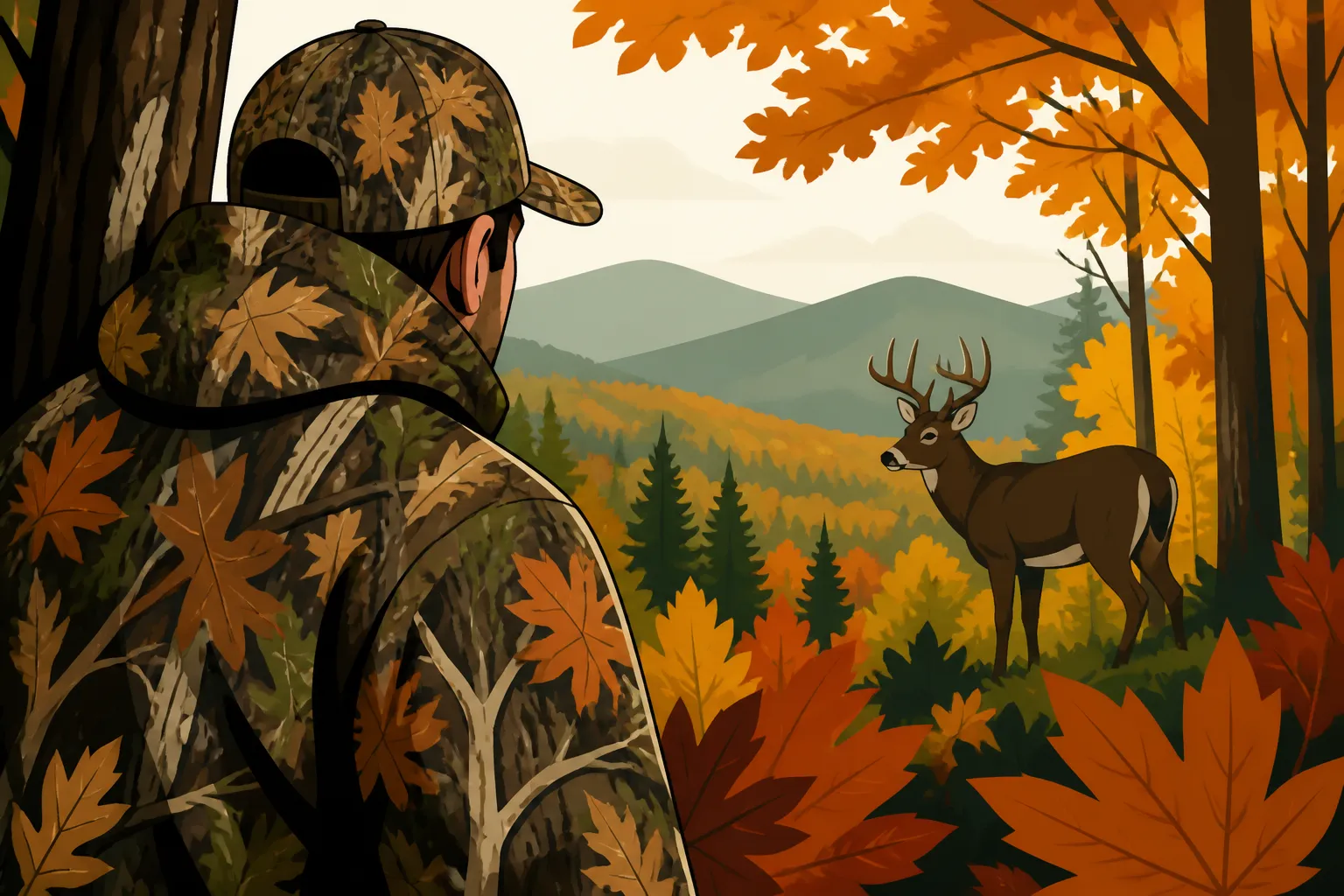
Perhaps the biggest factor influencing camo choice in Vermont hardwoods is the dramatic shift through the hunting seasons. In September, during Vermont's Expanded Archery Season, the woods are a vibrant green, with lush foliage creating a dense, almost tropical feel in some areas. By October and November, the famous Vermont fall foliage erupts, painting the landscape in oranges, reds, and yellows, before transitioning to the muted browns and grays of bare branches. Then, if we're lucky, winter brings snow, completely transforming the visual landscape. A pattern that's perfect for a September archery hunt will stick out like a sore thumb during Vermont's November Rifle Season when the leaves are down. This seasonal variability means that a "one-size-fits-all" camo approach often leaves you under-camouflaged for at least part of the year.
The Science Behind Effective Camouflage
It's easy to think of camouflage as just a cool pattern on fabric, but there's a real science to it. Effective camo isn't about perfectly matching the background; it's about disrupting the human form and confusing the predator's eye.
Disruptive Patterning and Micro/Macro Elements
At its core, good camouflage employs disruptive patterning. This means breaking up the recognizable outline of a human body into smaller, irregular shapes that blend with the surroundings. Think about it: a deer sees your overall shape, not the intricate details of your jacket. Disruptive patterns use contrasting colors and shapes to trick the eye into seeing branches, leaves, or shadows instead of an arm or a leg.
Modern camo patterns often utilize both micro and macro elements. Micro-patterns are the small, intricate details — individual leaves, twigs, bark texture — that help you blend in when an animal is close. Macro-patterns are the larger, bolder shapes and color blocks that break up your outline at a distance. If a pattern is all micro, you can appear as a blob from afar. If it's all macro, you might stick out when an animal is right in front of you. The best hardwood patterns strike a balance, offering detailed texture up close while still disrupting your form from a distance. Companies like Sitka and First Lite spend a lot of time on this balance, understanding how animals perceive patterns differently than humans. GoHunt often features discussions and reviews on patterns that excel in this regard, helping hunters understand which designs truly work in the field.
Color Palette: Mimicking the Forest Floor and Bark
The color palette is crucial, especially in Vermont's diverse hardwoods. While green is dominant in early season, the vast majority of our deer hunting takes place when browns, grays, and muted earth tones prevail. Effective hardwood camo patterns incorporate these colors extensively. They often feature various shades of brown to mimic bark and dried leaves, grays to represent bare branches and shadows, and hints of darker greens or dull yellows for lingering foliage or moss. It’s not just about solid colors, but the variations in those colors, often with subtle transitions that mirror natural gradients found in the woods. Too much of one color can make you stand out. For example, a pattern heavy on bright green will stick out in a leafless November woodlot, just as a pattern that is too dark and uniform might look like a black blob against a snow-dusted forest floor.
The Role of Movement and Human Form
Even the best camo pattern can't completely hide you if you're fidgeting or if your clothing isn't designed to reduce noise. Our bodies have a very distinct shape: vertical torso, horizontal shoulders, distinct head. Animals are incredibly attuned to this silhouette and any unnatural movement. The primary goal of camo is to break up this recognizable form. Beyond the pattern itself, the fit of your clothing and the texture of the fabric contribute to how well you disappear. Baggy clothing can snag on branches or rustle loudly. Stiff fabrics create noise. When you move, even subtly, your pattern shifts, and the disruption can be momentarily lost. This is why many seasoned hunters emphasize slow, deliberate movements, almost like you're part of the tree you're leaning against. Pairing your chosen pattern with quiet fabrics and a thoughtful approach to movement is often more important than the specific pattern itself. GoHunt's forums sometimes have hunters discussing the best "quiet" fabrics for still-hunting in crunchy leaves.
Popular Camo Patterns for Hardwood Forests
There are countless camo patterns out there, each claiming to be the best. For Vermont's hardwood cover, certain styles and patterns tend to perform better across various seasons and light conditions.
Traditional Stick-and-Leaf Patterns
These are the classic patterns many of us grew up with. Think Mossy Oak's Break-Up or Realtree's AP series. They feature realistic depictions of leaves, branches, and twigs, often in natural browns, greens, and grays. Their strength lies in their familiarity and their ability to blend into the overall texture of a wooded environment. They excel at close to mid-ranges, especially when you're nestled against a tree or in thick brush. The idea is to make you look like a pile of leaves or a brush pile.
However, traditional stick-and-leaf patterns can sometimes suffer from a lack of macro-patterning. From a distance, especially in open hardwoods, the intricate details can "blob" together, creating a solid, undefined mass. This can make you stand out more than you'd like against a uniform background. Despite this, they remain a very popular and often effective choice for the dense, varied cover found in many Vermont woodlots, particularly when Still-Hunting Green Mountain National Forest Timber or setting up in a heavy browse area.
Digital and Photo-Realistic Patterns
Digital patterns, like those used by some military forces or modern hunting brands, use a pixelated design to create a "visual noise" that helps disrupt the outline. The theory is that the human eye, and by extension an animal's eye, has difficulty discerning a clear outline when confronted with these randomized, blocky shapes. Photo-realistic patterns, on the other hand, take high-resolution images of actual forest elements—bark, leaves, shadows—and repeat them to create a seamless blend. Kryptek's Highlander or Typhon patterns use a combination of micro and macro elements with sharper lines, while brands like Sitka and First Lite leverage scientific principles of animal vision to create patterns like Optifade or Cipher, which are designed to confuse an animal's depth perception and ability to identify a distinct shape.
These newer patterns often excel at a wider range of distances, as the micro-macro interplay helps with both close-up blending and distant disruption. They're particularly effective in scenarios where you might be Glassing a Clear-Cut for a Bull Moose or watching a distant field edge from timber, where the fine details of a stick-and-leaf pattern might get lost. Many hunters find that these patterns, when chosen for the right environment, offer a superior level of concealment, especially as an animal's eyes become more accustomed to detecting human shapes. GoHunt often provides insights into how these advanced patterns perform in different terrain types, including specific tests in hardwood environments.
Solid Colors and Layering for Simplicity
Believe it or not, solid earth tones can be incredibly effective, especially when paired with smart layering and an understanding of your surroundings. Dark olive green, deep brown, or even gray can work wonders if you're good at using natural cover and breaking up your silhouette with elements like a backpack or a natural blind. The key is avoiding stark, uniform blocks of color. Instead, use different shades and textures in your layers. For instance, a brown base layer, a darker green mid-layer, and a textured brown outer shell can create enough visual breakup to be effective.
This approach is often favored by minimalist hunters or those who prioritize quietness and versatility over a specific pattern. It's also an excellent strategy for Layering for Vermont's Long Hunting Season, as you can mix and match pieces for warmth and concealment. While a deer's color vision isn't the same as ours, they are excellent at detecting movement and contrasting shapes. Solid colors, when used correctly and broken up by natural elements, can be surprisingly difficult for game animals to pick out. This method relies heavily on hunter skill in choosing the right background and remaining motionless, rather than on the pattern itself.
Adapting Camo for Seasonal Changes
Vermont's hardwoods undergo dramatic seasonal transformations, and your camo strategy needs to evolve right along with them. What works in September won't cut it in December.
Early Season Green-Out (Archery)
When Hunting Vermont's Expanded Archery Zones in September, the woods are still lush and vibrant green. Even well into October, many areas retain significant green undergrowth and lingering leaves on oaks. For this period, you want patterns with a strong green component, mimicking the chlorophyll-rich foliage. Patterns with realistic leaves and branches in varying shades of green, mixed with some brown and shadow elements, will serve you best.
Think about patterns like Mossy Oak's Original Bottomland, which has a good mix of dark and light, or Realtree's Edge, which incorporates sharp greens and browns. The goal is to blend with the dense canopy and understory. If you're setting up a treestand, consider how your silhouette will appear against the green leaves, and choose a pattern that helps you disappear into that backdrop. This is a critical time to be conscious of the color palette, as the contrast between bright green and an out-of-place brown or gray can be stark.
Peak Fall Foliage and Transition
Vermont's fall foliage is world-renowned, and it also presents a unique camo challenge for hunters. For a few weeks in October, the woods are ablaze with reds, oranges, and yellows. While stunning, these colors aren't typically found in many camo patterns. As the leaves begin to drop, the transition from vibrant color to the muted browns and grays of bare branches starts. During this phase, often around Hunting the Rut in Early-to-Mid November, patterns that are heavy on browns, grays, and dead-leaf patterns become paramount.
A pattern that incorporates yellows and muted oranges can work during peak foliage, but it’s a short window. More versatile patterns will focus on the browns and grays of bark and the forest floor, allowing you to blend as the leaves fall. You'll often find that patterns designed for "all-around" timber use tend to have a larger proportion of browns and grays, with just enough green or muted yellow to carry through transitional periods. The idea is to make you look like another tree trunk, or part of the forest floor, rather than a brightly colored anomaly.
Late Season Bare Branches and Snow
By late November and especially into December, during Hunting Vermont's December Muzzleloader Season, our hardwood forests are stark. The leaves are down, revealing the intricate network of bare branches, and the ground is often covered in snow or frozen leaves. In this environment, patterns with strong gray, black, and white elements, mimicking the bare branches and shadows against snow, are highly effective.
Traditional "stick" patterns with lots of dark, irregular branches against a lighter background are excellent here. If there's snow on the ground, a pattern with white or very light gray integrated into the design can be incredibly effective, as it helps you disappear against the snow and shadows. Often, hunters will shift to more open, "skeletal" patterns that emphasize the vertical and angular lines of bare trees, allowing them to blend with the chaotic appearance of a leafless wood. This is also where blaze orange requirements come into play, and you'll need to think about how your orange stands out against your chosen camo. For Blaze Orange Layering Options, it's smart to pick a pattern that works well with an outer orange vest, rather than clashing.
| Season | Dominant Colors & Textures | Ideal Camo Characteristics | Example Camo Elements |
|---|---|---|---|
| Early Fall | Lush greens, deep shadows, some browns | Strong green base, varied leaf patterns, dark shadow accents to break up form against dense foliage. | Green leaves, dark bark, mossy textures. |
| Mid-Fall (Peak) | Oranges, reds, yellows, browns | Muted browns, grays, dead leaf patterns. Some subtle orange/yellow for specific foliage, but primarily transitional. | Dried leaves, gray branches, subtle yellow/orange hints. |
| Late Fall | Muted browns, grays, bare branches | High contrast between dark branches/shadows and lighter bark/sky. Focus on vertical disruption. | Dark branches, mottled bark, stark shadows. |
| Winter (Snow) | White snow, dark branches, shadows | Incorporates white and light gray to blend with snow, dark elements for branches/shadows. | White snow patches, dark tree trunks, skeletal branches. |
Beyond Pattern: Factors for Camo Effectiveness
While the pattern itself is crucial, it's just one piece of the puzzle. Several other factors play a significant role in how truly invisible you are in the Vermont woods.
Scent Control and Noise Reduction
You can wear the most advanced camo pattern on the market, but if you smell like last night's campfire or your jacket rustles like a bag of chips, you're giving yourself away. Deer and other game animals rely heavily on their sense of smell and hearing. Scent control isn't just about covering your odor; it's about eliminating it. This means showering with scent-free soap, washing your hunting clothes in scent-free detergent, and storing them in airtight containers. Many hunters use specialized sprays, carbon-lined clothing, or even ozone generators to further reduce their scent footprint.
Noise reduction is equally vital. The crunchy leaves on the forest floor, the squeak of a treestand seat, the rustle of stiff fabric – these sounds are alien to the natural rhythm of the woods. Choose clothing made from quiet materials like fleece or soft shell fabrics. Make sure your backpack doesn't jingle and that your boots allow for quiet movement, especially when Still-Hunting a Northeast Kingdom Beech Ridge. Every little bit of noise you make can signal your presence long before an animal ever sees your camo.
Proper Layering and Movement
Vermont's weather is notoriously unpredictable. One morning it's frosty, the afternoon brings rain, and the next day is mild. Proper layering isn't just about staying comfortable; it's also about maintaining stealth. Bulky, ill-fitting layers can hinder movement, create unnecessary noise, and make you look like a shapeless blob rather than a part of the forest. Layering for Vermont's Long Hunting Season ensures you can adapt to changing temperatures without sacrificing your ability to move silently and without disrupting your visual concealment.
Beyond layers, your movement is paramount. No camo pattern, no matter how good, can mask rapid or unnatural movement. When you're in the woods, especially when Hunting a Ridge-Top Saddle for Rutting Bucks or approaching a bedding area, every step, every turn of your head, needs to be deliberate and slow. Animals are highly attuned to motion. Use the environment to your advantage: move when a gust of wind blows, when an airplane passes overhead, or when you have natural cover between you and your quarry. Think of yourself as a statue that occasionally shifts, rather than a constantly moving object.
Understanding Your Hunting Position and Background
Where you choose to position yourself is just as important as the pattern you wear. Are you leaning against a large oak? Are you tucked into a cedar thicket? Is there an open field behind you, or a dense wall of evergreens? Your background provides the context for your camouflage.
If you're treestand hunting, consider how your camo looks against the trunk and canopy of the tree you're in, and also how you blend into the distant background. A pattern that perfectly matches the tree bark might silhouette you against a bright sky. If you're hunting from the ground, always try to have a cluttered or dark background behind you – a dense cluster of pines, a thicket of brush, or a dark shadow. Never position yourself in front of a wide-open space if you can help it. The "blobbing" effect of some patterns is exaggerated when there's nothing for them to blend into. Utilizing features like downed logs, stone walls, or brush piles when Using a Ground Blind on Public Land can significantly enhance the effectiveness of your camo, making you virtually invisible to wary eyes. GoHunt's mapping tools can often help identify areas with suitable cover for various hunting styles.
Choosing Your Camo for Specific Hunting Scenarios
The "best" camo pattern often depends on how you're hunting and the specific terrain within Vermont's hardwoods. A pattern perfect for one scenario might be less effective in another.
Treestand Hunting in Hardwoods
When you're perched 20 feet up in a treestand, your camo needs to work differently than on the ground. You're typically silhouetted against the sky, or against the upper canopy of the forest. For this reason, many treestand-specific patterns feature more open, vertical elements and darker, less defined patterns that help break up your outline against the background, rather than trying to perfectly match a tree trunk. Patterns that blend with the chaotic structure of branches and filtered light are key.
Think about patterns that have lots of "negative space" or dark voids, mimicking shadows and openings in the canopy. The primary goal is to confuse the animal's eye as it looks up into the tree. Your camo should help you become another part of the tree itself, not a distinct blob. This is where the micro and macro elements truly shine, allowing you to blend up close to the tree trunk while also disrupting your form from a distance as deer look up. Remember to consider Treestand Rules on Vermont Public Land when setting up.
Still-Hunting the Forest Floor
Still-hunting is perhaps the most demanding style when it comes to camouflage, as you are constantly moving, albeit slowly and deliberately. When Still-Hunting Green Mountain National Forest Timber, you're relying on blending with the immediate surroundings: the forest floor, fallen leaves, tree trunks, and undergrowth. For this, patterns that are rich in realistic textures – bark, dried leaves, twigs – are often highly effective.
The color palette should lean heavily into the browns, grays, and muted earth tones that dominate the forest floor once the leaves have fallen. You want your pattern to make you look like another element of the forest, not a moving shape. The critical factor here is often the texture and quietness of your clothing, as much as the pattern. Any rustle or snag will give you away. GoHunt forums are a great place to find gear reviews on fabrics that prioritize silence for this very reason.
Ground Blind Setups
Hunting from a ground blind, whether a manufactured blind or one you brush in yourself, offers a different set of camo requirements. The blind itself is often the primary concealment, but your camo still plays a role, especially if animals get a glimpse of you through the blind's windows or if you're hunting without a full enclosure.
If you're using a manufactured blind, the exterior pattern of the blind itself should match the surroundings, but your personal camo still needs to be muted and blend into the interior shadows. For brushed-in blinds, like when Brushing In a Blind on a Field Edge, your clothing camo should match the surrounding environment as closely as possible, incorporating the same colors and textures as the natural materials you're using to build the blind. The goal is to make you an indistinguishable part of that brush pile. Darker, more shadow-heavy patterns can work well inside a blind, as they help you disappear into the interior gloom.
Final Thoughts on Camo Choices for Vermont Hardwoods
Choosing the right camo for Vermont's hardwood cover is less about finding one "magic" pattern and more about understanding the ever-changing environment and how animals perceive their world. It's a combination of pattern, color, scent control, noise discipline, and smart positioning. Don't be afraid to experiment, and always observe how your chosen pattern looks in different light conditions and against various backgrounds.
Remember, the goal isn't just to look like a tree; it's to look like nothing at all. By thoughtfully considering the science of disruptive patterning, the specific characteristics of Vermont's hardwood forests through the seasons, and the importance of factors beyond just the print on your clothing, you'll greatly increase your chances of disappearing into the landscape and making that close encounter a reality. Keep learning, keep adapting, and most importantly, keep enjoying your time in our incredible Vermont woods!
Disclaimer
This article is for general informational purposes only and does not constitute professional advice. Laws, prices and regulations vary by location and change over time. Consult a qualified professional for guidance on your specific situation.