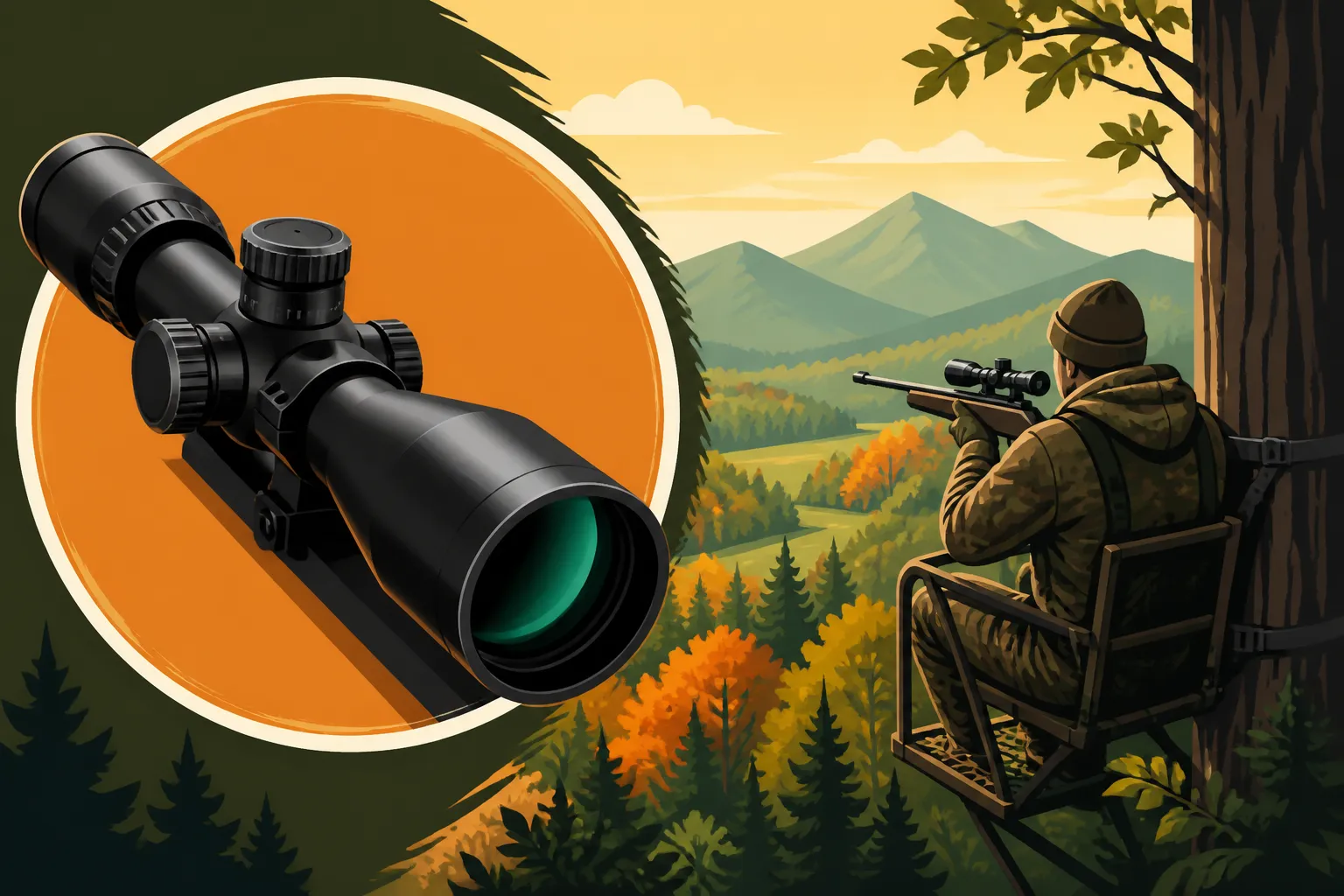
Best Scope for a Treestand Setup
Hunting from a treestand in Vermont presents a unique set of challenges that can make or break your hunt, especially when it comes to shot placement. Many of us have experienced that heart-pounding moment when a buck steps out, only to realize our scope isn't quite right for the steep angle, the close range, or the rapidly fading light of a Green Mountain evening. This guide is here to help you navigate the often-overlooked specifics of choosing the best scope for your treestand setup, ensuring you’re ready for whatever Vermont’s woods throw at you.
Why Treestand Hunting in Vermont Demands a Specialized Scope
Let's be honest, hunting from a treestand isn't just "hunting from up high." It fundamentally changes the dynamics of your shot. In Vermont, where you might be tucked into a softwood thicket overlooking a deer yard or perched on the edge of a field, the distances can be deceivingly short, and the angles can be surprisingly steep. This isn't like shooting across an open prairie; you're dealing with brush, limb interference, and often low light conditions that demand specific scope features.
The Unique Angles and Distances from Above
When you're 15 to 25 feet up in a treestand, that deer at 20 yards straight below you is an entirely different shot than a deer at 20 yards on flat ground. The angle is severe, and it can actually cause your bullet to impact higher than you expect if you're not compensating for it. Most hunters are taught to zero their rifles for flat trajectories, but gravity has less time to act on a projectile when shooting at a steep downward angle. A scope designed with simplicity and forgiveness in mind for these situations becomes crucial. You want to focus on the animal, not on complex ballistic calculations in the heat of the moment. For insights into where deer might gather, check out Reading a Green Mountain Deer Yard.
Low Light and Quick Target Acquisition
Vermont mornings and evenings, especially under a dense canopy of maple and spruce, mean low light. Deer are most active during these times, making your ability to acquire and identify your target quickly and clearly paramount. A scope with excellent light-gathering capabilities and a clear, uncluttered reticle can be the difference between a successful hunt and a missed opportunity. Fumbling with magnification or struggling to see crosshairs in the gloom is a frustrating experience many of us have endured. This is where a reliable scope earns its keep, allowing you to react swiftly when that buck finally steps out of the shadows.
The Importance of a Wide Field of View
Imagine a buck silently materializing just inside your effective range, perhaps even walking right under your stand before presenting a shot. From a treestand, your peripheral vision is often limited by branches and the stand itself. A scope with a wide field of view at lower magnifications helps you pick up movement and track a deer more easily without having to move your head as much. This reduces unnecessary movement, which is critical when you're trying to remain undetected by wary White-Tailed Deer Across Vermont. It also makes it easier to track an animal that might be moving quickly through a funnel, such as those discussed in Hunting a Funnel Between Two Woodlots.
Key Characteristics of an Ideal Treestand Scope
When you start digging into the technical jargon of scopes, it can feel overwhelming. But for treestand hunting, we can boil it down to a few core features that truly matter. These are the elements that will directly contribute to your success when you're perched high above the forest floor, waiting for that perfect moment.
Magnification Ranges: Low Power is Your Friend
Forget those high-power varmint scopes; they're overkill for a treestand. Most treestand shots in Vermont will be within 100 yards, often much closer – sometimes as close as 10 or 15 yards directly below you. A scope with a low minimum magnification, like 1-4x, 2-7x, or 3-9x, is ideal.
- Lower Magnification (1-3x): This gives you a massive field of view, making it incredibly easy to acquire a fast-moving target or one that pops up unexpectedly close. It also minimizes barrel movement wobble, making your hold feel steadier. For those intense moments, you want to be on target instantly.
- Higher Magnification (up to 7-9x): While rarely used from a treestand, having the option for a bit more zoom can be useful for identifying antler points on a distant deer in thick timber or confirming shot placement before the animal moves. However, resist the urge to crank it up too high; the increased shake and reduced field of view can hinder, rather than help, when that deer is standing 40 yards away.
Objective Lens Size and Light Gathering
The objective lens is the big lens at the front of your scope, and its size directly impacts how much light the scope can gather. For treestand hunting, especially during those magical last minutes of legal shooting light or the first rays of dawn, light gathering is crucial.
- 32mm to 40mm: This range offers a great balance. A 32mm or 36mm objective keeps the scope compact and lightweight, which is a big plus when packing into the woods and hanging a stand. Yet, quality glass in this size can still perform admirably in low light.
- 40mm and Larger: A 40mm or 44mm objective lens will gather more light, giving you brighter images in dim conditions. However, scopes with larger objectives are heavier and may require higher scope rings, which can affect your cheek weld and line of sight. It's a trade-off, and for most treestand hunters, a quality 32mm to 40mm scope with good coatings is more than sufficient.
Reticle Types for Quick Acquisition and Holdover
The reticle (your crosshairs) is personal, but for treestand hunting, simplicity and visibility are key. You don't want a busy Christmas tree reticle when a deer is quartering away at 30 yards.
- Duplex or German #4: These are classics for a reason. They offer a thick outer post that quickly draws your eye to the center, with thinner crosshairs for precise aiming. They are excellent for fast target acquisition in varying light conditions.
- Illuminated Reticles: This is a fantastic feature for treestand hunting. A dimly lit reticle, often red or green, can make all the difference in low light conditions or against a dark background (like a deer in deep shadows). It allows you to place your shot accurately without losing your aiming point. Just make sure it has adjustable brightness settings so it doesn't wash out your target.
- BDC (Bullet Drop Compensating) or Simple MOA/MRAD: While typically used for longer ranges, a very simple BDC reticle with a few holdover points can be useful if your stand offers shots out to 150-200 yards. However, for the typical treestand ranges in Vermont, a standard duplex with a solid zero will handle most situations. Some hunters even find that a simple dot or very basic holdover system is enough for those steeper downhill shots, as you're primarily compensating for angle rather than extreme drop.
Eye Relief and Parallax
These are often overlooked but are critical for comfort and accuracy from a treestand.
- Generous Eye Relief (3.5 inches or more): This is the distance your eye needs to be from the ocular lens (the one you look through) to see a full, clear image. From a treestand, your shooting position can be awkward, and your head position might not be perfectly consistent. Good eye relief gives you more flexibility without "scope bite" – a nasty whack to the eyebrow if your head is too close.
- Fixed Parallax or Adjustable for Close Range: Parallax is the apparent movement of the reticle relative to the target when you move your head. Most hunting scopes are fixed at 100 or 150 yards. For close-range treestand shots (20-50 yards), this can introduce a slight aiming error. Some scopes offer adjustable parallax (AO or side focus), allowing you to fine-tune it for closer distances, which can be beneficial if you anticipate many very close shots. However, for most hunters, a quality scope with decent eye relief set at a standard fixed parallax will be perfectly adequate.
Comparing Different Scope Types for Treestand Use
When you're ready to pick out a new scope, you'll quickly discover a vast array of options. Each type has its pros and cons, and understanding these differences will help you choose the best fit for your specific treestand hunting style in Vermont. Whether you're primarily still-hunting Still-Hunting Green Mountain National Forest Timber or sitting over a food source, the right scope can make a difference.
Low Variable Power Scopes (e.g., 1-4x, 2-7x, 3-9x)
This is arguably the most versatile and popular choice for treestand hunting. These scopes offer the best of both worlds:
- Pros:
- Versatility: The low end (1-3x) provides an excellent field of view for close, fast shots, while the higher end (7-9x) offers enough magnification for slightly longer ranges or better target identification in dense timber.
- Compact and Lightweight: Generally, these scopes are smaller and lighter than their high-power counterparts, making them easier to manage in a treestand and less cumbersome to carry into the woods.
- Good Eye Relief: Many models are designed with generous eye relief, which is a major advantage for awkward treestand shooting positions.
- Cons:
- Cost: Quality variable power scopes can be more expensive than fixed power options.
- Complexity: More moving parts mean more potential points of failure, though modern scopes are highly reliable.
- Brightness: While good, they generally won't match a fixed power scope of comparable objective size in extreme low light due to the added internal lenses.
Fixed Power Scopes (e.g., 4x)
Fixed power scopes, like a simple 4x, used to be the go-to for many hunters, and they still have a place, especially for dedicated treestand setups.
- Pros:
- Simplicity and Durability: Fewer moving parts mean they are incredibly robust and less prone to issues.
- Brighter Image: With fewer internal lenses, they often transmit light more efficiently, resulting in a brighter, clearer image, especially beneficial in low light.
- Affordability: Generally, fixed power scopes are more budget-friendly for comparable optical quality.
- Consistency: No temptation to adjust magnification, which can lead to missed shots if you forget to crank it back down.
- Cons:
- Lack of Versatility: You're stuck with one magnification, which can be limiting if shot distances vary significantly or if you need to identify small details at range.
- Field of View: While often good, it might not be as expansive as a 1x setting on a variable scope for extremely close, fast-moving targets.
Red Dot Sights (RDS) and Prism Scopes
While not traditional riflescopes, these deserve a mention for their incredible utility in specific treestand scenarios, especially for archery hunters who might be carrying a rifle during the Bowhunting During Vermont's Rifle Season overlap.
- Red Dot Sights:
- Pros: Incredibly fast target acquisition, unlimited eye relief, and excellent in low light due to the illuminated reticle. Perfect for very close-range shots (under 50 yards).
- Cons: No magnification, so not ideal for longer shots or target identification. Not great for hunters with astigmatism, as the dot can appear star-burst or smeared.
- Prism Scopes:
- Pros: Offer a fixed, low magnification (e.g., 1x, 2x, 3x), illuminated reticle, and etched reticle (so it still works if the battery dies). Often have better optical clarity than a red dot and can be used by hunters with astigmatism.
- Cons: More compact than a traditional rifle scope, but heavier than an RDS. Limited magnification.
Here's a quick comparison table to help you decide:
| Scope Type | Typical Magnification | Ideal Range (yards) | Key Pros | Key Cons |
|---|---|---|---|---|
| Low Variable Power Scope | 1-4x, 2-7x, 3-9x | 10 – 200 | Versatile, good FOV at low power, adequate zoom | Can be heavier/bulkier, more expensive |
| Fixed Power Scope | 4x, 6x | 20 – 150 | Simple, durable, bright image, affordable | Lacks versatility, fixed magnification |
| Red Dot Sight | 1x (no magnification) | 10 – 75 | Ultra-fast acquisition, unlimited eye relief | No magnification, may star-burst for astigmatism |
| Low Power Prism Scope | 1x, 2x, 3x | 10 – 100 | Fast, etched reticle, astigmatism-friendly | Fixed low magnification, heavier than RDS |
Mounting and Zeroing Your Treestand Scope
Having the perfect scope means nothing if it's not properly mounted and zeroed. For treestand hunting, there are a few considerations that can make your setup more effective and reliable. Attention to detail here will save you headaches and ensure ethical shots in the field.
Choosing the Right Rings and Bases
This is foundational. Don't skimp on rings and bases – they are the crucial link between your rifle and your scope.
- Quality Matters: Invest in solid, reputable scope rings and bases. They don't need to be fancy, but they must be durable and hold zero consistently. Brands like Leupold, Talley, and Warne offer excellent options.
- Ring Height: Choose rings that are just high enough to clear your objective lens without being overly tall. This keeps the scope as close to the bore as possible, aiding in consistent cheek weld and reducing parallax issues. A good cheek weld means your eye naturally aligns with the scope every time you shoulder the rifle, even in those awkward treestand positions.
- Mounting Correctly: Always follow the manufacturer's instructions for torque specifications. Overtightening can damage your scope tube, while undertightening can lead to shifting zero. If you're not comfortable doing it yourself, have a qualified gunsmith mount your scope.
Zeroing for Treestand Distances
Many hunters zero their rifles at 100 or 200 yards. While this is a great starting point, consider optimizing your zero for your most common treestand shot distance.
- The "Point Blank Range" Concept: For most common hunting cartridges, a zero between 50 and 75 yards can provide a very forgiving "point blank range" where your bullet won't deviate more than a few inches high or low out to 150-200 yards. This minimizes the need for holdover or holdunder at varying treestand distances.
- Shooting Downhill: When practicing, if possible, find an elevated position to simulate shooting from a treestand. This will help you understand how your rifle performs on those steep downward angles. Remember, shooting downhill means gravity has less time to act on the bullet, so it will tend to hit higher than on flat ground at the same distance. For typical treestand shots, simply aiming a little lower than usual for anything under 40 yards might be necessary, but only practice will confirm this for your specific setup. Resources like GoHunt can provide detailed topographical maps that might help you visualize potential treestand locations and angles for practice.
- Consistency: Practice shooting from a seated position, or even from a simulated stand setup, to get a feel for your rifle and scope in a similar position to how you'll be hunting. The more consistent you are, the better your accuracy will be. For more on preparing for the hunting season, consider Scouting Vermont Public Land Before Season.
Maintenance and Field Care for Your Treestand Scope
Your scope is a precision instrument, and like any other piece of critical gear, it needs proper care. Vermont's weather can be unforgiving, from driving rain to freezing temperatures, and your scope will bear the brunt of it. Taking the time for simple maintenance will ensure it performs flawlessly when it matters most.
Protecting Your Optics from Vermont's Elements
The Green Mountain State is known for its unpredictable weather, and your scope needs to be ready for anything.
- Scope Caps: Invest in high-quality flip-up or bikini-style scope caps. They protect your lenses from rain, snow, dirt, and scratches. Clear caps are an option for quick shots, but solid caps offer better protection during transport and when waiting in the stand.
- Lens Cleaning: Always use a proper lens cleaning pen, cloth, or solution. Wiping lenses with your shirt can scratch the delicate coatings. Carry a small cleaning kit in your pack.
- Moisture Management: If your scope gets wet, wipe it down thoroughly. If water gets into turret caps or crevices, let it air dry completely before replacing caps. Internal fogging usually indicates a seal issue, which requires professional servicing. Layering for different weather conditions, like those discussed in Layering for a Wet Green Mountain Day, also extends to protecting your gear.
- Sun Shades: A sun shade can reduce glare on bright days, which can be surprisingly useful even in timber, especially when the sun is low on the horizon.
Off-Season Storage and Inspection
When the season wraps up, don't just toss your rifle in the safe and forget about it. A little off-season attention goes a long way.
- Clean and Dry: Thoroughly clean your scope and rifle. Ensure they are completely dry before storing them to prevent rust or mildew.
- Turret Check: Spin your turrets through their full range of motion a few times to keep them from stiffening up. Return them to your zero setting.
- Mounting Screws: Periodically check the torque on your scope rings and bases. Vibrations from shooting and transport can sometimes loosen them over time.
- Lens Inspection: Inspect your lenses for any scratches or damage. Early detection of issues can prevent bigger problems next season.
- Dry Storage: Store your rifle and scope in a dry, temperature-stable environment, preferably in a gun safe with a dehumidifier. Avoid storing them in gun cases for long periods, as cases can trap moisture.
By following these tips and considering the unique demands of treestand hunting in Vermont, you'll be well-equipped to make the most of your time in the woods. While the right gear doesn't guarantee success, it certainly gives you a significant edge and more confidence when that big buck finally steps into your shooting lane.
Disclaimer
This article is for general informational purposes only and does not constitute professional advice. Laws, prices and regulations vary by location and change over time. Consult a qualified professional for guidance on your specific situation.