Vermont Mountain Lion Sighting Reports
There's something truly captivating about the thought of a big cat roaming our Vermont woods, isn't there? For years, tales of mountain lion sightings have swirled through our communities, sparking both excitement and a fair bit of debate. It's frustrating when you're convinced you saw something magnificent, only to hear the official word is often skepticism. This guide aims to dig into those elusive reports, explore what might be behind them, and give you the real scoop on what to do if you encounter what you believe is a Vermont mountain lion.
The Enduring Mystery of Vermont's Mountain Lions
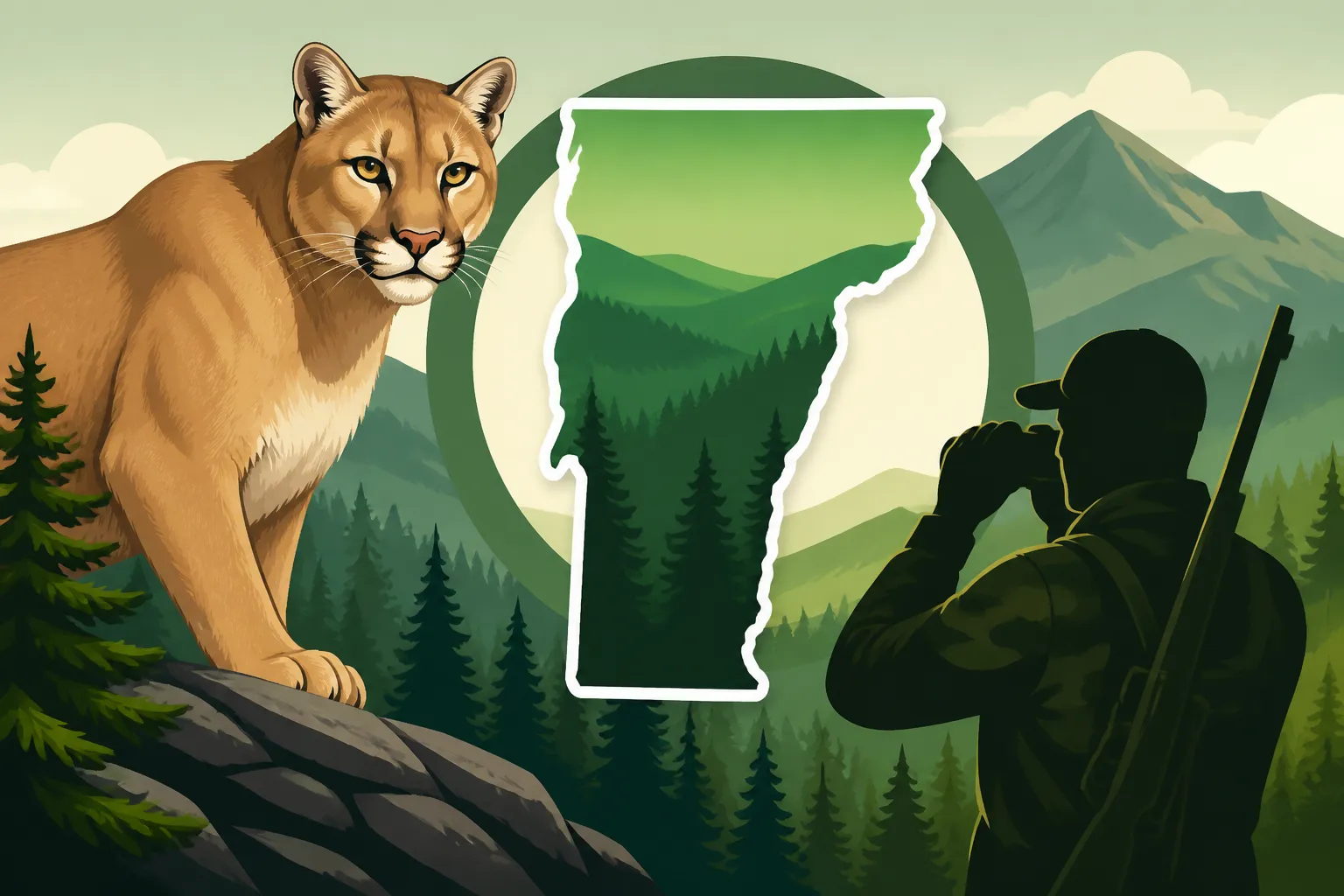
The idea of a mountain lion, sometimes called a cougar or puma, slipping silently through the dense Vermont forest is a romantic one for many of us. It taps into a primal sense of wilderness, suggesting that even in our relatively settled state, truly wild places and creatures still exist. These reports aren't just whispers; they often come from sincere individuals who are convinced of what they've seen. It’s a compelling narrative, especially for those who cherish the untamed spirit of the Green Mountain State.
A History of Elusiveness: Extirpation and Reappearance Theories
Historically, mountain lions certainly roamed what is now Vermont. Their presence was a natural part of the ecosystem, preying on abundant deer and other wildlife. However, by the late 1800s or early 1900s, due to extensive hunting, habitat loss, and human encroachment, the eastern cougar was largely considered extirpated from Vermont and most of the eastern United States. This means the native breeding populations were wiped out. The U.S. Fish and Wildlife Service even officially declared the eastern cougar subspecies extinct in 2011.
Despite this official declaration, the notion of a remnant population—a few secretive individuals that somehow survived deep in the Green Mountain National Forest or the vast stretches of the Northeast Kingdom—persists. People desperately want to believe in this possibility, often pointing to the sheer wildness of some of our most remote corners. They imagine these cats as masters of evasion, thriving just out of sight, occasionally offering a fleeting glimpse to a lucky or observant individual. It’s a testament to the wild heart of Vermont that such a powerful legend continues to grip our imagination.
The Scientific Stance: Lack of Concrete Evidence
While the allure of a hidden predator is strong, wildlife biologists and state agencies, like the Vermont Fish and Wildlife Department, have a difficult job. Their responsibility is to work with verifiable, scientific evidence. For a species as significant as a mountain lion, "proof" isn't just a blurry photo or a quick glimpse. They need hard evidence: scat for DNA analysis, clear and unambiguous photographic or video evidence, confirmed tracks that rule out all other species, or even a carcass. These are the kinds of irrefutable clues that would allow them to confirm a breeding population or even a transient individual.
Unfortunately, despite hundreds of sighting reports over the decades, verifiable evidence in Vermont remains elusive. Every report is taken seriously and investigated, but time and again, the evidence points elsewhere. It’s not that the biologists don't believe people are seeing something; it's that what they're seeing almost always turns out to be another, more common animal, or the evidence isn't conclusive enough to stand up to scientific scrutiny. This gap between heartfelt belief and scientific confirmation can be incredibly frustrating for those who swear they saw a mountain lion.
Common Misidentifications and What They Really Are
It's easy to dismiss sighting reports as imagination, but that's not fair. People genuinely see things that, to their eye, resemble a mountain lion. The reality is, our woods are full of incredibly skilled and sometimes surprisingly large animals that can, under certain conditions, fool even experienced outdoorspeople. Low light, distance, dense cover, and the excitement of the moment can all conspire to make a familiar creature look like something much more exotic.
The Usual Suspects: Bobcats, Coyotes, and Domestic Animals
One of the most common animals mistaken for a mountain lion in Vermont is the bobcat. People often underestimate the size and power of a mature bobcat. They are stoutly built, incredibly agile, and possess a stealthy, feline grace that can certainly mimic a cougar at a distance. When a large bobcat is glimpsed through thick brush, or its short tail isn't clearly visible, it's easy to jump to the conclusion that it must be a much larger cat. The way they move, often with a fluid, low-to-the-ground gait, can be very deceiving.
Coyotes, especially the larger eastern coyotes that roam Coyotes and Predators in Vermont, are another frequent culprit. While dogs in form, their coloration, bushy tails, and sometimes lanky build can, in poor lighting or at a glance, make them appear more feline than canine. Imagine a large coyote trotting along a distant field edge at dusk – its silhouette could easily be misinterpreted. Even very large domestic house cats, particularly barn cats or feral individuals seen at the extreme range of vision, have sometimes been the source of "big cat" sightings. Their movements and predatory focus can make them seem much larger than they are.
The Elusive "Black Panther" Phenomenon
Perhaps even more persistent than the mountain lion reports are the sightings of "black panthers." The image of a sleek, jet-black feline predator is captivating, conjuring images of African or South American jungles. However, it's crucial to understand that there is no scientific evidence of melanistic (black-phased) cougars in North America. While jaguars and leopards in other parts of the world can be black, the North American cougar species does not exhibit this genetic trait. Any black cat the size of a mountain lion seen in Vermont would be an entirely unknown subspecies, which is highly improbable.
So, what are people seeing when they report a "black panther"? Often, these sightings are likely very dark-colored Black Bears in Vermont, especially younger individuals whose fur can appear uniformly black and sleek. A bear cub or juvenile, moving with surprising speed and agility, especially at night or in deep shadows, can easily be misidentified. Other possibilities include large, dark-colored dogs, or even optical illusions caused by shadows, reflections, or debris in the woods that briefly take on the shape of a large, dark animal. The human brain is remarkably good at filling in gaps and making sense of incomplete visual information, sometimes to our own deception.
| Feature | Mountain Lion (Hypothetical) | Bobcat | Coyote | Black Bear (Juvenile/Dark Phase) | Large Domestic Cat |
|---|---|---|---|---|---|
| Size | Large (4-8 ft long w/ tail) | Medium (2-3.5 ft long w/ short tail) | Medium (3.5-4.5 ft long w/ bushy tail) | Variable, can be large or compact | Small to Medium (1.5-2.5 ft w/ tail) |
| Tail | Long, thick, muscular, often | Very short, "bobbed" | Bushy, typically held low | Short, hidden in fur | Varies, usually long and thin |
| Color | Tan, tawny, reddish-brown | Mottled brown/tan, spots, barred legs | Gray, brown, rusty-red, grizzled | Black, can appear very dark brown | Varies widely |
| Head Shape | Small for body, rounded ears | Rounded ears, often tufted | Pointed snout, erect ears | Rounded ears, broad snout | Rounded ears, distinct face |
| Movement | Fluid, stealthy, powerful | Stealthy, pouncing, agile | Trotting, loping, often in pairs | Lumbering, but can be surprisingly fast | Agile, graceful, pouncing |
| Tracks | Asymmetrical, no claw marks | Asymmetrical, no claw marks | Symmetrical, distinct claw marks | Large, five toes, claw marks usually visible | Small, no claw marks, sometimes asymmetrical |
| Vocalization | Purrs, growls, screams | Growls, hisses, chirps | Howls, yips, barks | Grunts, snorts, huffs, growls | Meows, purrs, hisses |
What to Do If You Believe You've Seen a Mountain Lion
It's one thing to hear about mountain lion sightings, and another entirely to believe you've just seen one yourself. That adrenaline rush, the feeling of disbelief mixed with awe, can be overwhelming. Instead of just brushing it off or letting the memory fade, there are specific steps you can take to help verify your sighting and contribute to the ongoing discussion. Your thoughtful observation could potentially be a missing piece of the puzzle.
Documenting Your Sighting Responsibly
First and foremost, your safety is paramount. If you see an animal you believe is a mountain lion, maintain a safe distance and do not approach it. Once you are safe, try to document as much as you can. Note the exact date and time of the sighting. Pinpoint the location as precisely as possible – GPS coordinates are ideal, and you can often get these from a mapping app on your phone, like those offered by GoHunt, or by marking a waypoint on a dedicated GPS unit. Even detailed landmarks (e.g., "half a mile north of the old maple tree on the logging road leading into the Victory Basin Wildlife Management Area") are helpful.
Next, focus on the animal itself. What was its size compared to a known object (like a deer or a fence post)? What was its color? Did it have a long tail, and what was the tail doing? How did it move – did it walk, trot, or run? Was it alone or with others? Note any distinctive markings or behaviors. If you have a camera, even a phone camera, try to get a photo or video. Even a blurry image can sometimes reveal key characteristics upon closer inspection. Look for tracks, scat, or hair samples if it's safe to do so, but do not handle them directly without proper guidance. Remember, clear, objective details are far more useful than emotional descriptions.
Reporting to Vermont Fish & Wildlife
Once you have as much documentation as possible, the next step is to report your sighting to the Vermont Fish and Wildlife Department. They are the official authority on wildlife in our state and are genuinely interested in receiving reports, especially those with good supporting evidence. Don't expect them to confirm a mountain lion immediately; their process is thorough because they need to be certain. You can usually find a contact form or phone number for wildlife sightings on their website.
When you report, provide all the details you gathered. Be as objective as possible. Tell them exactly what you saw, where, and when. If you have photos, videos, or have found any potential evidence like tracks or scat, they will instruct you on how to share it or if they want to investigate the site themselves. While it can be disheartening if your sighting is ultimately attributed to another animal, remember that every report helps wildlife biologists better understand what's truly out there and where animals are moving.
The Larger Picture: Prey, Habitat, and Dispersal
Beyond the individual sighting reports, there's a broader ecological context to consider when talking about mountain lions in Vermont. For a large predator to exist, let alone thrive and establish a breeding population, a specific set of environmental conditions must be met. It's not just about one animal passing through; it's about whether the landscape can truly sustain them long-term.
Would Vermont Even Support a Mountain Lion Population?
Vermont certainly has abundant prey animals. Our White-Tailed Deer Across Vermont population is healthy in many areas, and deer are the primary food source for mountain lions. We also have Moose in Vermont's Northeast Kingdom, whose calves could be vulnerable, and a variety of Vermont Small Game and Furbearers. So, in terms of food, the table might seem set. However, a viable mountain lion population requires more than just dinner. They need vast, contiguous tracts of remote habitat with minimal human disturbance.
While Vermont boasts significant public lands, including the Hunting Vermont's Green Mountain National Forest and numerous state forests and WMAs, these areas might not be as vast or interconnected as the wilderness strongholds where Western cougars thrive. Fragmentation by roads, development, and human activity can be a major barrier. Mountain lions are territorial and require large home ranges. While a single animal could theoretically survive, the challenge lies in supporting a breeding population with multiple individuals needing undisturbed areas to hunt, den, and raise young. Understanding these habitat needs helps us assess the likelihood of a self-sustaining population. For hunters, tools like GoHunt can provide invaluable insights into large, contiguous blocks of cover that might appeal to such an elusive animal, if they were truly here.
The Possibility of Transient Animals
While a breeding population in Vermont seems highly unlikely given the lack of concrete evidence, the possibility of a "transient" mountain lion is a different story. These are typically young male cougars that disperse from established Western populations, often traveling thousands of miles in search of new territory and mates. There have been documented cases in other eastern states, like Connecticut, where a mountain lion was killed after crossing multiple states, with DNA evidence tracing it all the way back to South Dakota. These animals are usually lone males, driven by instinct to find unoccupied ranges.
Such an animal passing through Vermont is not entirely impossible, though it would be an incredibly rare event. They would be moving through, not establishing a home. If such a transient animal were to be confirmed, it would be a landmark event for Vermont wildlife. However, even these rare, documented cases of dispersal do not indicate a re-establishment of a native eastern cougar population, nor do they suggest that a breeding population could survive long-term without significant habitat changes and a source of consistent immigration. The evidence from these transient movements underscores just how difficult it is for these animals to make a permanent home far from their established ranges.
Disclaimer
This article is for general informational purposes only and does not constitute professional advice. Laws, prices and regulations vary by location and change over time. Consult a qualified professional for guidance on your specific situation.