Vermont Turkey Roost Tree Preferences
There’s nothing quite like that pre-dawn chill, knowing a gobbler is still tucked in on his roost, waiting for the first rays of sun to hit the ridge. But if you’ve spent any time chasing Vermont wild turkeys, you know the frustration of trying to pinpoint that exact tree. They don’t just pick any old branch; there’s a definite method to their madness, and understanding their preferred roosting habits can drastically improve your odds of setting up in the sweet spot for that morning fly-down. This guide will dive deep into the specific kinds of trees, habitat features, and environmental factors that draw Vermont gobblers to their nightly perches, helping you decode their aerial hideouts.
Why Turkeys Pick Certain Roost Trees: Safety and Comfort Above All
Wild turkeys, especially those big, wary gobblers, are incredibly keen on self-preservation. When it comes to choosing a roost tree, their primary motivations boil down to safety from ground predators and, to a lesser extent, comfort and energy conservation. Imagine being a big, clumsy bird, needing to spend the night in the open woods. You'd want to be as high and as protected as possible, right? That's exactly how a turkey thinks.
Protection from Ground Predators
The biggest threat to a roosting turkey is a stealthy predator on the forest floor—think coyotes, bobcats, or even a determined fisher. By getting high off the ground, turkeys put a significant barrier between themselves and these nocturnal hunters. They'll often pick the tallest trees in an area, giving them maximum elevation. Not only does this make them harder to reach, but it also gives them a vantage point. Before flying up to roost or flying down in the morning, they'll often survey the surroundings, looking for anything out of place. This cautious behavior is why a quiet approach is absolutely critical during Spring Turkey Hunting in Vermont and Fall Turkey Hunting Vermont's Statewide Archery Window.
They also prefer trees with strong, horizontal limbs that can support their weight. A flimsy branch won't do; they need a stable platform to sleep on. These larger branches also provide a bit more cover, breaking up their silhouette against the moonlight. You'll rarely see a turkey roosting on a spindly sapling in the middle of an open field. Instead, they'll gravitate towards more robust, mature trees, often on the edges of dense cover or along natural breaks in the landscape.
Thermal Regulation and Weather Shelter
While safety is paramount, comfort plays a role too. Turkeys are exposed to the elements all night long. In Vermont, that can mean cold winds, freezing rain, or heavy snow. Certain tree types offer better thermal protection. Dense conifers, with their thick needles and close-knit branches, act like natural shelters, breaking the wind and offering a bit more warmth than an exposed deciduous tree in winter. They also prefer to be out of the direct path of prevailing winds.
Consider a blustery November evening after the leaves have fallen. A mature oak might provide a high perch, but it offers little in the way of windbreak. Contrast that with a towering white pine or hemlock stand. These evergreens provide a much more sheltered environment. Turkeys will conserve valuable energy by reducing their exposure to harsh weather, meaning they might opt for slightly less elevation if it means better protection from a biting northwest wind. This isn't just a comfort factor; it's a survival strategy, especially during the colder months in the Green Mountains.
Preferred Roost Tree Species and Characteristics in Vermont
When scouting for potential roost sites, it helps to know which specific trees Vermont turkeys gravitate toward. While they can and will roost in many types of trees, some stand out as clear favorites due to their structure, height, and location.
Conifers: The Evergreen Fortresses
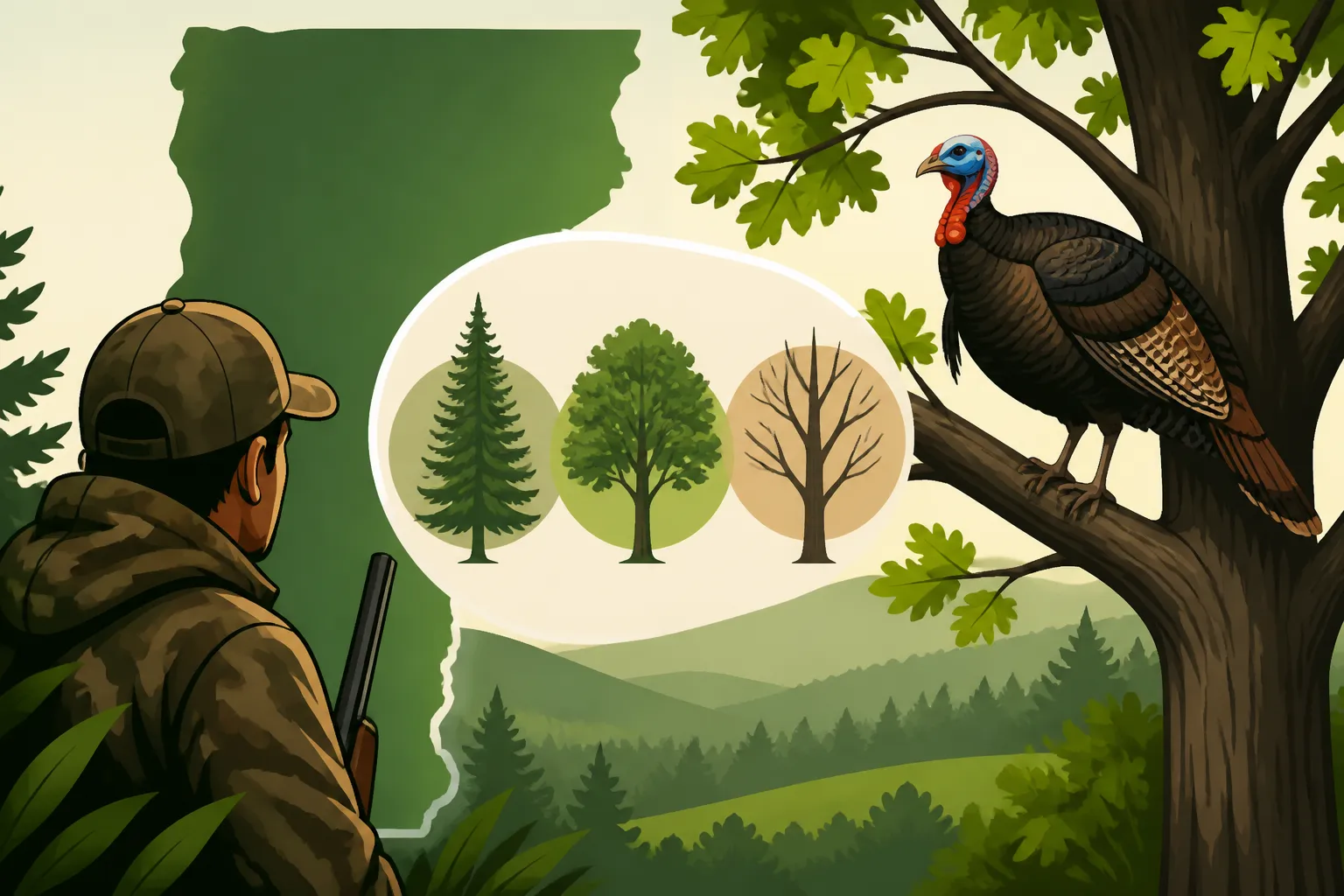
Without a doubt, large conifers are high on a Vermont gobbler’s list of preferred roost trees. White pines, hemlocks, and various firs offer several advantages that deciduous trees simply can’t match, especially outside of the leafy spring and summer months. These trees typically grow tall, providing the desired elevation. More importantly, their dense needles and strong, often horizontal, branches create excellent cover and windbreaks.
Think about scouting for Hunting Vermont's November Rifle Season deer in a big pine block. Turkeys use these same areas. A cluster of mature white pines with substantial limbs provides a natural fortress against the elements and prying eyes from below. I've often seen turkeys flying into these stands at dusk, disappearing into the dark green canopy. The thick foliage makes it harder for owls to spot them from above and provides a solid visual barrier for anything on the ground. When you're scouting, look for those older, larger pine stands, particularly those on ridge lines or near water sources. They are prime real estate for a roosting flock.
Mature Hardwoods: Strong Limbs and Open Understories
While conifers offer cover, mature hardwoods also play a significant role, especially when they're still holding leaves or in areas where conifers are less prevalent. Large oaks, maples, and beech trees can provide the robust, horizontal limbs turkeys need. The key here is mature trees—those with substantial girth and limbs that can easily support a 20-pound bird.
During the early spring, before trees fully leaf out, or in the fall when leaves are changing, turkeys might favor hardwoods that provide good visibility around their roost. They want to be high enough to see any approaching danger. Often, these hardwoods will be found on slopes or ridges where the terrain drops off, giving them an even greater sense of elevation. I’ve known hunters who swear by specific old oak trees that consistently hold birds year after year. Setting Up Against a Big Sugar Maple near a food source can be a great strategy, especially if that maple offers the right roosting characteristics. Remember, it’s not just about the tree, but its surroundings.
Hybrid Roosts and Mixed Stands
Sometimes, the best roost is a combination. You might find turkeys roosting in a large pine that is part of a mixed stand of hardwoods and conifers. This gives them the best of both worlds: the density of the evergreens for cover and the often taller heights of some hardwoods. They might also choose a prominent hardwood that is adjacent to a dense conifer thicket, allowing them to fly down into that cover for safety first thing in the morning.
Understanding these preferences isn't about finding one perfect tree, but identifying areas with a high concentration of suitable roosting habitat. This is where diligent scouting comes in. Reviewing satellite imagery on a platform like GoHunt before you even hit the woods can help you identify dense stands of conifers or mature hardwood ridges that might be overlooked from the ground. Then, a pre-season walk-through can confirm your suspicions, looking for droppings or shed feathers at the base of likely roost trees.
Here’s a quick comparison of general tree characteristics for roosting:
| Characteristic | Preferred Roost Trees | Less Preferred Roost Trees |
|---|---|---|
| Species | White Pine, Hemlock, Fir, Mature Oak, Sugar Maple | Young Aspen, Birch, Cherry, Small Saplings |
| Height | Tallest available in the immediate area | Short, stunted trees |
| Limb Structure | Strong, horizontal, broad limbs, multiple perches | Thin, vertical, weak branches, few stable spots |
| Foliage Density | Dense (conifers), or full (deciduous in season) | Sparse, leafless (deciduous out of season) |
| Location | Ridge tops, slopes, near water, edges of thickets | Open lowlands, middle of open fields, exposed areas |
| Understory | Relatively clear for fly-down/visibility | Very dense, tangled thickets right below roost |
Habitat Features and Landscape Considerations
It’s not enough to just find the right kind of tree. A turkey’s roosting decision is heavily influenced by the surrounding habitat and the lay of the land. They’re thinking strategically, considering their approach, their escape route, and their morning food sources.
Ridgelines and Steep Slopes
Turkeys love to roost on ridgelines, particularly those with a steep drop-off on one or more sides. Why? It's all about that feeling of being high and mighty. When they fly up to roost, they often use the terrain to their advantage, gaining altitude with minimal effort. A steep incline allows them to fly a shorter horizontal distance while still achieving significant vertical height. In the Green Mountains, where steep terrain is common, this is a huge factor. These ridgelines also offer excellent visibility, allowing them to survey the landscape before committing to a roost.
Imagine hiking a logging road that winds its way up a steep Vermont hillside. As you approach the top, you notice a stand of huge white pines just below the crest. This is prime roosting habitat. The birds can pitch up from the valley below, catch a thermal, and glide into these trees, feeling secure in their elevated position. Identifying these kinds of topographic features is key to finding consistent roost sites. Utilizing detailed topo maps on a scouting app like GoHunt can highlight these crucial elevation changes and help you plan your approach for Calling an Early May Gobbler Off the Roost.
Proximity to Water and Food Sources
While turkeys don't roost in the water, they often choose trees that are reasonably close to reliable water sources like creeks, rivers, or ponds. After flying down in the morning, one of their first stops is often a drink. Being near water also means better insect activity and often more lush vegetation, which can hold additional food sources.
Similarly, roost trees are frequently located within a reasonable distance of their primary feeding areas. If a flock is spending its days in a cornfield, a beech flat, or a mast-producing oak grove, you can bet their roost will be somewhere nearby. They don’t want to travel miles just to get to bed. Look for those big timber blocks or dense conifer stands that border agricultural fields or mature nut-bearing forests. This proximity reduces their vulnerability during their morning fly-down and evening fly-up. It makes their daily commute efficient and safer.
Seclusion and Hunting Pressure
Vermont turkeys, like all wild game, are highly sensitive to hunting pressure. They will actively seek out more secluded areas to roost if they feel disturbed. This means that while a gorgeous stand of pines right next to a well-used logging road might look perfect, if it's regularly walked by hunters or hikers, those birds will likely find a more out-of-the-way spot.
When you're Scouting Vermont Public Land Before Season, look beyond the obvious spots. Often, the best roosts are found deeper in, or in parcels that are harder to access. Sometimes, it means getting permission for Hunting Small Private Tracts in Vermont where birds might feel less pressured. Turkeys are smart; they learn quickly where they feel safe and where they don't. A gobbler that has been pressured repeatedly might even change his roosting habits within the same general area, opting for a different tree or even a different ridge to avoid detection. This is why thorough scouting and understanding local hunting patterns are just as important as knowing their preferred tree species.
Seasonal and Weather Influences on Roosting Habits
Turkey roosting preferences aren't set in stone; they can shift quite a bit depending on the time of year and the prevailing weather conditions. What works for a gobbler in a warm September might be a terrible choice in a snowy December.
Spring and Early Summer: Leaves and Breeding Activity
In the spring, when the hardwoods are rapidly leafing out, turkeys will often use these new leaves for added concealment. They might favor large oaks or maples that offer strong limbs and ample cover. During the breeding season, gobblers might also roost closer to their hen groups, or in areas where they can easily pitch down and begin their morning displaying. I’ve noticed that during peak gobbling activity, especially during the Vermont Spring Turkey Season Dates, birds tend to roost in more traditional, prominent trees that allow their calls to carry further.
However, even in spring, if a severe cold front or a heavy rain moves in, they might temporarily shift their preferences towards more sheltered conifers. They're still prioritizing protection from the elements, especially when wet feathers can lead to chilling. Knowing that a spring storm could push birds into a dense hemlock stand, even if they'd been roosting in hardwoods all week, can give you a crucial edge.
Fall and Winter: Cold and Lack of Cover
As fall progresses and the leaves drop, the landscape changes dramatically, and so do the turkeys' roosting choices. The open canopy of deciduous trees offers little in the way of cover from predators or shelter from cold winds. This is when conifers truly shine. During Vermont Fall Archery Turkey Season Dates, you’ll find turkeys increasingly relying on white pines, hemlocks, and firs for their nightly roosts. The dense needles provide crucial visual obstruction and insulation.
In late fall and into the colder winter months, turkeys will actively seek out sheltered spots. A group of conifers on a leeward slope (sheltered from the wind) will be much more appealing than an exposed ridge line, even if the latter offers more height. Heavy snow can also influence their choices, as they might prefer trees with branches strong enough to shed snow easily, rather than accumulating it and making their perch unstable or too cold. This need for cold-weather shelter explains why areas like those in the Northeast Kingdom with abundant softwood forests are often hotspots for wintering and roosting turkeys, even though that region has a Northeast Kingdom Deer Density that might push deer into different cover.
Weather Events and Overnight Changes
Unexpected weather can cause birds to change their roosting locations even overnight. A sudden, heavy rainstorm or an unexpected wind advisory might prompt a flock to move from an exposed hardwood to a more sheltered conifer stand, even if it means flying a bit further. Always be aware of the forecast when planning your morning hunt. If you hear thunder or feel the wind picking up late in the afternoon, it might be worth reconsidering your planned setup based on their likely reaction to the weather.
It's a continuous puzzle, but one that becomes more predictable the more time you spend in the woods. Every time you successfully locate a roost, take note of the tree species, its characteristics, the surrounding terrain, and the weather conditions. Over time, you'll build a mental map of what Vermont turkeys prefer, and you'll find yourself spending less time blindly guessing and more time executing a well-planned, successful morning hunt.
Practical Scouting Tips for Locating Vermont Roosts
Knowing what types of trees and habitats turkeys prefer is one thing, but actually finding their roosts in the vast Vermont landscape is another. It takes dedication, keen observation, and sometimes a bit of luck. But with a systematic approach, you can significantly improve your odds.
Pre-Season Map Scouting and Aerial Imagery
Before you even step foot in the woods, start with your maps. Modern mapping applications, like GoHunt, are invaluable tools for identifying potential roosting areas. Look for:
- Dense conifer blocks: These will show up as darker green patches on satellite imagery, especially in areas otherwise dominated by hardwoods.
- Ridge lines and steep contours: Use the topographic layers to pinpoint prominent ridges, knobs, and steep slopes that offer turkeys elevation.
- Proximity to food and water: Identify agricultural fields, known mast-producing areas (like oak or beech flats), and reliable water sources (creeks, ponds). Roosts will often be in timber adjacent to these areas.
- Remote or less-pressured areas: Look for parcels that are further from roads, trailheads, or residential areas. These are often where less-pressured birds will choose to roost.
You're essentially looking for intersections of these key features. A dark green patch of conifers, on a ridgeline, overlooking a cornfield and near a stream? That's a strong contender. Reading Aerial Photos for Green Mountain Deer isn't just for deer; it's a critical skill for turkey hunters too.
On-the-Ground Reconnaissance: Looking for Sign
Once you’ve identified some promising areas on your map, it’s time for boots on the ground. This is where you confirm your suspicions and find the actual trees.
- Droppings: This is the most definitive sign of a roost. Turkeys will leave a significant amount of droppings directly beneath their roost trees. Look for a concentration of white and dark droppings, often in a circular pattern, at the base of large trees.
- Feathers: You might find shed body feathers, particularly around the base of the tree or caught in lower branches.
- Dusting bowls: While not directly indicating a roost tree, dusting bowls nearby suggest active turkey use in the area.
- Tracks: Look for tracks along logging roads or field edges leading into potential roosting timber.
Walk through these potential areas in the late morning or early afternoon when turkeys are typically feeding, not roosting. This allows you to scout quietly without disturbing them. You might also find Scrape Lines Along a Logging Road from deer, which can sometimes indicate general game activity, though it's not specific to turkeys.
Listening at Dawn and Dusk
The most direct way to pinpoint a roost is to listen. Go out before dawn, well before shooting light, and position yourself in a likely area. Listen for gobblers sounding off from their roost. They often gobble aggressively right before fly-down, giving away their position. Similarly, listen at dusk. Turkeys will often "yelp" or "tree call" as they fly up to roost, and you might hear wingbeats as they settle in.
When Hunting the Youth and Novice Turkey Weekend or anytime you're chasing spring birds, locating that roost tree the evening before can be the difference between success and frustration. Just remember to give the birds plenty of space and don't try to get too close once you've located them. You don't want to spook them off their preferred spot. Once you know roughly where they are, you can plan your silent, pre-dawn approach to get within calling range.
Disclaimer
This article is for general informational purposes only and does not constitute professional advice. Laws, prices and regulations vary by location and change over time. Consult a qualified professional for guidance on your specific situation.