Hunting a Sugarbush Woodlot
Hunting a sugarbush woodlot in Vermont can feel like navigating a maze where the deer always know the way out better than you do. It's not always the dense cedar swamp or the impenetrable thicket that holds the biggest bucks; sometimes, it's those seemingly open maple stands, the ones tapped for syrup each spring, that offer incredible, often overlooked, hunting opportunities. But how do you approach them? These unique habitats present their own set of challenges and rewards. This guide will walk you through understanding these unique landscapes, effective scouting techniques, and strategic hunting methods to help you unlock the potential of Vermont's sugarbush woodlots.
Understanding the Sugarbush Landscape for Deer
A sugarbush is far more than just a collection of maple trees. It’s a dynamic environment, shaped by both nature and human activity, offering a distinct set of advantages and disadvantages for the whitetail deer that call it home. Learning to read this landscape is your first step to success.
The Unique Habitat of a Sugarbush
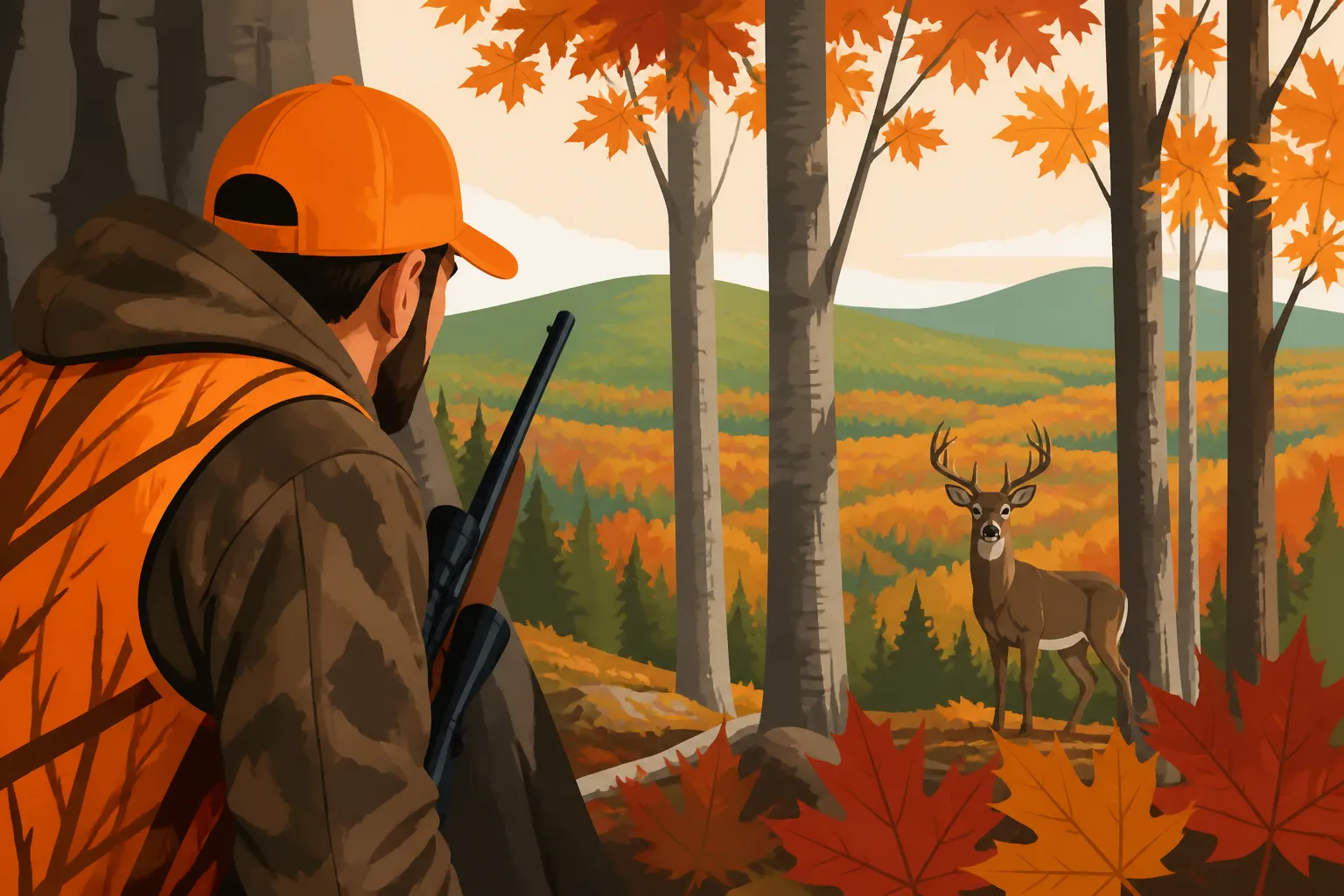
Picture a sugarbush: mature sugar maples, sometimes red maples, standing tall, often with a relatively open understory that's been thinned over decades for sap collection. This isn't your typical thick, brushy forest. The ground might be somewhat clear, allowing for easier movement for both you and the deer, but also making concealment a challenge. You’ll often find old logging roads or sap lines winding through these woods, which can act as deer highways or natural funnels.
While the canopy is dominated by maples, don't overlook pockets of other tree species. You might find a cluster of beech trees, remnants of an old apple orchard, or areas where softwoods like hemlock and spruce provide thicker thermal cover. These variations, no matter how small, are critical to deer, offering diverse food sources and bedding opportunities that break up the monotony of pure maple stands. Understanding these subtle shifts in habitat within a sugarbush can be the difference between seeing deer and just walking through pretty woods.
Deer Behavior and Food Sources in a Sugarbush
Deer are constantly seeking food, water, and cover, and a sugarbush provides a unique mix. In the spring and summer, they’ll browse on the tender new growth of maple saplings, leaves, and other understory plants. However, the real draw often comes in the fall when the mast crops mature. While maples don’t produce a traditional mast, if there are any oak or beech trees mixed in, those acorns and beech nuts become prime feeding locations. Even the budding branches of maples themselves can be a critical food source in late fall and winter.
Deer use the relatively open nature of a sugarbush to their advantage, too. They can see and hear predators (like us) coming from a distance, making them wary. However, they'll often bed down in areas of slightly thicker cover within or adjacent to the sugarbush, or along subtle rises that offer good visibility and a thermal advantage. Look for transition zones – where the mature maple stand meets a thicker cedar swamp, a patch of pines, or even an old field edge. These areas provide the security deer crave while allowing them quick access to food. Understanding where they feed, bed, and travel between these zones is key to intercepting them.
Scouting and Planning Your Sugarbush Hunt
Effective scouting is paramount when hunting sugarbush woodlots. These areas can be deceivingly uniform, so knowing how to read the subtle cues the deer leave behind and how to leverage modern tools will greatly increase your chances.
Reading the Sign: Tracks, Rubs, and Scrapes in a Sugarbush
In a sugarbush, deer sign often stands out more clearly against the relatively open forest floor. Look for well-worn trails, especially those that follow old logging paths, contour lines, or connect thicker cover to feeding areas. These are deer highways. Keep an eye out for fresh tracks – the sharper the edges, the more recent the passage. During the rut, you'll be specifically looking for rubs and scrapes. Bucks will rub their antlers on young saplings, often maples, to mark their territory. The size and freshness of these rubs can tell you a lot about the buck's size and recent activity.
Scrapes, often found under low-hanging branches, are another critical sign. Bucks will paw away the leaves, urinate, and sometimes chew on an overhanging branch, leaving behind a calling card for does. In a sugarbush, these might be less obvious than in dense woods, but when you find them, they are gold. Pay attention to clusters of rubs and scrapes, as these indicate areas of frequent buck activity. Don't just look for one or two; seek out lines or networks of them, especially along the edges where the sugarbush transitions into denser cover.
Utilizing Mapping Tools for Sugarbush Access and Layout
Modern mapping applications are an absolute game-changer when scouting a sugarbush. Tools like onX Hunt are invaluable for getting a bird's-eye view of the landscape before you even set foot in the woods. You can identify property lines with incredible accuracy, which is crucial in Vermont where private land often abuts public parcels or different landowners. Using the app, you can pinpoint potential access points, old logging roads that might serve as natural funnels, or even subtle topographical features like benches, draws, or small rises that deer might use for travel or bedding.
I've used onX Hunt countless times to identify thick pockets of cover that aerial photos might not immediately reveal, or to understand how a small stream or a change in elevation could create a natural funnel for deer movement. You can mark potential stand locations, track your movements, and even check wind direction against your proposed setup. This kind of detailed planning, especially when combined with on-the-ground scouting, helps you visualize how deer are using the entire sugarbush, including knowing where Reading Aerial Photos for Green Mountain Deer can help you find overlooked spots. It also helps you differentiate between privately owned sugarbush operations and state or federal land where hunting rules might differ, ensuring you stay legal.
Best Stand Locations: What to Look For
Selecting the right stand location in a sugarbush requires careful thought about deer movement and concealment. Because these woods can be more open, traditional treestand placement might feel exposed. Look for natural funnels created by the terrain, such as a narrow neck of timber between two larger blocks of woods, or a dip in a ridge that deer use to cross. The edges where the sugarbush transitions to thicker cover, a clear-cut, or an agricultural field are always high-percentage spots, offering deer both food and security.
Another prime location is along established deer trails that connect bedding areas to feeding grounds. Pay close attention to trails that intersect, as these are natural travel corridors. If you can find a subtle rise or a cluster of evergreens within the sugarbush, these spots can offer better concealment and a more commanding view. Consider the prevailing wind direction and thermals – especially if you're hunting in hilly or mountainous terrain, as a swirling wind can quickly give you away. Always have multiple approach and exit routes planned that minimize scent contamination and disturbance. For more on how to identify these key areas, consider studying Hunting a Funnel Between Two Woodlots – the principles apply perfectly here.
Effective Hunting Strategies for Sugarbush Woodlots
Hunting a sugarbush often demands a more nuanced approach than denser forest types. The open nature calls for different tactics, whether you're still-hunting slowly or trying to bring a buck in with calls.
Still-Hunting the Rolling Terrain
Still-hunting is perhaps one of the most effective strategies in a sugarbush. This isn't about sitting and waiting; it's about moving through the woods at an incredibly slow, deliberate pace, pausing frequently to observe your surroundings. Because the understory can be sparse, your visibility is often good, but so is the deer's. Take one or two steps, then stop and scan, looking for horizontal lines in a vertical world – the back of a deer, an antler tined, a flick of an ear.
Use the gentle rolling terrain and mature maple trunks for concealment. Move from tree to tree, using each as cover as you slowly advance. Focus your attention on drainages, subtle benches, and any patches of thicker cover you identified during your scouting. Pay particular attention to the wind, as deer will often circle downwind of you to confirm your presence. In the Green Mountains, thermals can be tricky, especially in the mornings and evenings, so understanding Wind and Thermals in Steep Green Mountain Terrain is crucial to avoid having your scent broadcast. This slow, patient approach allows you to cover ground effectively while minimizing your impact and increasing your chances of spotting a deer before it spots you.
Calling and Decoying in Maple Stands
The open nature of a sugarbush can actually work to your advantage when it comes to calling. Sounds travel further, and a buck cruising through might hear your call from a greater distance. Rattling antlers can be particularly effective during the rut, mimicking a sparring match between two bucks. The key is to start subtly, then increase intensity, followed by a long pause. Bucks in a sugarbush are often on the move, so they might investigate the sound of a challenge. Combine rattling with grunt calls to mimic a full deer interaction.
Doe bleats can also be effective, especially during the pre-rut and rut, to attract curious bucks. While decoying might be challenging in dense timber, in more open sugarbush areas, a single doe or buck decoy placed strategically might draw a buck into range. Ensure your decoy is visible but not in a completely open area where it looks unnatural. Always set up to allow for a shot to the side or slightly past your decoy, as bucks often circle downwind to scent-check the "intruder." To really perfect your vocal game, I highly recommend digging into Rattling and Grunting Vermont Bucks for advanced tips.
Adapting to Seasonal Changes
Hunting a sugarbush successfully means understanding how deer use the area throughout the different seasons. In the early archery season (September and early October), deer patterns are often food-driven. Focus your efforts on any areas with early dropping mast, like beech nuts, or where they are browsing on young maple growth. As the season progresses into the peak of the rut in early to mid-November, bucks become more mobile and less predictable, cruising widely for does. This is when still-hunting or strategically placed stands along travel corridors can be most effective.
Once rifle season has passed and we move into late-season muzzleloader, deer activity shifts back to food and thermal cover. In a sugarbush, if there are any remaining mast crops, they'll be hammered. Deer will also seek out dense softwood thickets adjacent to the sugarbush for thermal protection during cold snaps. Knowing where to find Late-Season Food Sources for Vermont Whitetails is crucial, and targeting the edges of the sugarbush that offer direct access to these secure bedding areas becomes your primary strategy. Your approach needs to be flexible, always considering the current conditions and deer behavior.
Overcoming Challenges and Maximizing Success
Hunting sugarbush woodlots comes with unique challenges, but with the right mindset and preparation, you can turn them into successful hunts. From navigating land ownership to dealing with Vermont's unpredictable weather, being prepared is key.
Navigating Private vs. Public Sugarbush Land
One of the biggest hurdles when hunting sugarbush woodlots is often land access. Many prime sugarbushes are privately owned and actively managed for syrup production. This means you absolutely need to obtain permission before stepping foot on the property. In Vermont, trespassing is a serious offense, and respecting private land is not just a courtesy, it’s the law. Start by identifying the landowner using property maps (like those found on onX Hunt) and then make a polite, in-person request. Be respectful, offer to help out, and be prepared for a "no." Building relationships with landowners can open up incredible opportunities.
On public lands that contain sugarbushes (such as parts of the Green Mountain National Forest or some State Forests), ensure you understand the specific regulations for that area. While public land offers access, it often comes with more hunting pressure. If you're looking for new areas, consider scouting different parcels of public land, perhaps by referring to Scouting Vermont Public Land Before Season. Even on public land, identifying heavily used areas versus overlooked corners is vital. Always carry your license and proof of permission if you’re on private ground, and adhere to all blaze orange requirements, especially if you're Hunting a Bow During the Rifle Season Overlap.
Weather Considerations and Their Impact
Vermont weather is famously fickle, and it plays a significant role in hunting a sugarbush. Early season hunts might be warm, requiring light, breathable layers. However, as fall progresses, cold snaps can bring frost and even early snow. Snowfall can be a hunter's best friend, as it reveals fresh tracks and makes it easier to follow deer movement. A light dusting can make still-hunting incredibly quiet, but a heavy, crusty snow can make noise unavoidable. Rain, while often miserable for the hunter, can also muffle your sounds and wash away your scent, potentially giving you an advantage.
However, rain and damp conditions also make it harder to find and follow blood trails. Be prepared for mud and slippery conditions underfoot, especially on old logging roads. Extreme cold in late season will push deer to seek thermal cover, often in dense conifers adjacent to the sugarbush, or in south-facing slopes that get more sun. Your gear choices will need to reflect these changes; nobody wants to be miserable and unproductive because they’re shivering uncontrollably. Having the right layers and knowing how to adapt your strategy to the conditions is paramount for staying out longer and increasing your odds.
Gear Essentials for a Sugarbush Hunt
Having the right gear makes all the difference when hunting a sugarbush. Because you might be doing a lot of walking or sitting for extended periods in variable conditions, comfort and functionality are key. First, think about your clothing: Layering for Vermont's Long Hunting Season is critical. Start with a moisture-wicking base layer, add insulating mid-layers, and top it off with a quiet, waterproof outer shell. This allows you to adjust to temperature changes and exertion levels.
Your footwear is equally important. Good quality, waterproof boots with excellent ankle support are a must for navigating potentially uneven terrain, mud, or snow. Quiet outsoles are beneficial for still-hunting. Best Boots for Green Mountain Ridge Terrain can give you some excellent options. A reliable GPS or mapping app (like onX Hunt on your phone) is non-negotiable for navigation, especially if you venture deep into unfamiliar territory. Don't forget binoculars for scanning the open woods, a good headlamp for pre-dawn walks or post-sunset retrieves, and a sharp knife for field dressing. Finally, carry a small pack with essentials like water, snacks, a first-aid kit, and blaze orange, even if not legally required, for visibility when still-hunting the rifle season overlap.
| Aspect of Sugarbush Hunting | Pros | Cons |
|---|---|---|
| Visibility | Often more open understory allows for better sight lines and spotting deer from a distance. | Deer can also see you more easily, requiring extreme caution and patience. |
| Terrain | Generally rolling, less extreme than true high country, potentially easier walking. | Can still be steep in spots, leading to challenging retrieves and thermal shifts. |
| Food Sources | Maple browse, potential for beech nuts/acorns if mixed hardwoods, late-season buds. | Less consistent mast crops compared to diverse oak/hickory forests; primarily maple-dependent. |
| Cover | Mature trees offer concealment when still-hunting; adjacent thickets provide bedding. | Relatively open, making it harder to hide stands and for deer to feel secure in the open. |
| Access | Old logging roads/sap lines provide good travel corridors for hunters and deer. | Many sugarbushes are private, requiring permission; public land sections may see higher pressure. |
| Scouting | Deer sign can be more apparent against the open forest floor. | Uniformity can make identifying key deer travel routes and subtle features more challenging without detailed mapping. |
| Calling Potential | Open woods allow calls to travel further, potentially attracting deer from a greater distance. | Deer might be warier due to better visibility, requiring more subtle or realistic calling techniques. |
| Weather Impact | Snow can create excellent tracking opportunities and quiet movement. | Rain can create slippery conditions; extreme cold can push deer out of the open sugarbush into denser cover. |
Disclaimer
This article is for general informational purposes only and does not constitute professional advice. Laws, prices and regulations vary by location and change over time. Consult a qualified professional for guidance on your specific situation.