Entry Routes Through a Cut Cornfield
Hunting cut cornfields in Vermont can be incredibly frustrating. What looks like an open invitation to spot deer often turns into a deer-spooking, heart-pounding exercise in futility, leaving you wondering if those smart Green Mountain whitetails saw you coming from a mile away. The challenge isn't just finding the deer; it's getting to them without blowing your cover. This guide will walk you through effective strategies and entry routes to successfully hunt these deceptively tricky agricultural landscapes.
The Deceptive Nature of Cut Cornfields for Deer Hunting
Many hunters look at a freshly cut cornfield and see an open, easy-to-read landscape. The reality, however, is far more nuanced. While cut cornfields are undeniable magnets for deer, they also present unique challenges that can easily thwart a hunter's efforts if not approached with careful consideration. Deer thrive in these environments, and their comfort makes them extra sensitive to disturbances.
Why Cut Cornfields Attract Deer
Once the combines have rolled through, leaving behind only stubble and scattered kernels, a cut cornfield becomes an irresistible buffet for white-tailed deer. This isn't just about the leftover corn; it's a multi-faceted attraction. Firstly, those residual kernels are a high-energy food source, especially critical as the colder Vermont days set in and natural forage becomes scarce. Deer will literally vacuum up every last morsel, often spending hours grazing in these fields. Secondly, the remaining stubble, though short, still offers a surprising amount of visual cover, particularly in low light conditions or when deer are bedded down in the middle of a large field. It's not thick woods, but it's enough to break up their outline against the ground, especially with their natural camouflage.
Furthermore, cut cornfields often act as natural travel corridors between bedding areas in dense timber and other food sources. Deer use the edges of these fields, or even subtle dips and rises within them, as highways. They know these areas intimately and feel relatively secure, even when actively feeding. The sheer volume of food and the established travel patterns make these fields prime real estate for deer throughout the fall, particularly as the rut approaches and bucks start to cruise for does that are frequenting these areas. They become social hubs, and understanding this magnet effect is the first step toward effective hunting.
The Hunter's Challenge: Visibility and Noise
For hunters, the very attributes that make cut cornfields so appealing to deer also make them incredibly challenging. The lack of tall, standing cover is the most obvious hurdle. While deer might find adequate concealment in the stubble, a human hunter, typically standing upright, is silhouetted against the horizon. This makes any approach through the open field a high-risk maneuver. Deer have incredible eyesight, especially for detecting movement, and a human form moving across a field is an unmistakable red flag.
Beyond visibility, noise is a significant factor. Walking through crunchy corn stubble can sound like a drum solo to wary deer. Every broken stalk, every scuff of a boot, echoes across the open space. This auditory signature is often enough to send deer scattering long before you ever get within range. Add in the prevailing wind, which can carry your scent across vast distances, and you begin to understand the complex array of senses you're up against. Deer in these fields are often relaxed but incredibly vigilant, relying on their collective senses to detect danger. Approaching without proper planning is almost guaranteed to result in spooked deer and an empty tag.
Scouting and Planning Your Approach
Success in a cut cornfield, much like success in any Vermont deer hunting scenario, hinges on meticulous scouting and thoughtful planning. You can't just walk in and expect to connect. You need to understand how the deer are using the field, what the local topography offers, and how to leverage environmental conditions to your advantage.
Reading the Sign and Identifying Deer Movement
Before you even think about an entry route, you need to understand where the deer are going and why. This means putting boots on the ground, or at least eyes on aerial maps. Look for classic deer sign: tracks, droppings, and well-worn trails. In a cut cornfield, these trails might not be as obvious as in thick woods, but deer will still leave tell-tale paths, especially along field edges or where they cross from one patch of timber to another. Pay close attention to the freshness of the sign. Are the tracks crisp, or are they weathered? Are the droppings dark and moist, or dry and faded? This tells you about recent activity patterns.
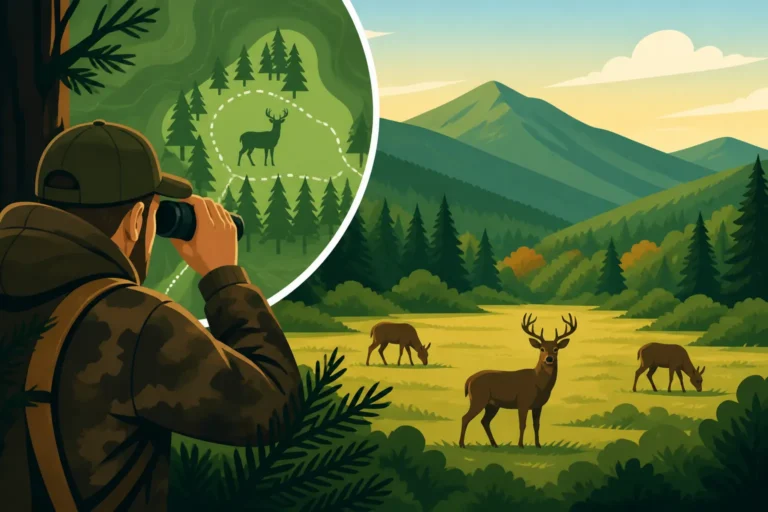
Don't just look for sign within the field; examine the adjacent cover. Where are the deer entering and exiting the field? Are there funnels created by small woodlots, drainage ditches, or brushy fencerows? These funnels are critical ambush points. I often use mapping tools like GoHunt to analyze aerial photos, looking for subtle terrain features or strips of cover that might concentrate deer movement. A small hump in the middle of a field, for example, could be a favored bedding spot offering a slight elevation advantage for deer to survey their surroundings. You'll want to connect these feeding areas to their bedding cover, which might be a dense softwood stand or a thicket along a river bottom. Understanding these connections is paramount, and applying techniques learned from Reading Vermont Mud for Fresh Deer Movement can significantly enhance your ability to decipher deer patterns here.
Wind, Thermals, and Time of Day
These three factors are not merely important; they are non-negotiable when hunting cut cornfields. Your scent is your biggest enemy in open terrain. Always, always, always approach with the wind in your favor, blowing your scent away from where you expect deer to be. This sounds basic, but in a field, wind can swirl more unpredictably than in dense timber, so having a good wind checker is essential. Watch how leaves move, how dust kicks up, or use a puff of milkweed silk to get a true read on the breeze.
Thermals play a role too, particularly around dawn and dusk. As the sun rises, thermals typically begin to lift uphill, carrying your scent with them. In the evening, as the air cools, thermals drop downhill. While cut cornfields might seem flat, even subtle changes in elevation, like a slight draw or a minor ridge, can create thermal currents that deer will instinctively use to their advantage. You need to understand how these will affect your scent cone and plan your approach accordingly. If you're hunting an area with more pronounced topography, revisiting the principles of Wind and Thermals in Steep Green Mountain Terrain will be invaluable.
As for time of day, low light is your best friend. Deer feel most secure in the twilight hours of dawn and dusk. This is when they are most likely to enter or exit the field to feed. Your entry should happen well before first light, or several hours before last light, giving you ample time to get into position and settle in. Approaching in the harsh light of midday is an invitation for detection. Deer have an uncanny ability to spot anything out of place when the sun is high.
Executing Effective Entry Routes
With your scouting complete and the wind checked, it's time to put your plan into action. The goal is always to get into your chosen ambush point without alerting a single deer. This requires slow, deliberate movement and a deep understanding of available cover, no matter how sparse it seems.
Utilizing Field Edges and Natural Cover
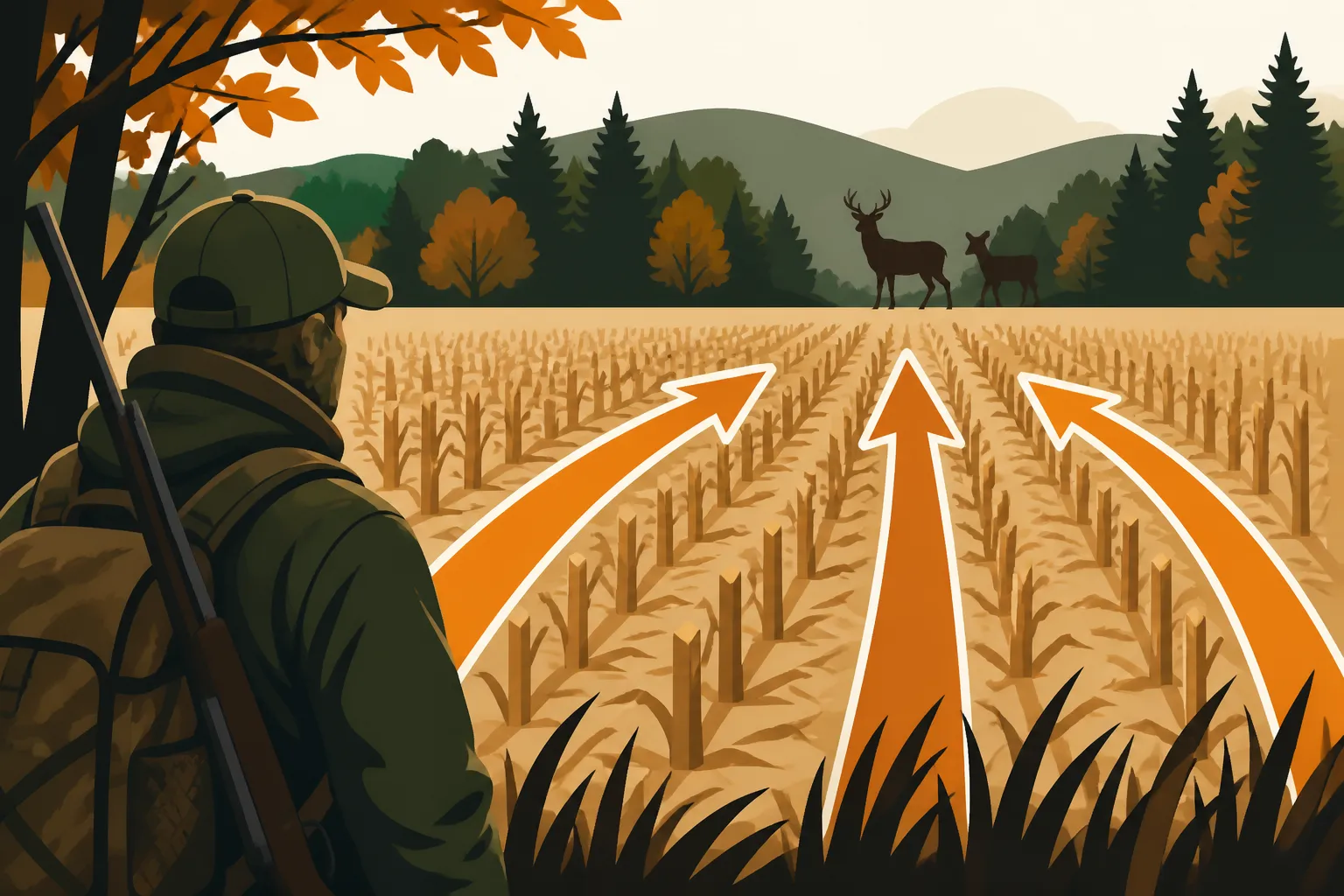
The most common and often most effective entry route for cut cornfields is to stick to the periphery. This means using existing natural cover along the edges of the field. Look for fencerows, drainage ditches, old logging roads, or the dense timber line that borders the field. These natural features provide crucial visual breaks and can mask your sound. If you're lucky enough to be Hunting a Champlain Valley Dairy Farm Edge, those old stone walls or brushy fencerows become your best friends.
When moving along these edges, it's not a race. Take small, deliberate steps, always scanning ahead. Use the terrain to your advantage: stay in the shadows, duck into depressions, and utilize any available vegetation. If you're moving along a wooded edge, stay just inside the timber line, using the trees for concealment while still being able to peek into the field. This also helps with scent control, as the trees can help break up and dissipate your scent. Remember, the idea is to flow with the landscape, becoming part of it, not a foreign object moving across it. Setting up on these edges can be highly productive, especially when following tips for Setting Up on a Dairy Farm Field Edge.
Strategic Incursions: The "Creep and Set" Method
Sometimes, sticking to the edge isn't enough, especially if the deer are feeding deep in the middle of a large field. This is where the "creep and set" method comes into play, a more aggressive but highly rewarding tactic. This involves slowly, carefully moving into the cut cornfield itself, using the remaining stubble and subtle undulations of the terrain for concealment. The key here is an extremely low profile. This might mean crawling on your hands and knees, or even belly crawling, for significant distances.
The idea is to identify a slight rise, a drainage ditch, or even a patch of slightly taller stubble that you can use as a temporary hide. You creep to that spot, then you set – meaning you become absolutely motionless, often hunkered down or even lying flat, and observe for a good 10-20 minutes. Use your binoculars to thoroughly glass the field, looking for flicking ears, a deer's back, or movement in the stubble. Only when the coast is clear, and you have identified your next piece of cover, do you move again. This is incredibly slow work, often covering only a few yards at a time. This method is particularly effective when trying to get closer to deer already in the field, or when setting up a ground blind. For advice on Using a Ground Blind on Public Land or Brushing In a Blind on a Field Edge, these methods of ingress are essential. The noise factor is still a concern, so move when the wind is rustling the stubble, or when background noise provides cover.
Entry During Different Seasons
The specific time of year will also influence your entry strategy. In the early archery season, before the corn is cut, deer might be deep within the standing corn, making entry routes virtually impossible without significant noise. Once the corn is down, usually by late October or November, the fields become prime. This is often when deer are building up fat reserves for winter, making them highly reliant on the leftover kernels. For instance, if you're hunting in November, you're likely right in the thick of the rut, and bucks will be cruising these fields checking for receptive does. Your entry then might focus on intercepting a buck moving along the field's periphery rather than just a feeding doe.
Late season, after the rifle season closes, can be particularly productive. Deer are often more nocturnal due to hunting pressure, but the caloric needs are still high, pushing them into fields during daylight. Your approach might need to be even more subtle, focusing on catching them in the first or last few minutes of legal shooting light. Understanding Late-Season Food Sources for Vermont Whitetails is crucial here, as cut corn remains a top choice. The more cold and snow there is, the more deer will rely on these exposed food sources.
| Strategy | Wind Direction | Optimal Time | Best Conditions | Notes |
|---|---|---|---|---|
| Field Edge Crawl | Quartering Away | Dawn/Dusk | Dense edge cover (brush, timber), subtle terrain | Slow movement, utilize every bit of cover, minimal noise. |
| Deep Field Creep | Direct Away | Pre-Dawn/Post-Dusk | Large fields, slight terrain rises, heavy stubble | Extremely slow, low profile, stop frequently to observe. |
| Timber Ingress | Any (with caution) | Pre-Dawn/Post-Dusk | Wooded finger extending into field, small islands | Stay in the trees as long as possible, clear shooting lanes. |
| Ditch/Swale Approach | Direct Away | Dawn/Dusk | Existing ditches or depressions in the field | Excellent for scent and visual cover, can be muddy. |
Gear and Mindset for Cut Cornfield Success
Hunting cut cornfields effectively isn't just about strategy; it's also about having the right gear and, perhaps even more importantly, the right mindset. These open environments demand meticulous attention to detail and a high degree of patience.
Essential Gear for Stealthy Movement
Quiet clothing is paramount. Any fabric that rustles or scrapes loudly against corn stubble will give you away. Opt for soft, quiet materials like fleece, wool, or brushed cotton. Layering is always smart in Vermont, allowing you to shed clothes as you move and avoid overheating, which can lead to excessive scent. Your boots should be comfortable and provide good traction, but also be as quiet as possible. Avoid hard-soled boots that will crunch loudly.
Optics are indispensable. A good pair of binoculars, like a quality 10×42, is essential for scanning the field thoroughly before and during your approach. You need to identify deer, but also subtle changes in terrain or cover that could hide them. A rangefinder is also highly recommended, as distances in open fields can be deceiving. Don't forget a headlamp with a red-light setting for pre-dawn entries, helping you see without blowing your night vision or alerting game. Finally, a mapping app like GoHunt on your phone, with downloaded offline maps, is invaluable for marking entry points, potential deer sign, and property boundaries, especially if you're on unfamiliar ground or engaging in Scouting Vermont Public Land Before Season. This digital advantage can make all the difference in navigating effectively and discreetly.
Patience, Persistence, and Adapting to Conditions
More than any other type of hunting, success in cut cornfields often comes down to sheer patience and persistence. You might spend an hour covering a few hundred yards, or sit for hours without seeing a single deer. Don't get discouraged. The deer are there, but they are incredibly wary. Rushing your approach or giving up too early will guarantee failure. Be prepared to back out quietly if the wind shifts unexpectedly or if you spot deer too close for a stealthy approach. There's no shame in retreating and trying another day, or even a different field.
You must also be prepared to adapt. Conditions change rapidly in Vermont. A sudden gust of wind, a passing rain shower, or even the subtle shift in light can alter deer behavior and your chances of success. Have multiple entry plans for different wind directions and be ready to switch tactics on the fly. Sometimes, the best strategy is simply to stay put, let the deer make the first move, and rely on your ability to remain still and unnoticed. Remember, every time you spook a deer, you're educating it, making it harder to hunt in the future. The more you put in, the more you learn, and the closer you get to understanding those elusive Green Mountain whitetails. The comprehensive guide to Hunting a Champlain Valley Dairy Farm Edge offers further insights into this adaptive mindset.
Disclaimer
Hunting is an inherently dangerous activity. Always prioritize safety, understand and follow all Vermont Fish & Wildlife Department regulations, and obtain appropriate licenses and permits. Be aware of your surroundings, know your target and what is beyond it, and hunt ethically and responsibly. This guide is for informational purposes only and does not replace official hunter education or regulations.