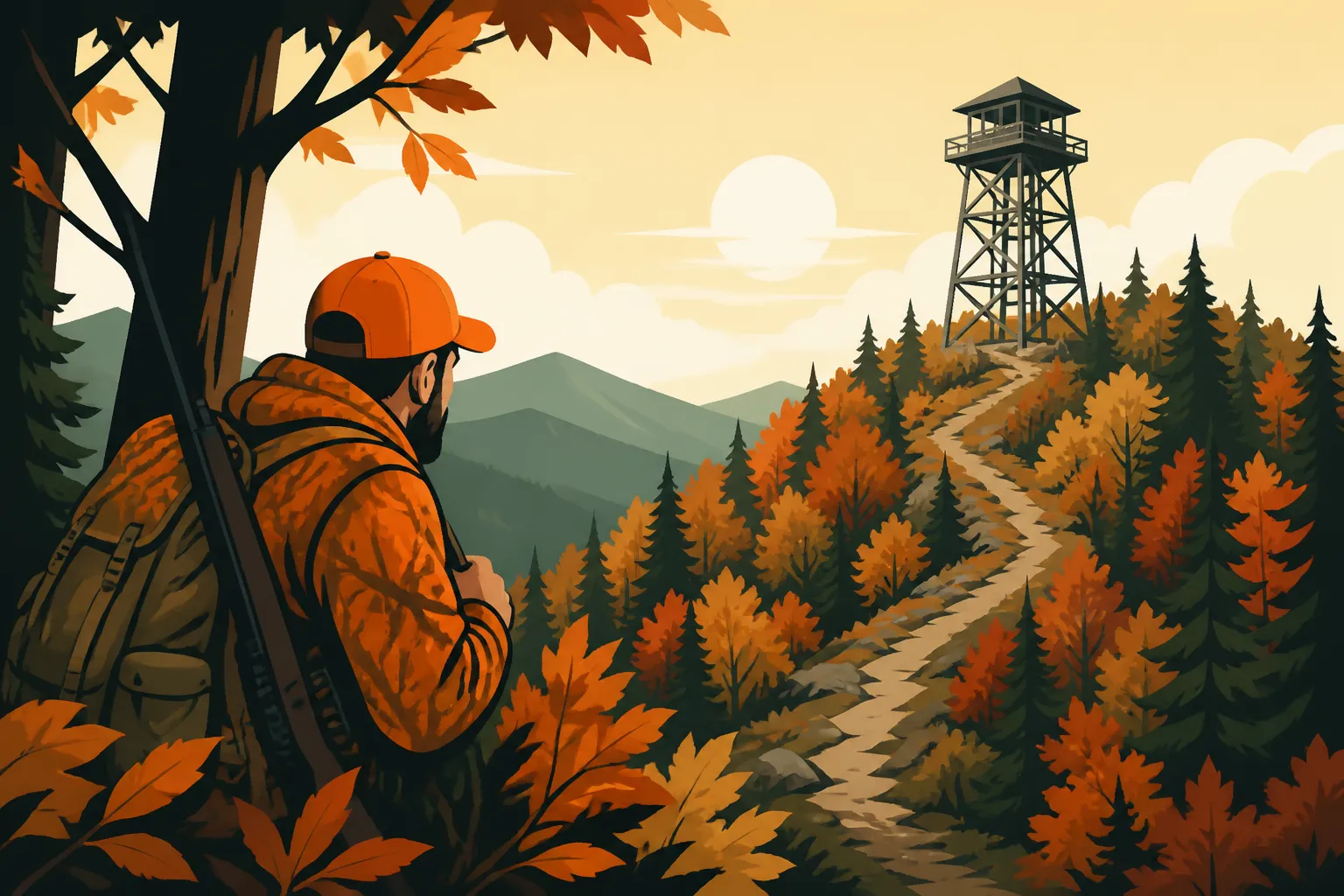
Hunting a Fire Tower Trail
Heading up a steep trail to a fire tower might seem like a great hike, but for us Vermont hunters, it presents a unique and often overlooked hunting opportunity. Many of us have hiked these trails in the summer, maybe taking in the incredible views, but we rarely consider them seriously as prime hunting real estate. The reality is, these high-elevation pathways and the surrounding terrain offer distinct advantages and challenges for deer, bear, and even turkeys, making them a worthy focus for serious hunters. This guide will help you understand the dynamics of hunting fire tower trails in Vermont, offering strategies to make your efforts on these vertical landscapes pay off.
The Unique Appeal of Vermont's Fire Tower Trails for Hunters
When you think of a fire tower, you probably picture panoramic views and perhaps a bit of a calf burn from the climb. What often escapes notice, though, is how these elevated points and the trails leading to them act as natural magnets for wildlife, especially during hunting season. It’s not just about the summit; it’s about the journey and the diverse habitats you encounter along the way.
Why Deer and Other Game Gravitate Towards These High-Elevation Features
Deer, bears, and even turkeys utilize elevated terrain for a variety of reasons, and fire tower trails often cut right through some of their preferred zones. For deer, those steep slopes and rocky outcrops provide fantastic thermal cover, especially as the weather cools. They can bed down just off the trail, out of the wind, and often catch the rising thermals in the morning, which helps them detect scent from below. During the rut, bucks will often cruise ridgelines and saddles, which these trails frequently traverse, looking for does. It's a natural travel corridor, not just for humans, but for the local wildlife population that becomes accustomed to certain paths of least resistance.
Black bears, always on the lookout for mast crops like beechnuts and acorns, will often forage heavily on the upper slopes and ridges where these trees are common. A fire tower trail might lead you directly through an old-growth beech stand that’s a bear buffet in the fall. Turkeys, too, will feed on these higher elevations, scratching through leaf litter for insects and seeds. In the spring, gobblers might even roost in the tall trees near the summit, using the elevation for safety and to project their calls across vast distances. The key is to understand that what looks like a simple hiking trail to us is a dynamic wildlife highway for them, driven by food, cover, and prevailing winds.
Understanding the Habitat Diversity Along the Ascent
A fire tower trail isn't a monolithic strip of woods; it's a journey through multiple microclimates and habitat types. As you ascend, you'll typically move from mixed hardwoods at lower elevations, often with thicker undergrowth, through more mature timber, and then into softwoods or even alpine zones near the summit. Each of these transitions offers different opportunities and challenges.
Lower sections might hold denser populations of deer browsing on saplings and regenerating clearcuts. These areas are often where you’ll find early-season food sources before the higher elevations are fully producing. As you climb, you might enter old-growth forests with mature mast-producing trees, ideal for both deer and bears. Higher still, dense conifer stands provide crucial wintering cover for deer and excellent escape cover year-round. Thinking about the trail as a series of distinct ecological zones, rather than just one long path, can help you pinpoint where game might be holding or moving at different times of the season. Knowing how to Reading a Green Mountain Deer Yard can be especially helpful when you get into those dense softwood pockets. It's truly a diverse landscape that demands a nuanced hunting approach, rather than a one-size-fits-all strategy.
Pre-Season Scouting and Planning Your Fire Tower Hunt
You wouldn't just wander into the woods blind for any hunt, and a fire tower trail hunt is no different. In fact, due to the varying terrain and elevation changes, detailed pre-season scouting and meticulous planning are even more critical. This is where your modern tools and old-fashioned legwork truly combine to give you an edge.
Leveraging Mapping Tools Like onX Hunt for Trail Analysis
Before you ever set foot on the mountain, your computer or phone can be your best friend. Digital mapping applications, particularly powerful ones like onX Hunt, are invaluable for dissecting fire tower trails. You can trace the trail itself, identify adjacent ridgelines, locate potential saddles, and even mark changes in timber type. Look for benches or flat spots on steep hillsides – these are often deer magnets where they will travel or bed. You can also identify old logging roads or lesser-used game trails that might intersect the main fire tower path, indicating natural travel corridors.
Use the topographical layers to understand the elevation changes and steepness. This will inform your physical preparation and help you predict thermals and wind patterns, which are critical in mountain hunting. For instance, you can use the software to identify potential funnel points created by changes in terrain, dense cover, or natural features like rock ledges. When you’re planning your approach, visualizing the terrain in advance can save you hours of wasted effort and ensure you’re spending your valuable hunting time in the most productive areas. I always spend hours with my Reading Aerial Photos for Green Mountain Deer before I even tie my boots.
Ground Truthing: What to Look For Before Season Opens
As helpful as digital maps are, there's absolutely no substitute for putting boots on the ground. A pre-season hike up and around the fire tower trail, well before hunting season opens, is essential. This is your chance to "ground truth" what you saw on your mapping app and discover things no digital image can show you. Look for fresh deer sign: tracks, rubs, scrapes, and droppings. Pay close attention to transition areas – where different timber types meet, where flat spots interrupt steep slopes, or where the main trail intersects a small drainage.
Identify water sources, even small seeps, as these can be crucial attractants in dry periods. Look for old apple trees or oak flats that might be dropping mast. During this scouting trip, don't just stick to the main trail. Walk parallel to it, 50-100 yards off, looking for parallel game trails. Often, animals will use the general direction of human trails but stay just far enough off to feel secure. These parallel game trails can be absolute gold for setting up a stand or planning a still-hunt. Remember, the goal isn't just to find game, but to understand why they're there and how they're using the terrain, particularly in relation to the main trail. This pre-season legwork is invaluable for understanding Where Vermont Bucks Bed in Thick Cover and how they might move in and out of those areas.
| Trail Section | Typical Habitat | Game Species Potential | Hunting Considerations |
|---|---|---|---|
| Lower Ascent | Mixed hardwoods, thick undergrowth, logging roads | Deer, turkey, bear | Denser cover, early food sources, scout for parallel trails |
| Mid-Elevation | Mature hardwoods, scattered softwoods, benches | Deer, bear, turkey | Mast crops, thermal bedding, natural funnels |
| Upper Ridgeline | Conifers, rock ledges, open timber | Deer (rut), bear, coyote | Travel corridors, escape cover, wind/thermals crucial |
| Summit Area | Exposed rock, scattered conifers, tower views | Limited direct hunting, good glassing | High wind, minimal cover; good for observing distant movement |
Strategic Approaches to Hunting Fire Tower Trails
Hunting fire tower trails isn't like hunting a flat woodlot. The elevation changes, the wind dynamics, and the sheer physical exertion involved demand a more thoughtful and adaptable strategy. It's a game of patience, smart movement, and understanding how animals use vertical space.
Still-Hunting the Ridgelines and Saddles
One of the most effective ways to hunt fire tower trails is to still-hunt the ridgelines and saddles they often lead to or traverse. Animals, especially bucks, frequently use these high-ground features as travel corridors, especially during the rut. A saddle is a natural low point between two higher peaks – think of it as a highway for deer moving from one drainage to another. If the fire tower trail goes over a saddle, that's a prime spot to focus.
When still-hunting, move incredibly slowly, taking a few steps and then pausing for several minutes to glass and listen. Use your binoculars constantly to pick apart the cover, looking for horizontal lines that don't belong in a vertical forest. Pay attention to the wind, as it will often swirl in these elevated areas. You’ll want to be extra vigilant about Wind and Thermals in Steep Green Mountain Terrain as they can dictate deer movement and your scent dispersion. Focus on hunting into the wind or with a crosswind that carries your scent away from where you expect game to be. Often, the best hunting isn't directly on the trail, but 20-50 yards off, where deer feel a bit more secure. These parallel paths are often well-worn and offer natural cover for your slow, deliberate approach. This active style of hunting is often most rewarding when deer are on the move, such as during the peak of the rut.
Setting Up Near Natural Funnels and Benches
While still-hunting is productive, setting up in a strategic ambush point can also pay dividends. Look for natural funnels created by the terrain. This could be a pinch point between a steep drop-off and the main trail, or where two fingers of timber converge. Benches, which are relatively flat sections on an otherwise steep hillside, are also prime locations. Deer love to travel these benches, as it's easier than constantly going up or down, and they often lead to bedding areas or feeding zones.
Identify these spots during your scouting trips and consider hanging a stand or setting up a ground blind if appropriate. A good location for a treestand might be at a transition line between a dense softwood thicket and a more open hardwood ridge, especially if there's a bench connecting them. With a mapping tool like GoHunt, you can really drill down into these micro-terrain features and pinpoint exactly where these funnels and benches lie. Remember, the animals are looking for the path of least resistance and the most cover, so placing yourself along those routes will increase your chances of an encounter. Don't be afraid to walk a little farther and climb a little higher to get into one of these honey holes; sometimes the extra effort is exactly what it takes to find unpressured game.
Adapting to Weather and Pressure on High Ground
Weather conditions in the mountains can change rapidly and dramatically, and hunting fire tower trails means you need to be prepared and adaptable. A sunny morning can quickly turn into a cold, windy, and wet afternoon. Dress in layers, always with good rain gear, and ensure your boots are up to the challenge of steep, often rocky and muddy terrain. Check out Best Boots for Green Mountain Ridge Terrain for ideas.
Deer, bears, and turkeys will react to these weather shifts. High winds often make deer bed down in thick cover, reducing their movement. Heavy rain can also keep them hunkered down. After a storm, however, especially when the wind dies down, game can become very active. Snowfall can be a huge advantage, allowing you to track fresh movement. Similarly, understand the hunting pressure. Fire tower trails, especially those easily accessible, can see a fair amount of foot traffic. This means deer may go nocturnal or move to even thicker, more remote cover. Your strategy might need to shift from targeting the main trail to focusing on those remote parallel game trails or deeper bedding areas that are harder to reach. Knowing how to adapt to Hunting Pressure on Vermont Public Land is key to success.
Essential Gear and Safety Considerations for Fire Tower Hunts
Hunting a fire tower trail is an adventure, and like any backcountry excursion, it requires careful thought about your gear and an unwavering commitment to safety. The mountains of Vermont are beautiful, but they demand respect.
Packing Smart for Steep Terrain and Variable Conditions
Given the physical demands of climbing a fire tower trail, smart packing is paramount. Every ounce counts. Your backpack should contain essentials: water, high-energy snacks, a first-aid kit, a headlamp (even for a day hunt, you never know), a knife, fire-starting materials, and extra layers. For layering, consider a moisture-wicking base layer like those discussed in Best Base Layer for a Steep Green Mountain Hike, an insulating mid-layer, and a waterproof/windproof outer shell. Even if it's warm at the trailhead, conditions at the summit can be vastly different.
Navigation is critical. While you might know the main trail, it's easy to get disoriented once you venture off. A reliable GPS unit or a smartphone with a robust mapping app like onX Hunt is non-negotiable. Always carry a physical map and compass as a backup, and know how to use them. If you're going deep, a satellite communicator is a smart addition, especially in areas with no cell service. Finally, don't forget game processing gear: good gloves, game bags, and a sharp knife are essential if you're fortunate enough to harvest an animal. Remember, getting an animal out of a steep ravine can be a monumental task, so plan for that possibility.
Navigating Public Access and Hunter Etiquette
Most fire tower trails in Vermont are on public land, often within the Hunting Vermont's Green Mountain National Forest or state forests. This means they are open to hunters, but it also means you'll likely share the woods with other users – hikers, bird watchers, and other hunters. Always be aware of your surroundings, identify your target positively, and be absolutely certain of what is beyond your target. Blaze orange requirements during rifle season are strict, so ensure you meet those guidelines, even if you're only bowhunting during the Hunting a Bow During the Rifle Season Overlap.
Hunter etiquette is just as important. If you encounter other hunters or hikers, be courteous. Give them space. If someone is clearly hunting a specific area, move on and find another spot. Leave no trace – pack out everything you pack in, including spent shell casings or food wrappers. Public land is a privilege, and we all have a responsibility to keep it pristine and accessible. It's not just about getting your game; it's about being a responsible steward of the land and a respectful member of the outdoor community.
Disclaimer
This article is for general informational purposes only and does not constitute professional advice. Laws, prices and regulations vary by location and change over time. Consult a qualified professional for guidance on your specific situation.