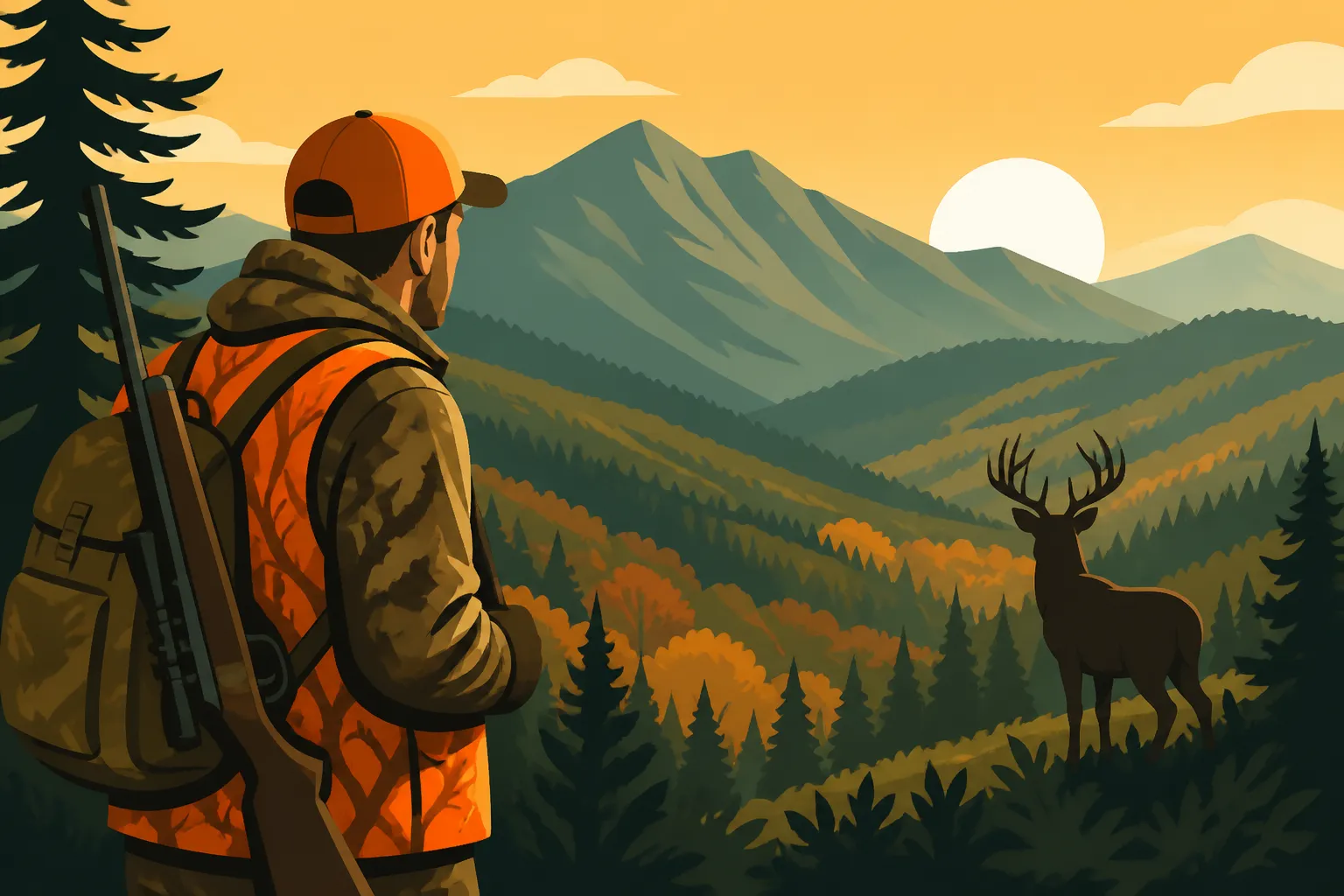
Hunting the Worcester Range Timber
Hunting the expansive timber of Vermont's Worcester Range presents a unique challenge and reward for any hunter. This guide is dedicated to helping you decipher its dense forests, navigate its steep slopes, and develop the strategies needed to successfully pursue deer, bear, and other game in this rugged, beautiful part of the Green Mountain State.
Understanding the Worcester Range Timber Habitat
The Worcester Range, stretching north-south through the heart of Vermont, is characterized by its significant elevation changes and a beautiful, yet demanding, mix of timber. It's not your flat farmland hunting, that's for sure. The landscape here demands respect and a good understanding of how game uses the terrain and varied forest types.
The Landscape and Its Cover
When you step into the Worcester Range timber, you're entering a world dominated by forest. At lower and mid-elevations, you'll primarily encounter northern hardwood forests—think towering sugar maples, beeches, and yellow birches. These areas often have a more open understory, especially if the canopy is mature and dense. But don't let that fool you; pockets of thick regenerating timber from past logging operations, or blowdowns from winter storms, create incredibly dense cover. As you climb higher, particularly on north-facing slopes and at the highest elevations, the forest transitions into spruce-fir stands. These conifer woods are often incredibly thick, creating almost impenetrable walls of evergreens that provide exceptional thermal cover for deer during harsh winters and security for all game throughout the year.
The topography itself plays a massive role. You'll find deep ravines, steep ridge lines, and hidden benches that create natural funnels and bedding areas. Understanding these transitions – from open hardwoods to thick spruce, from gentle slopes to sheer rock faces – is key to predicting game movement. Deer will often travel along contour lines, avoiding unnecessary elevation changes, especially when they can find cover. Bears, on the other hand, will utilize those steep, dense areas for bedding and escape. The varied cover also means that what might be a productive still-hunting ground in one section could be an impenetrable bedding area just a few hundred yards away.
Food Sources and Deer Movement
The diverse timber in the Worcester Range offers a variety of food sources, which directly influences where deer, bear, and other game will be throughout the seasons. In the hardwood sections, mast crops are king. Beech trees, in particular, can be absolute magnets for deer and bear when they drop their nuts in the fall. If it's a good mast year, you can bet that many animals will be focused on these areas, sometimes even pulling them away from traditional agricultural food sources further down in the valleys. Keep an eye out for fresh beech nuts on the forest floor, and deer sign like disturbed leaves or fresh scat will confirm their presence.
Beyond hard mast, deer rely heavily on browse—the twigs and buds of young trees and shrubs. Areas that have seen recent timber harvesting, or natural disturbances like wind damage, often sprout a dense understory of regenerating hardwoods and softwoods. These clearcuts and young regrowth areas, though tough to hunt, can be vital feeding grounds and bedding cover. You'll often find deer trails skirting the edges of these thickets, or even tunnels running through them, offering ambush opportunities. Conversely, in years with poor mast crops, deer will spread out more, relying on this browse and whatever persistent soft mast (like wild apple trees in old clearings or along stone walls) they can find. Understanding the mast crop situation each year is a huge piece of the puzzle for locating deer in these timbered mountains.
Navigating and Accessing the Worcester Range
Successfully hunting the Worcester Range timber hinges on knowing how to get into these areas and, crucially, how to navigate them once you're there. This isn't flat, easy terrain, and cell service can be spotty at best. Preparedness is paramount.
Public Access Points and State Forests
Much of the Worcester Range is comprised of state forest land, intermingled with private parcels. This means you have a significant amount of public ground to explore, but it's essential to know the boundaries. Vermont's state forests, like the Mount Mansfield State Forest or parts of the Camels Hump State Forest that extend into the Worcester foothills, offer numerous access points. These often include designated parking areas at trailheads, or access along Class 3 and 4 town roads that may become gated further in. Always check road conditions and access rules, especially during mud season or after heavy snows. Some of these logging roads might be open to foot traffic or even ATV access for certain purposes, but it's vital to confirm.
When planning your hunt, be sure to consult up-to-date maps provided by the Vermont Fish and Wildlife Department, as well as digital mapping apps like onX Hunt. These tools are indispensable for identifying property lines. Remember, even if you’re on public land, surrounding parcels might be private and posted. Respecting landowners and understanding Vermont State Forest Hunting Rules are critical for a good hunting experience and maintaining access for everyone. Don't be shy about knocking on doors if you see a promising private woodlot adjacent to public land; sometimes, a friendly chat can open up new opportunities.
Mapping and Technology for the Timber
Given the dense cover and often challenging terrain of the Worcester Range, reliable navigation is non-negotiable. Don't rely solely on cell service; it's notoriously unreliable in these remote timbered valleys and ridgelines. A GPS unit or a smartphone with a robust offline mapping application is your best friend. I personally swear by onX Hunt. It allows you to download detailed satellite imagery and topographic maps for offline use, meaning you'll have accurate property boundaries, trails, and contour lines even when your phone has no bars. You can mark potential stand locations, food sources, and even your route in and out, which is a lifesaver when you're tracking a deer in fresh snow or trying to find your way back to the truck after dark.
Beyond simply not getting lost, these mapping tools help you scout from home, identifying potential funnels, saddles, and benches that might hold deer. Reading Aerial Photos for Green Mountain Deer can give you a massive leg up before you even step foot in the woods. You can pinpoint old clearcuts, transition zones between hardwood and softwood, and areas of dense cover where deer are likely to bed. For instance, high-elevation benches on the leeward side of a ridge, sheltered from the prevailing wind, often serve as prime bedding areas. Studying the contours with an app like onX Hunt before your hunt can help you plan your approach and exit routes effectively. Also, don't forget the official Using the Fish and Wildlife App Without Cell Service for quick checks on regulations and reporting game.
| Terrain Feature | Description | Hunting Significance | Navigation Tips |
|---|---|---|---|
| Ridge Lines | Elevated, linear landforms; can be steep or rounded. | Travel corridors, bedding on leeward sides, natural funnels. | Use contours on map to find saddles; watch for thermals. |
| Saddles | Dips or low points along a ridge line. | High traffic areas for deer crossing between drainages. | Prime ambush points; mark on onX Hunt. |
| Benches | Flat or gently sloped areas on a hillside. | Excellent bedding areas, especially with dense cover. | Often hidden; look for subtle contour changes on topo maps. |
| Ravines/Drainages | Steep-sided valleys; often contain small creeks. | Travel routes, can funnel deer, good for accessing higher ground. | Be aware of steep descents/ascents; can be noisy. |
| Hardwood Stands | Deciduous trees (maple, beech, birch). | Mast crops, browse, more open for visibility/still-hunting. | Focus on mast years; look for rubs/scrapes. |
| Softwood Thickets | Coniferous trees (spruce, fir); very dense. | Thermal cover, bedding, escape routes, security. | Hunt edges; still-hunt slowly or use ground blinds. |
Effective Hunting Strategies in the Timber
Hunting the timbered slopes of the Worcester Range is a different game than hunting open fields or brushy lowlands. It requires patience, keen observation, and a strategy tailored to the specific environment.
Still-Hunting and Stand Placement
Still-hunting is perhaps the most effective method for covering ground in the Worcester Range timber. This means moving slowly, deliberately, and quietly, taking a few steps then pausing for several minutes to observe and listen. The dense cover often means that a deer can be incredibly close without you knowing it, and rushing through the woods will almost guarantee you push game out of the area. Focus on areas where timber transitions, like the edge where dense spruce gives way to more open hardwoods, or along old logging roads. These transition zones are natural travel corridors and often hold deer feeding or moving between bedding and feeding areas. Pay close attention to subtle changes in elevation, old logging decks, or natural funnels created by the terrain. Still-Hunting Green Mountain National Forest Timber techniques are perfectly applicable here.
When it comes to stand placement, look for those natural funnels. A saddle between two ridge points, a pinch point where a dense thicket forces deer into a narrow travel lane, or a bench overlooking a steep ravine are all prime spots. Wind and thermals are absolutely critical in this mountainous terrain. Always try to set up so your scent isn't blowing into where you expect deer to approach from. In the mornings, thermals generally rise as the air warms, pulling your scent uphill. In the evenings, they typically fall, carrying your scent downhill. Understanding Wind and Thermals in Steep Green Mountain Terrain is not just good practice, it's essential for success. Don't be afraid to move your stand if conditions change or if you find fresh sign elsewhere.
Reading Sign and Understanding Thermals
The timber in the Worcester Range is a busy place, and knowing how to read the "newspaper of the woods" is fundamental. Fresh rubs on small trees indicate bucks are actively marking their territory, especially during the pre-rut and rut. Scrapes, particularly those along logging roads or at the base of large trees, are also key indicators of buck activity. Pay attention to their freshness—a freshly pawed-out scrape with a broken licking branch is a hot sign. You might also find Scrape Lines Along a Logging Road, which can be excellent travel corridors for bucks checking for does. Droppings and tracks are obvious signs, but look for how consistent they are. A heavily used trail with fresh tracks every time you check it is a winner.
Beyond deer, look for other signs like bear scat or claw marks on beech trees where they've been climbing for nuts. Turkeys will leave distinctive droppings and wing prints where they've been dusting. The more you scout, the better you become at distinguishing fresh sign from old, and understanding what story the woods are telling you. Remember, even if you don't find a lot of game sign, understanding how the terrain itself funnels or restricts animal movement can be just as valuable. A tight saddle is a tight saddle, whether there are fresh tracks there today or not; if game is in the area, they'll likely use it. Learning to interpret Reading Vermont Mud for Fresh Deer Movement can provide valuable clues about recent activity.
Essential Gear for Worcester Range Hunts
Hunting the Worcester Range timber means being prepared for physically demanding conditions and unpredictable weather. Your gear choices can make or break your hunt, impacting your comfort, safety, and ultimately, your success.
Clothing and Footwear for Mountain Terrain
Layering is key when hunting in the Green Mountains, and the Worcester Range is no exception. Temperatures can swing dramatically from morning to midday, and elevation changes mean you'll work up a sweat on the climb only to cool down rapidly once you stop. Start with a good moisture-wicking base layer to manage sweat, followed by insulating layers like fleece or wool, and topped off with a waterproof, breathable outer shell. Having adaptable layers is far more effective than one heavy coat. Remember your blaze orange, even if bowhunting, especially during the rifle overlap season. Having a lightweight but warm vest or jacket that allows you to fulfill Blaze Orange Layering Options is crucial.
Your footwear is arguably the most important piece of gear. You'll be traversing steep, uneven ground, often wet and rocky. A sturdy pair of waterproof boots with excellent ankle support and aggressive traction is non-negotiable. Look for boots designed for mountain hunting or backpacking. Depending on the time of year, consider insulated boots for late-season hunts to keep your feet warm during long sits. Boots for Green Mountain Ridge Terrain are essential for maintaining stability and comfort over long days. Gaiters can also be a godsend for keeping snow, mud, and debris out of your boots, especially when pushing through thick undergrowth or crossing small streams.
Navigation and Safety Preparedness
Beyond your onX Hunt app or GPS, always carry a physical compass and a paper map as a backup. Batteries die, and electronics can fail. Knowing basic land navigation skills could be a lifesaver. A good headlamp with extra batteries is crucial for early morning hikes in and late-night walks out after a successful hunt or tracking job. Remember, it gets dark fast in the dense timber. A small first-aid kit with essentials for cuts, blisters, and minor emergencies is also a must.
Consider carrying a personal locator beacon (PLB) or a satellite messenger device, especially if you're venturing deep into the more remote sections where cell service is non-existent. Devices like a Garmin inReach or a Zoleo can send SOS signals, track your location, and even allow two-way text communication with loved ones, providing immense peace of mind. A sharp knife, a small saw or folding limb trimmers, a fire starter, and enough water and high-energy snacks for longer than you expect to be out round out your essential safety kit. Proper Packing for a Northeast Kingdom Moose Hunt principles, while for a different animal, illustrate the level of preparedness needed for serious backcountry hunting in Vermont.
Disclaimer
This article is for general informational purposes only and does not constitute professional advice. Laws, prices and regulations vary by location and change over time. Consult a qualified professional for guidance on your specific situation.