Best Arrow Weight for Vermont Deer
For many deer hunters in Vermont, the question of arrow weight can feel like a deep dive into physics, full of intimidating numbers and conflicting advice. It’s easy to get caught up in the allure of blazing fast arrows, seeing those impressive speed ratings on new bows, and thinking that speed alone is the holy grail for taking down a whitetail. But the truth is, while speed has its place, it's often a much heavier, more stable arrow that delivers the consistent, deep penetration needed for a quick, ethical harvest, especially when dealing with a tough Vermont buck in our varied terrain. This guide will walk you through the nuances of arrow weight, helping you understand what truly matters for successful deer hunting here in the Green Mountain State.
Understanding the Balance: Speed, Momentum, and Kinetic Energy
When you’re standing at the pro shop, looking at dozens of arrow shafts, it’s natural to want the one that flies the fastest. That initial burst of speed is definitely satisfying, and a flatter trajectory can certainly instill confidence on longer shots. However, when it comes to punching through bone and hide, especially on a quartering shot, raw speed often takes a backseat to other critical factors like momentum and kinetic energy.
Why Arrow Weight Matters More Than You Think
Think about it this way: a feather shot from a high-powered bow might leave the string at an incredible speed, but it won't penetrate a deer. A heavier object, even at a slightly slower speed, carries far more energy and mass that it can transfer upon impact. This is the essence of momentum. Kinetic energy (KE) is the energy an arrow possesses due to its motion, and it's certainly important for initial impact. But it's momentum that dictates how well that arrow continues to push through resistance once it hits the target, whether that's thick hide, muscle, or even bone.
In Vermont, we hunt deer that can be surprisingly rugged. Whether you’re drawing back on a mature buck in the hardwoods of the Green Mountains or a doe feeding on an apple orchard edge in the Champlain Valley, you need an arrow that won't just hit, but will drive through. Shots aren't always perfect broadside, and sometimes a branch or a stiff gust of wind can affect flight. A heavier arrow is more forgiving of minor imperfections and carries more punch to ensure a pass-through, which is absolutely critical for a strong blood trail and a quick recovery. White-Tailed Deer Across Vermont are tough animals, and they deserve our best efforts for a swift, humane harvest.
The Trade-Offs of Lighter vs. Heavier Arrows
Every hunting setup involves trade-offs, and arrow weight is no exception. Lighter arrows, typically those under 400 grains total weight, boast impressive speeds and a flatter trajectory. This can be appealing if you anticipate longer shots or hunt in wide-open country where precise range estimation might be challenging beyond 40 yards. They might feel good coming off the bow, with less perceived hand shock. However, this speed often comes at a cost: reduced momentum, making them less efficient at penetrating dense tissue or bone. They are also generally more susceptible to wind drift, which can be a real concern on exposed ridges or in open fields.
On the other hand, heavier arrows, generally 450 grains and up, will leave your bow at a slower speed, resulting in a more arched trajectory. This means you need to be more dialed in with your range estimation, especially beyond 30 yards. But what they lack in flat trajectory, they more than make up for in penetration and stability. A heavier arrow is less affected by wind, quieter out of the bow (often leading to less deer jump), and delivers a far more devastating blow upon impact. For the close-quarters hunting common in Vermont’s timber, where shots are often 30 yards or less, the benefits of superior penetration often far outweigh the slight decrease in speed or flatter flight. When you're Hunting a Funnel Between Two Woodlots or in a thick Reading a Green Mountain Deer Yard, that extra penetration capability can make all the difference.
Factors Influencing Your Ideal Arrow Weight for Vermont Deer
Choosing the "best" arrow weight isn't a one-size-fits-all equation; it's a careful calibration based on several key elements unique to your setup and hunting style. What works perfectly for one hunter might be less than ideal for another, even when targeting the same species. It's about finding that sweet spot that maximizes your chances for an ethical kill here in Vermont.
Your Bow Setup: Draw Weight and Length
The foundation of your arrow choice really starts with your bow itself. Your draw weight and draw length dictate how much energy your bow can impart to an arrow. A hunter pulling a higher draw weight, say 65-70 pounds, can more easily propel a heavier arrow with sufficient speed and kinetic energy. This allows them to lean into the benefits of heavier arrows (more momentum, better penetration) without sacrificing too much speed. On the flip side, someone shooting a lighter draw weight, perhaps 40-50 pounds, might need to be more mindful. While they still want a heavy enough arrow for good penetration, going too heavy might result in a dangerously slow arrow speed, which can compromise accuracy and energy transfer at longer distances.
It’s about maintaining a balance. For those with lighter draw weights, a total arrow weight in the 400-450 grain range can often be a great compromise, providing much better penetration than ultralight arrows while still maintaining reasonable speed. Regardless of your draw weight, proper tuning of your bow is paramount. A well-tuned bow, where the arrow leaves cleanly and flies true, will shoot a properly spined arrow of any weight far better than a poorly tuned bow will shoot any arrow, no matter its weight. If you're struggling, a visit to a pro shop for a thorough tuning can work wonders for your arrow flight. Consider what's involved in Tuning a Bow for Broadhead Flight to maximize your setup's efficiency.
Hunting Conditions: Shots in the Timber vs. Openings
Vermont hunting is incredibly diverse, from the dense spruce thickets of the Northeast Kingdom to the rolling agricultural fields of the Champlain Valley. Your typical hunting conditions should heavily influence your arrow weight decision. If you primarily hunt tight timber, dense cover, or brushy edges where shots are consistently 30 yards and under – which is a very common scenario for Vermont archers – the trajectory difference between a lighter and heavier arrow is almost negligible. In these situations, the ability of a heavier arrow to smash through a rib or penetrate deeper on an awkward angle becomes incredibly valuable.
Conversely, if you find yourself hunting more open country, perhaps Hunting a Standing Apple Orchard or along a large power line where 40-50 yard shots are more common, a slightly flatter shooting arrow might seem appealing. However, even in these scenarios, a heavier arrow's resistance to wind drift can be a huge advantage. Imagine aiming for that trophy buck at 45 yards, and a sudden gust pushes your light arrow off course. A heavier arrow is less prone to this. Most Vermont archers will find themselves in closer quarters, making penetration the dominant factor. Whether you're in a stand Hanging a Stand on a Champlain Valley Field Edge or carefully Hunting a Ridge-Top Saddle for Rutting Bucks, a heavy, stable arrow is a reliable choice.
Broadhead Choice: Fixed Blades vs. Mechanicals
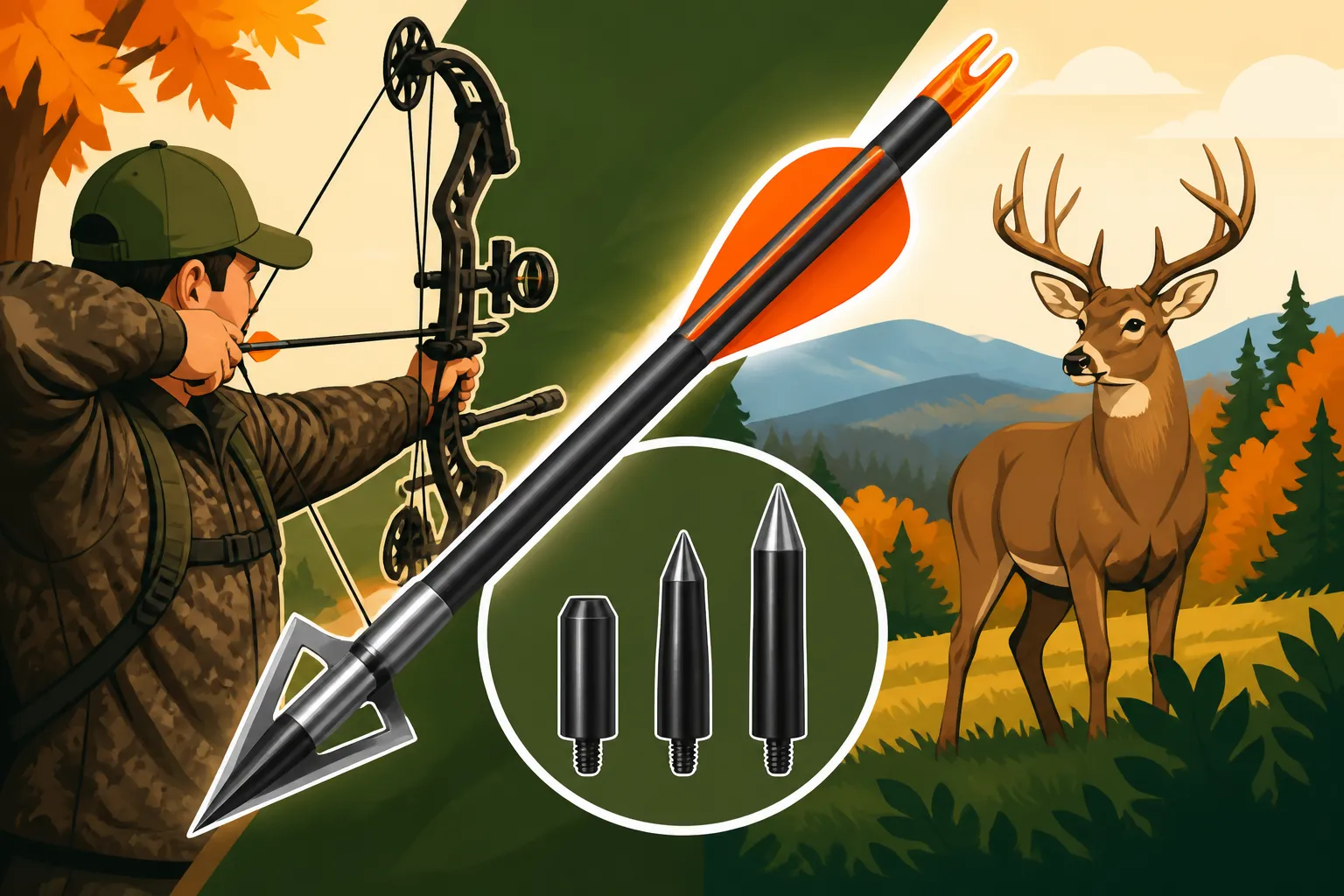
The type of broadhead you choose is inextricably linked to your ideal arrow weight. Each broadhead type has different energy requirements and performance characteristics that benefit from a well-matched arrow. Fixed-blade broadheads, with their unyielding construction, rely less on kinetic energy for initial deployment since there are no moving parts to open. They are exceptionally efficient at transferring the arrow's momentum into cutting energy, making them an excellent pairing with heavier arrows for maximum penetration, even on tough bone.
Mechanical broadheads, on the other hand, are designed to open upon impact, creating a larger cutting diameter. This deployment mechanism requires a certain amount of kinetic energy to function reliably. While modern mechanicals are incredibly robust, pairing them with a slightly heavier arrow that delivers ample kinetic energy and momentum can ensure consistent deployment and deep penetration, even on challenging shots through hide and muscle. For many Vermont hunters, a heavier arrow (450+ grains) combined with a well-designed mechanical broadhead offers a potent combination of wide cutting diameter and robust penetration, maximizing the chances of a clean pass-through. If you're still deciding, take a look at our deeper dive into Best Broadhead for a Vermont Whitetail and Fixed Versus Mechanical Broadheads in Thick Cover for more insights.
Finding Your Sweet Spot: A Practical Approach
The journey to finding your optimal arrow weight for Vermont deer isn't just about reading charts; it's about practical application and understanding how your setup performs in real-world scenarios. It's a blend of science and experience, ensuring that when the moment of truth arrives, you have full confidence in your arrow's ability to do its job.
Calculating FOC and Why It's Important
One crucial factor often discussed alongside arrow weight is FOC, or Front of Center. This measurement indicates how much of your arrow's total weight is concentrated in the front half. A higher FOC generally means greater stability in flight, much like a dart. The more weight forward, the more the arrow wants to maintain a straight path, even when encountering slight breezes or inconsistencies in your release. While general recommendations often suggest an FOC between 10-15%, some advanced setups push this even higher, into the 20% range, for extreme penetration and stability.
Achieving a higher FOC usually involves using heavier inserts in the front of your arrow shaft, pairing them with heavier broadheads, or selecting an arrow shaft that naturally has more weight distributed forward. While the exact calculation involves measuring the arrow's total length and balance point, the key takeaway is that an arrow with sufficient FOC flies more consistently and is less prone to fishtailing or porpoising. This stability translates directly into more accurate shots and improved penetration, as the arrow maintains a straight path into the target rather than yawing. When you're aiming at a vital zone, knowing your arrow will fly true is half the battle.
Testing Different Arrow Weights in the Field
Reading about arrow weight is one thing; experiencing it is another entirely. The best way to determine your ideal arrow weight is to test different setups thoroughly at the range and in conditions that mimic your actual hunting environment. Don't just pick an arrow based on an article; shoot it. Purchase a few shafts of different weights or configurations (perhaps heavier inserts, different broadheads) and spend time sending them downrange. Pay attention to how the arrow feels coming off your bow, the sound it makes, and most importantly, how it groups at various distances.
Practice shooting from different positions – off the ground, from a simulated treestand height, and even from inside a ground blind if that's part of your strategy. Using a Ground Blind on Public Land or from an elevated stand changes your angles and can reveal subtle differences in arrow flight. Observe how the arrows perform at 20, 30, and 40 yards, as these are likely your most common shooting distances for deer in Vermont. Notice any differences in trajectory and how quickly the arrow drops. This hands-on testing will build confidence and help you intuitively understand what feels right and performs best for you.
The "GoHunt" Approach to Gear Selection
When you're trying to dial in your archery setup, especially with something as critical as arrow weight, it can feel like there are endless options. This is where a structured approach to gear selection becomes invaluable. Services like GoHunt are great examples of platforms that empower hunters to make informed decisions by providing detailed data and analysis on a vast array of hunting gear, including arrows, broadheads, and other accessories. They help you move beyond anecdotal evidence and look at the actual performance characteristics that matter.
Instead of just grabbing the flashiest, fastest arrow, GoHunt encourages hunters to consider their specific hunting objectives, bow setup, and the game they're pursuing. They help you analyze how different arrow weights interact with your draw weight, broadhead choice, and desired outcome (e.g., maximum penetration vs. flat trajectory). This data-driven approach helps you create a truly optimized system, ensuring that every component of your archery setup works in harmony to achieve the most ethical and effective shot possible. They emphasize being deliberate and informed, pushing you to think critically about every piece of gear.
Here's a quick comparison of general arrow weight characteristics:
| Characteristic | Lighter Arrow (Under 400 grains) | Heavier Arrow (450+ grains) |
|---|---|---|
| Speed | Faster | Slower |
| Trajectory | Flatter | More arched |
| Momentum | Lower | Higher |
| Penetration | Less, especially through bone | More, excellent bone-breaking capability |
| Kinetic Energy | Can be high initially, but drops quickly | Solid, sustains better |
| Wind Drift | More susceptible | Less susceptible |
| Noise | Can be louder off the bow | Generally quieter |
| Hand Shock | Potentially more perceived hand shock | Generally less perceived hand shock |
| Typical Use Case | Open country, very long shots (less common for VT deer) | Dense timber, close to mid-range shots (ideal for VT deer) |
Common Misconceptions and Advanced Tips
Hunting lore and internet forums are rife with advice, some good, some less so. When it comes to arrow weight, separating fact from fiction is crucial for any serious Vermont bowhunter. Moving beyond basic understanding and into more advanced considerations can truly fine-tune your setup.
Dispelling the "Faster is Always Better" Myth
It’s easy to get caught up in the marketing hype surrounding bow speeds. Every year, new bows promise higher IBO ratings, and many hunters naturally assume that a faster arrow is unequivocally a better arrow. While speed does offer a flatter trajectory, which can reduce the margin of error in range estimation, it’s not the ultimate metric for an ethical harvest, especially here in Vermont. A blazing fast, ultralight arrow might look impressive on paper, but if it lacks the momentum to achieve a clean pass-through, you're left with a wounded animal and a difficult, if not impossible, tracking job.
The primary goal of any bowhunter should be a quick, humane kill. This requires an arrow that not only hits its mark but penetrates deeply enough to destroy vital organs. For Vermont whitetails, which can be stocky and tough, especially mature bucks, that means prioritizing momentum over sheer velocity. A moderately heavy arrow (450-550 grains is a popular range for many experienced hunters) provides an excellent balance of speed, stability, and most importantly, devastating penetration. It's an investment in the animal and your commitment to ethical hunting.
The Role of Arrow Spine and Tuning
While arrow weight is a critical factor, it works hand-in-hand with arrow spine and the overall tuning of your bow. Arrow spine refers to an arrow's stiffness. An arrow that is too stiff for your bow's draw weight and length, or one that is too weak, will not flex correctly as it leaves the bowstring. This incorrect flex, known as paradox, will cause the arrow to fly erratically, regardless of its weight or your shooting skill. A perfectly weighted arrow that is improperly spined or poorly tuned will never shoot consistently or accurately.
Proper tuning is the process of making sure your bow and arrow setup are perfectly matched so the arrow flies as straight as possible out of the bow. This involves methods like paper tuning, bare shaft tuning, and walk-back tuning. A skilled bow technician can guide you through this process, helping you select the correct spine for your arrow weight and bow setup. Once tuned, your arrow will fly true, maximizing the effectiveness of your chosen weight and broadhead combination. Remember, an accurate, well-penetrating shot is the result of a holistic approach to your archery system, not just one isolated component. It's about optimizing everything from your Best Bow Sight for Vermont Archery Season to your chosen arrow and broadhead combination.
Disclaimer
This article is for general informational purposes only and does not constitute professional advice. Laws, prices and regulations vary by location and change over time. Consult a qualified professional for guidance on your specific situation.