Cellular Camera Coverage in Remote Northeast Kingdom
There’s nothing quite like the allure of Vermont’s remote Northeast Kingdom, especially when you’re dreaming of big woods bucks and elusive bears. But let’s be real for a moment: trying to get a cellular trail camera to reliably send photos from those deep, dark timber blocks can feel like you’re trying to communicate with outer space. You invest in these cameras, hoping for instant intel, only to find yourself driving for hours just to pull a blank SD card. This guide is all about navigating the frustrating reality of cellular camera coverage in Vermont's most remote corners and equipping you with practical strategies to make them work, or at least understand why they sometimes won't.
The Harsh Reality of Northeast Kingdom Connectivity
The Northeast Kingdom (NEK) is a special place, wild and rugged, which is exactly why we love to hunt there. But those same qualities – the towering peaks, the dense softwoods, the deep valleys, and the sheer distance from major population centers – create a perfect storm for poor cellular service. It’s not just a minor inconvenience; it can be a genuine barrier to leveraging modern scouting technology.
Understanding Signal Strength and Terrain Obstacles
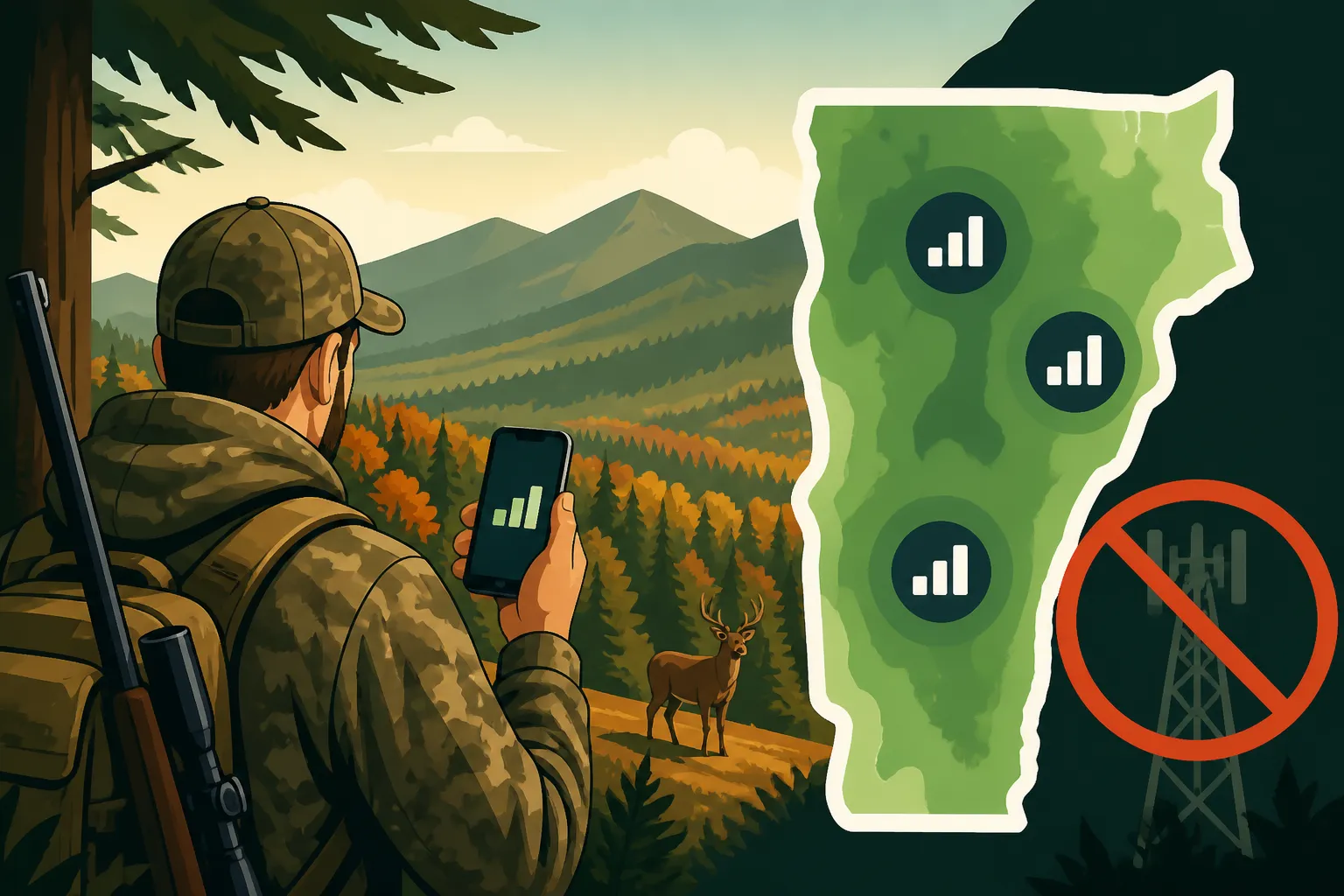
Think about your phone in the NEK. One minute you’ve got a couple of bars, the next you’re in a dead zone, even if you’ve only walked a hundred yards. Cellular cameras operate on the same principle, but they often have smaller, less powerful internal antennas than your smartphone. When that signal hits a mountain, dives into a ravine, or has to fight its way through acres of mature spruce and fir, it loses strength fast.
It’s not always about distance from a cell tower. Sometimes, a perfectly good tower might be just a few miles away, but there's a huge ridge or a dense stand of pines directly between it and your camera. These physical obstructions act like giant signal sponges, soaking up precious bandwidth. Even subtle changes in elevation, like placing a camera at the bottom of a slight dip versus ten feet up on a bench, can make a world of difference. You might have great signal on top of a ridge where a buck briefly cruises, but zero down in the swamp where he spends most of his time. It's a constant battle between where the deer are and where the signal might be.
Carrier Coverage Maps: More of a Suggestion Than a Guarantee
We've all looked at those pretty coverage maps on carrier websites – the ones painted in vibrant greens and blues, promising robust service across vast swathes of land. But in the Northeast Kingdom, especially on public lands or deep in private timber, those maps are often more aspirational than accurate. They’re usually generated from predictive models, not on-the-ground testing in every hollow and hardwood stand.
What might be listed as "good" 4G LTE coverage on a map could easily be a single, weak bar of 3G in reality when you're 1,500 feet up a mountain, tucked into a hemlock grove. And let’s be honest, 3G for a cellular camera is often too slow and unreliable to transmit anything useful, especially high-resolution photos or video. This discrepancy can lead to immense frustration. You buy a camera that specifies it works with a particular carrier, check the map, feel confident, and then spend hours in the woods only to find it stubbornly refuses to connect. It’s enough to make you want to throw your phone – and your camera – right into the Lamoille River. Checking Hunting the Northeast Kingdom before you head out can give you a better feel for the general remoteness of some areas.
Strategies for Maximizing Cellular Camera Performance
Alright, enough commiserating. While the NEK poses challenges, it’s not entirely hopeless. There are genuine strategies you can employ to give your cellular camera the best possible chance of success. It often comes down to careful planning, a bit of trial and error, and understanding the limitations you’re up against.
Scouting for Signal Before You Set Up
This is, hands down, the most critical step. Don’t just plop your expensive cellular camera down hoping for the best. Treat signal scouting like you would deer scouting. Before you ever hang that camera, take your phone (and ideally, a friend's phone on a different carrier if possible) to the exact spot you plan to place the camera. Turn off Wi-Fi, toggle off your mobile data, and then turn it back on to force a fresh connection. Check the signal bars. Send a text message, make a quick call, or try to load a simple webpage. Repeat this process at various heights, elevations, and orientations. Sometimes just moving your phone five feet in one direction can change a single bar into two or three.
Pay attention to natural clearings, higher ground, and areas with less dense canopy cover. While you want your camera to be discreet, a slightly more open location might be necessary for reliable transmission. Remember, even if your phone gets decent service, your camera might struggle, so aim for the strongest signal you can possibly find. If you’re using a mapping app like GoHunt, you can even mark potential camera locations based on terrain features that might offer better line-of-sight to distant towers. This kind of pre-planning, coupled with tools like GoHunt that allow you to mark potential stands or bedding areas, is crucial. For more scouting tips, check out Scouting Vermont Public Land Before Season.
External Antennas and Boosters: What Works and What Doesn't
Many cellular trail cameras come with a small, often omnidirectional antenna. While these are convenient, they’re rarely powerful enough for truly fringe areas. This is where external antennas can really shine. Most cellular cameras have a small threaded port (often SMA or RP-SMA) where you can screw in a larger, more powerful antenna.
- High-Gain Antennas: These are typically longer and designed to capture weaker signals. Think of them like a bigger ear for your camera. They can definitely help, especially if you have a weak but consistent signal.
- Directional Antennas: These are more advanced and look a bit like a small flat panel or a yagi antenna (like an old TV antenna). They need to be aimed precisely at the nearest cell tower. This requires a bit more effort – knowing where towers are (apps like CellMapper can help, though they're not always perfect in the NEK) – but a well-aimed directional antenna can provide a significant boost in those truly challenging spots.
- Cellular Boosters: These are more complex systems that involve an outdoor antenna, an indoor antenna, and an amplifier. While powerful, they are generally designed for structures like cabins or vehicles, not small, battery-powered trail cameras left out in the elements. Plus, they can be pricey. For most trail camera applications, a good external antenna is a more practical and cost-effective solution. Just be mindful that every connection point (the cable from the camera to the antenna, for example) can introduce signal loss, so keep cable runs as short as possible.
Testing Multiple Carriers and SIM Cards
It might seem obvious, but cellular coverage isn't universal across all carriers. In the Northeast Kingdom, one carrier might have a tower covering a particular valley, while another’s closest tower is blocked by a mountain range. Don’t assume your personal phone's carrier is the best for your camera in a different area.
Many cellular trail cameras are "unlocked" or can accept SIM cards from various carriers. If you're really struggling in a particular spot, consider purchasing a prepaid SIM card from a different major carrier (like a different provider than your phone) and testing it in your camera. Some cameras even offer multi-carrier plans or come with SIM cards that can switch between networks to find the strongest signal. This trial-and-error approach, while requiring a bit of upfront investment in SIM cards and data plans, can be the difference between a camera that sends photos and one that just sits there silently, collecting intel you can't access. You can often buy these pay-as-you-go SIMs for a few dollars to try out coverage before committing to a full plan. It’s worth the small expense to avoid endless frustration.
| Factor | Accessible Hunting Areas (e.g., Champlain Valley Field Edge) | Remote Northeast Kingdom (e.g., Deep Timber, Ridgeline) |
|---|---|---|
| Cell Tower Proximity | Usually closer, more direct line of sight | Often distant, many physical obstructions |
| Terrain Obstacles | Minimal (open fields, gentle slopes) | Significant (mountains, dense forests, deep ravines) |
| Foliage Density | Varies, but often less dense in open areas | Extremely dense, especially softwoods, acts as signal blocker |
| Carrier Redundancy | Multiple carriers likely have strong service | Often only one or two carriers provide any usable signal |
| Required Antenna Strength | Standard internal antennas often sufficient | External high-gain or directional antennas frequently necessary |
| Battery Life Impact | Camera spends less energy searching for signal | Camera constantly searches for signal, draining batteries faster |
| Data Transmission Reliability | High, quick photo/video uploads | Low, often delayed or failed transmissions, reduced quality |
| Scouting Importance | Still good practice, but less critical for basic function | Absolutely critical to find any signal before deployment |
Alternative Monitoring Solutions and Best Practices
Sometimes, despite all your best efforts, cellular service just isn't happening in that prime hunting spot deep in the NEK. It’s important to acknowledge when the technology simply can’t keep up with the wildness of Vermont. But that doesn’t mean you’re out of luck entirely for scouting. There are other valuable tools and approaches.
Traditional Trail Cameras and Manual Checks
Before cellular cameras became widespread, hunters relied entirely on traditional trail cameras. And guess what? They still work! If you can't get a reliable signal, revert to the old-school method. Use standard, non-cellular cameras and plan for regular, manual checks. This means physically hiking in to retrieve the SD cards. While it lacks the instant gratification of a cellular camera, it forces you to spend more time in the woods, which is rarely a bad thing.
When you're doing these checks, you're not just grabbing cards; you're also re-scouting the area, looking for fresh sign, assessing changes in food sources, and getting a real feel for deer movement. It’s a more immersive approach that can yield insights beyond what a camera might show. Plus, traditional cameras are often more affordable, and you don't have to worry about data plans. Consider using several traditional cameras spread across an area, checking them every week or two, depending on your time and commitment. This might mean strategically placing them on Scrape Lines Along a Logging Road or near Late-Season Food Sources for Vermont Whitetails.
Leveraging Mapping Tools for Remote Scouting
Even without cellular service for your camera, modern mapping tools are invaluable. Services like GoHunt allow you to download offline maps to your phone, so you can still navigate and mark waypoints even when you’re deep in a dead zone. This is absolutely critical in the vast and sometimes disorienting terrain of the Northeast Kingdom.
You can use these apps to:
- Identify potential travel corridors: Look for saddles, benches, creek bottoms, and logging roads.
- Locate water sources: Ponds, streams, and beaver flowages are often magnets for deer and bear.
- Pinpoint bedding areas: Thick conifer stands on south-facing slopes are prime wintering habitat, and also good places to start looking for bedding during hunting season.
- Mark access points: Know exactly how to get in and out of your hunting area, especially when Finding Ground That Sees Fewer Hunters.
- Plan efficient camera checks: Plot the most direct and quiet routes to your traditional cameras.
By using GoHunt or similar platforms to analyze topography, satellite imagery, and public land boundaries, you can effectively scout from your couch before ever stepping foot in the woods. This helps you narrow down potential camera locations to maximize your time, even if you’re just pulling SD cards later. Understanding Reading Aerial Photos for Green Mountain Deer can really boost your scouting game.
Managing Expectations in Truly Remote Country
Ultimately, the most important piece of advice when dealing with cellular cameras in the remote Northeast Kingdom is to manage your expectations. It’s not always going to be perfect, and sometimes, it's not going to work at all. Vermont’s wild landscapes are beautiful precisely because they are untamed, and that often means less human infrastructure, including reliable cell service.
Don't let the frustration of a non-transmitting camera overshadow the joy of being in the woods. If a spot is truly too remote for cellular, accept it and adapt. Use traditional cameras, rely on your boots-on-the-ground scouting, and trust your instincts. The NEK still holds incredible opportunities for those willing to put in the effort, even if it means leaving some of the high-tech gadgets at home or just using them for data collection rather than instant intel. Sometimes the best "signal" you can get is the rustle of leaves underfoot and the smell of pine in the crisp fall air. Understanding Northeast Kingdom Deer Density will confirm why putting in this effort is often worth it!
Disclaimer
This article is for general informational purposes only and does not constitute professional advice. Laws, prices and regulations vary by location and change over time. Consult a qualified professional for guidance on your specific situation.