Choosing a Scope Magnification for Timber Country
Oh, the age-old question for us timber hunters in Vermont: what in the world is the right scope magnification for these dense woods? It's a real head-scratcher, isn't it? You spend good money on a rifle, you pick a great spot, but if your optics aren't suited to the thick cover and fast action of a Green Mountain woodlot, you could be missing out on opportunities. This guide is all about helping you cut through the confusion and dial in the perfect scope magnification for the kind of hunting we do here in Vermont's beautiful, yet often frustratingly dense, timber.
The Unique Challenges of Vermont's Timber Country
Let's be honest, hunting in Vermont isn't like glassing wide-open alfalfa fields out West or sitting on a cutline in Saskatchewan. Our terrain, especially in the timber, presents a very specific set of challenges that directly impact your choice of optics. It’s not just about seeing a deer; it’s about seeing it clearly, quickly, and reliably in conditions that often work against you.
Dense Cover and Limited Visibility
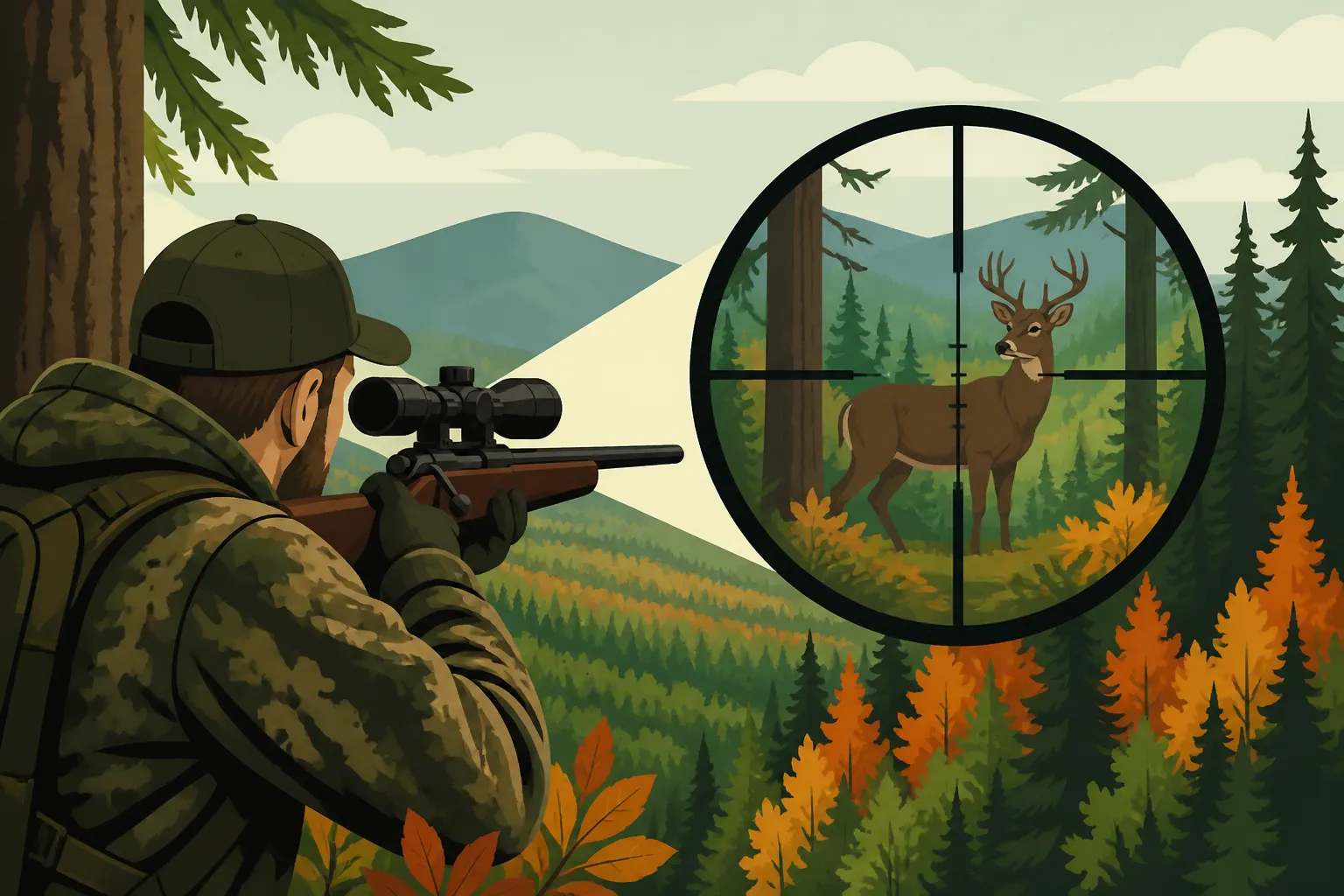
Anyone who has still-hunted a hardwood ridge or sat on a softwood edge knows this frustration intimately. You might have the best deer sign in the world, a well-worn trail, fresh scrapes, but actually seeing a deer clearly for more than a few seconds? That’s the real trick. The Green Mountains are called green for a reason – they are often incredibly lush, even after the leaves drop. Think about those dense stands of spruce and fir, or the thick underbrush in a regenerating clear-cut. Your line of sight is rarely more than 50-75 yards, and often much less. You’re looking through a maze of branches, saplings, and briars. A deer might appear as just a fleeting glimpse of brown between two hemlocks, or a flash of white in a tangled blowdown.
This isn't an environment for long-range target shooting. The challenge here is less about precision at 500 yards and more about identifying a legal deer and finding a clear shot lane in a matter of seconds. Many of us have experienced that heart-pounding moment when a buck materializes out of nowhere, just to disappear again before you can get a bead on it. It’s a reality of hunting in these tight quarters, and your scope needs to be an asset, not a hinderance, in those crucial moments.
Shots Are Often Close and Fast
Because of that dense cover, those majestic Green Mountain whitetails often appear practically on top of you. We’re talking 20, 30, maybe 60 yards – occasionally 100 yards if you’re sitting on a powerline cut or a wider logging road. These aren't scenarios where you have minutes to set up a stable rest, range the target, and slowly squeeze off a shot. More often than not, it’s a quick decision, a snap shoulder, and a shot that needs to happen almost instinctively.
If you’re Still-Hunting Green Mountain National Forest Timber, you’re constantly anticipating that close encounter. You’re scanning, moving slowly, and your rifle should feel like an extension of your body, ready to come up quickly. A scope with too much magnification can turn that quick, close shot into a blurry, disorienting mess. Imagine a deer bounding through the timber at 30 yards – with a high-power scope, it’ll be a blur in your field of view, and you’ll waste precious seconds trying to dial down the magnification or find the animal. It’s an exercise in frustration that can cost you a deer.
Variable Light Conditions Under the Canopy
Vermont's timber also throws curveballs with light. Even on a bright, sunny November day, once you step into a dense stand of pines or a thick bottomland, the light levels drop dramatically. Early morning and late evening, when deer are most active, are even darker. Shadows are long, deep, and constantly shifting, making it hard to distinguish deer from shadows, or antlers from branches.
Your scope needs to gather as much light as possible to help pierce through that gloom. This is where many hunters find themselves struggling. A scope that performs brilliantly in an open field under full sun might become a dark, unusable tunnel under the canopy of a thick spruce stand on a cloudy day. You need an optic that can suck in every last photon of available light to give you a clear, bright picture, even when Mother Nature is trying her best to hide your quarry. Hunting Public Land in Vermont often means dealing with these varied light conditions as you move between different habitat types.
Understanding Scope Magnification Basics
Before we talk about specific numbers, let’s quickly break down what those numbers on your scope actually mean and how they influence your hunting experience, especially in the timber. It’s more than just "how big things look."
Fixed Versus Variable Power Scopes
When you're choosing a scope, one of the first decisions you'll face is whether to go with a fixed power or a variable power model.
- Fixed Power Scopes: These scopes have one set magnification, like a 4x or a 6x.
- Pros: They are often simpler in design, which can make them extremely durable and reliable. With fewer moving parts, there’s less to go wrong. They tend to have excellent light transmission for their objective size because there are fewer lenses involved, and they usually offer a wide field of view. You also don't have to fiddle with settings in the heat of the moment; what you see is what you get.
- Cons: The obvious drawback is their lack of versatility. If your fixed 4x scope is perfect for a 50-yard timber shot, it might feel a bit underpowered if a deer steps out at 150 yards in a small clearing. Conversely, if you chose a higher fixed power, say 8x, it could be too much for those super close, fast encounters. For most Vermont timber hunters who encounter a variety of conditions and shot distances (even if still relatively close), fixed power scopes aren't always the first choice, though they certainly have their dedicated followers.
- Variable Power Scopes: These are the most popular choice, allowing you to adjust the magnification within a range, such as 3-9x, 1.5-6x, or even 4-12x.
- Pros: Their greatest advantage is versatility. You can dial down to a low magnification for a wide field of view and quick target acquisition in thick cover, and then dial up a bit if a deer pauses in a slightly more open lane. This adaptability is incredibly useful in Vermont’s diverse timber environments, where you might be Hunting a Funnel Between Two Woodlots that opens up slightly at one end.
- Cons: They tend to be more complex mechanically, sometimes making them a bit heavier or potentially less rugged than a fixed power scope of comparable quality (though modern variable scopes are incredibly tough). High-end variable scopes can also be more expensive. However, for the flexibility they offer, most hunters find the trade-offs well worth it.
What Magnification Numbers Really Mean in the Field
Let's demystify those numbers you see printed on a scope. A "3-9×40" scope means it has a variable magnification from 3 times to 9 times, and the objective lens (the front lens) is 40mm in diameter.
- Low Magnification (1-4x, 1.5-6x):
- In the Field: When you're on 1x or 1.5x, it's almost like looking through a red dot sight – a wide, almost true-to-life field of view. This is perfect for those fast, close shots where you need to get on target instantly. As you creep up to 4x or 6x, you get a good balance of magnification to identify antler size and place a shot, without getting tunnel vision. You'll keep a great field of view, making it easy to track a moving deer.
- Vermont Application: This range is arguably the sweet spot for 90% of our timber hunting. If you're busting brush or actively still-hunting, starting at the lowest power is a smart move.
- Mid-Range Magnification (2-7x, 3-9x):
- In the Field: These are your classic "all-around" hunting scopes. At 3x, you still have a decent field of view for timber, but you can crank it up to 7x or 9x if a deer stops a bit further out in a small clearing or on a logging road.
- Vermont Application: A 3-9x is an incredibly popular choice for a reason. It offers a good balance for hunters who might encounter deer from 20 yards to 150 yards, which is a fairly typical range in much of Vermont. It’s versatile enough for a variety of Vermont Hunting Licenses and What They Cost and scenarios.
- Higher Magnification (4-12x, 4.5-14x, etc.):
- In the Field: These scopes are designed for longer shots. At 4x, they still offer a reasonable low end, but when cranked up to 12x or 14x, they really let you see fine details at extended distances.
- Vermont Application: For strictly timber hunting, these scopes often have too much top-end magnification. While 4x is manageable, anything above 9x or 10x often becomes a hindrance in dense woods. The field of view narrows dramatically, making it hard to find a deer that's close or moving. Unless you’re primarily hunting larger clear-cuts, agricultural fields, or open powerline corridors in the Champlain Valley, you’ll likely find the higher magnifications largely unused and potentially problematic in typical Vermont timber.
Exit Pupil and Light Gathering
This is where things get a little more technical, but it’s vital for those low-light timber conditions. The "exit pupil" refers to the diameter of the column of light that leaves the eyepiece and enters your eye. A larger exit pupil means more light reaches your eye, giving you a brighter image, especially in dim conditions.
You calculate exit pupil by dividing the objective lens diameter (that second number, like the "40" in 3-9×40) by the magnification you're using.
| Scope Example | Magnification | Objective (mm) | Exit Pupil (mm) |
|---|---|---|---|
| 3-9×40 | 3x | 40 | 13.3 |
| 3-9×40 | 9x | 40 | 4.4 |
| 1.5-6×42 | 1.5x | 42 | 28 |
| 1.5-6×42 | 6x | 42 | 7 |
Your eye’s pupil dilates in low light to let in more light, typically up to about 5-7mm in adults (younger people often have larger pupils). To maximize brightness, you want your scope's exit pupil to be at least as large as your eye's pupil.
Notice how the exit pupil shrinks as you increase magnification. A 3-9×40 scope at 9x gives you a 4.4mm exit pupil – perfectly usable in good light, but it might start to look dim in deep timber at dusk. The same scope at 3x, however, has a massive 13.3mm exit pupil, delivering an incredibly bright image. This is a huge advantage in low light situations, reinforcing why lower magnification is often better for light gathering in the timber. When you're trying to make out a Late-Season Food Sources for Vermont Whitetails deer in the waning light, every bit of brightness matters.
Optimal Magnification Ranges for Vermont Timber
So, what's the sweet spot? Based on the realities of hunting in Vermont's timber, we can narrow down the ideal magnification ranges that give you the best chance of success.
The Case for Low Power Magnification (1-4x, 1.5-6x)
For many, this is the absolute ideal range for the majority of Vermont's wooded areas. When you're deep in the timber, shots are typically close, and they often happen fast.
- Wide Field of View: At 1x or 1.5x, your field of view is incredibly wide, making it effortless to find and track a moving deer in dense brush. This is critical when a buck suddenly bolts from a thicket 30 yards away. You’ll acquire the target almost instantly, much like shooting with open sights or a red dot, but with the added precision of a reticle.
- Fast Target Acquisition: With a wide field of view, your brain and eye can naturally pick up the target much faster. There's no "tunnel vision" effect. This translates directly to quicker, more confident shots when time is of the essence. If you're Hunting the Rut in Early-to-Mid November, that fleeting glimpse of a buck chasing a doe needs immediate action.
- Superior Low-Light Performance: As we discussed with exit pupil, lower magnifications inherently gather more light for a given objective lens size. This means a brighter, clearer image when hunting in shaded timber, during predawn or last light, or on overcast days. A good 1-4x or 1.5-6x scope can literally add precious minutes to your hunt when light is fading.
- Less Scope Wobble: At lower magnifications, any natural wobble or movement from your body is less exaggerated in the scope. This makes it easier to hold steady and take an accurate shot without the added pressure of a wildly jumping reticle.
Many experienced timber hunters, especially those who Still-Hunting Green Mountain National Forest Timber or driving deer with small groups, will start their day with their variable scope set to its lowest power and only dial up if the situation absolutely demands it.
Mid-Range Magnification (2-7x, 3-9x) for Versatility
The 2-7x or 3-9x scope has earned its legendary status for a reason: it's incredibly versatile. While a low-power fixed scope has its merits, the ability to adjust your magnification is invaluable.
- Balancing Act: A 3-9x scope, for example, allows you to drop down to 3x, which still offers a decent field of view and good light gathering for most timber encounters. It's not as wide as a true 1x, but it's far from tunnel vision. Then, if you're set up on a logging road or looking across a small clear-cut where shots might stretch to 75-100 yards, you can bump it up to 6x or 7x (or even 9x for a precision shot on a standing deer). This gives you the extra clarity needed for antler identification and precise shot placement at those slightly longer distances without being overkill.
- Common Choice: This range is often considered the workhorse for general deer hunting. It handles the close timber shots adequately and offers enough reach for those occasional longer opportunities. Many hunters find that a good 3-9×40 or 3-9×50 scope provides the best all-around performance for Vermont conditions, especially if they might occasionally venture into more open country or want to take a shot at a coyote crossing a field edge. For someone just starting out or looking for one do-it-all scope, a quality 3-9x is often recommended. When you’re looking at your options, make sure to consider platforms like GoHunt for gear reviews and user experiences, which can provide practical insights on how these magnifications perform in real hunting scenarios.
When Higher Magnification (above 9x) Is Detrimental or Unnecessary
This is where many timber hunters go wrong. It’s easy to think "more power is better," but in the dense woods, it’s often quite the opposite. Scopes with a top-end magnification much higher than 9x—think 4-12x, 4.5-14x, or even greater—are usually overkill and can actively hinder your success in Vermont timber.
- Tunnel Vision: When you crank a scope up to 10x, 12x, or 14x, your field of view becomes incredibly narrow. Imagine looking through a paper towel tube. In a wide-open field, you can easily find your target. In dense timber, where deer are often moving and only briefly visible, that narrow field of view makes it nearly impossible to find the animal, let alone track it or find a clear shooting lane. You spend precious seconds sweeping the scope, trying to locate the deer you just saw with your naked eye.
- Exaggerated Movement: Every little shake or wobble from your body becomes dramatically exaggerated at high magnification. What might be a slight tremor at 3x becomes a violent shake at 12x, making it incredibly difficult to hold steady and make an accurate shot, especially if you’re standing or shooting off-hand.
- Poor Low-Light Performance: Higher magnifications mean smaller exit pupils, which translates to a darker image in low light. This is a critical drawback in the often shaded and low-light conditions of Vermont's timber, particularly during prime hunting hours.
- Unnecessary for Typical Shots: How many times in Vermont's thick woods do you get a clear, unobstructed shot at 200, 300, or 400 yards? Probably never. Most timber shots are well within 100 yards. The added weight, cost, and complexity of a high-power scope are simply not justified for the vast majority of our hunting here. Focus on the tools that excel at the ranges you actually shoot. If you're interested in Choosing a Rifle Twist Rate for Timber Shots, pair that research with finding a scope magnification that makes sense for the same close-range, timber-focused hunting.
Practical Considerations Beyond Magnification
While magnification is key, it's part of a larger system. Several other scope features play a crucial role in how well your optic performs in Vermont's timber.
Field of View and Eye Relief
These two aspects often get overlooked but are paramount for quick, comfortable shooting in tight cover.
- Field of View (FOV): This is simply how wide an area you can see through your scope at a given distance (usually measured in feet at 100 yards). As mentioned, a wider FOV is critical in timber. It helps you pick up moving deer, maintain situational awareness, and quickly acquire your target. Lower magnifications naturally provide a wider FOV. Always prioritize a wide field of view for timber hunting. When you're Hunting a Ridge-Top Saddle for Rutting Bucks, you want to see as much of that dense cover as possible.
- Eye Relief: This is the distance your eye needs to be from the scope's eyepiece to see a full, clear image without black rings (vignetting). Generous eye relief is important for safety (preventing "scope bite" from recoil) and comfort, especially when you need to shoulder your rifle quickly and aren't perfectly aligned. In the fast-paced environment of timber hunting, you won’t always have time for a perfect cheek weld, so a scope that is forgiving with eye relief makes a huge difference.
Reticle Choice for Quick Target Acquisition
The reticle (the crosshairs or aiming point inside your scope) is your direct link to the target. For timber hunting, simplicity and visibility are usually best.
- Duplex Reticles: A simple duplex reticle, with thick outer posts that thin down to a fine crosshair in the center, is a classic for good reason. The thick posts guide your eye quickly to the center, even in low light or against a busy background.
- Illuminated Reticles: Many modern scopes offer illuminated reticles, where the center dot or crosshair glows. This can be an absolute game-changer in very low light conditions, such as deep timber at dawn or dusk, or against a dark background like a deer’s hide in shadow. It gives you a clear, crisp aiming point without washing out your target.
- BDC or Mil/MOA Reticles: While these can be useful for longer-range shooting, they can also be too busy for the close, fast action of timber hunting. A simpler reticle is often less distracting and faster to use when a deer is only 40 yards away.
- GoHunt Considerations: When researching optics, looking at reviews and forums on sites like GoHunt can offer a lot of insight into what reticles hunters are finding most effective in conditions similar to Vermont's timber.
Durability and Weather Resistance
Vermont weather is, shall we say, character-building. Your scope needs to withstand the elements without fail.
- Fog Proofing: Rapid temperature changes, rain, and snow can cause internal fogging. A properly sealed and nitrogen-purged or argon-purged scope will prevent this, ensuring a clear image no matter how nasty the weather gets.
- Waterproofing: Hunting in Vermont often means hunting in rain, freezing rain, or snow. Your scope needs to be completely waterproof to prevent moisture ingress that can damage internal components or lead to fogging.
- Shock Proofing: Tumbles, bumps, and the recoil of your rifle demand a scope that can take a beating and still hold zero. A well-built, shockproof scope will retain its accuracy even after being subjected to the rigors of a multi-day hunt through rough terrain. Consider this when you're Best Boots for Green Mountain Ridge Trails – your scope should be as tough as your footwear. Don't compromise on these features; a scope that fails in the field is worse than no scope at all.
Magnification Comparison for Vermont Timber Scenarios
To help you visualize how different magnification ranges might perform, here's a quick comparison for common Vermont timber hunting situations.
| Magnification Range | Best Use Case in Vermont Timber | Pros | Cons |
|---|---|---|---|
| 1-4x or 1.5-6x | Still-hunting, thick cover, fast close shots (0-75 yards) | Wide field of view, excellent low-light, very fast target acquisition, lightweight. | Limited reach for longer shots (though rare in timber). |
| 2-7x or 3-9x | General timber hunting, small clearings (20-150 yards) | Versatile, good balance of FOV and magnification, adequate for most Vermont scenarios, good light gathering at lower settings. | Can feel slightly "busy" or narrow at 7x-9x in extremely dense brush; not as lightning-fast at max low power as a true 1x. |
| 4-12x or higher | Open powerlines, large fields, long distances (150+ yards) | Superior detail at long range, good for stationary targets in open areas. | Narrow field of view in timber, poor for fast-moving or close targets, reduced low-light performance at high power, often heavier and more expensive than necessary for the vast majority of timber hunting. |
Ultimately, choosing the right scope magnification for Vermont's timber country comes down to understanding the realistic distances you'll be shooting, the speed at which opportunities arise, and the challenging light conditions you'll face. For most of us, less is truly more when it comes to power. A quality low-to-mid range variable scope, set to its lowest power for most of the day, will serve you exceptionally well, ensuring you’re ready when that Green Mountain whitetail finally steps into view. Focus on clarity, brightness, and a wide field of view, and you’ll be well on your way to a successful hunt.
Disclaimer
This article is for general informational purposes only and does not constitute professional advice. Laws, prices and regulations vary by location and change over time. Consult a qualified professional for guidance on your specific situation.