Best Stabilizer for a Treestand Shot
There’s nothing quite like the crisp air of a Vermont morning from a treestand, but the exhilaration of a deer stepping into range can quickly turn to anxiety when you think about making that shot count. Between the awkward angles, the limited range of motion, and maybe a touch of adrenaline-induced jitters, getting a steady aim can be a real challenge for bowhunters. This guide is all about helping you understand and choose the best stabilizer to steady your bow for those crucial treestand shots, ensuring you feel confident when it matters most.
Understanding Stabilizers and Their Purpose for Treestand Hunting
Let's be honest, shooting from a treestand is a whole different ballgame than standing on flat ground at the practice range. Your body position is often less stable, you're usually shooting at a downward angle, and you might have branches or leaves limiting your swing. This is where a good bow stabilizer can really shine, making a significant difference in your accuracy and confidence.
What a Bow Stabilizer Actually Does
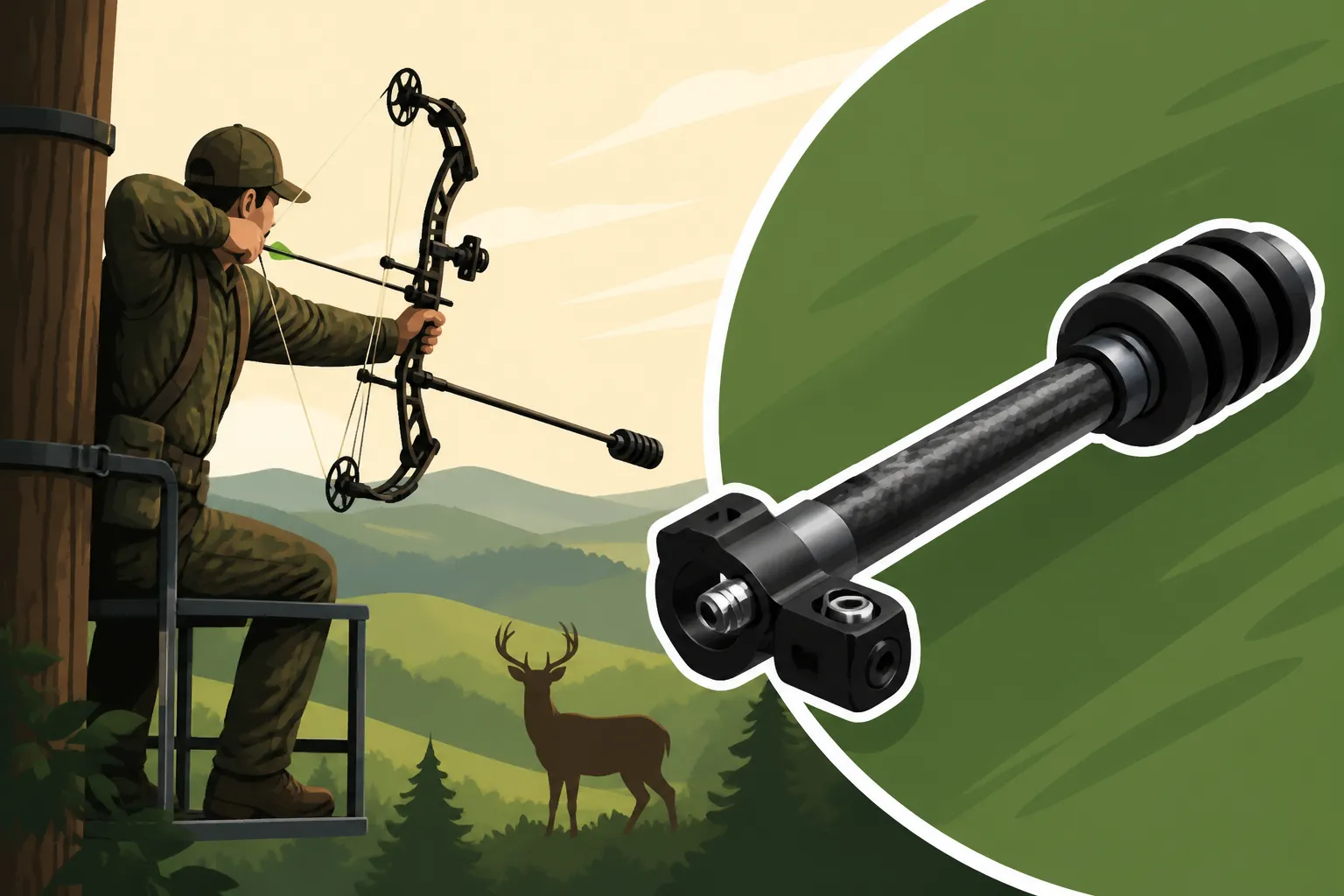
At its core, a bow stabilizer is a weighted rod, or series of rods, that attaches to your bow. Its primary job is to improve the balance of your bow, making it feel more steady in your hand. Think of it like a tightrope walker holding a long pole – that pole isn't just for show; it helps distribute weight and makes maintaining balance much easier. When you add a stabilizer, it helps to extend the bow's center of gravity, naturally counteracting the weight of other accessories like your sight and quiver.
Beyond just balance, a good stabilizer also plays a crucial role in reducing hand torque. Hand torque happens when you grip the bow unevenly, twisting it slightly during the shot. Even a tiny bit of torque can send your arrow significantly off target, especially at hunting ranges. The added mass and extended lever arm of a stabilizer help to resist this rotational movement, forcing you to maintain a more consistent and relaxed grip. This translates directly to tighter groups downrange, and more importantly, ethical shots in the field.
Finally, and this is a big one for stealthy Vermont hunting, stabilizers are excellent at dampening vibration and reducing noise. When you release an arrow, the bow's limbs snap forward, creating vibrations that travel through the riser. These vibrations cause noise, which can spook a deer, and also contribute to a less comfortable shooting experience. Many modern stabilizers incorporate materials like rubber, gel, or specialized internal structures designed specifically to absorb these vibrations, making your bow quieter and more pleasant to shoot. A quieter bow means a better chance of that buck not jumping the string.
Why Treestand Shots Present Unique Challenges
Hunting from a treestand brings a host of unique challenges that can severely test your shooting form and equipment. First off, you're often elevated, which means most of your shots will be at a downward angle. This requires adjusting your aiming point and often forces you into awkward body contortions, especially when a deer slips in close or moves to an unexpected position. You might find yourself leaning out, twisting, or trying to shoot around a tree trunk, all of which compromise your natural shooting posture.
Then there's the element of limited movement. Unlike ground hunting where you might have more freedom to shift your feet or pivot, in a treestand, you're often confined to a relatively small platform. Your shooting lanes are predefined by trimmed branches, and you have to be ready to contort your body to get a clean shot. A bulky, unbalanced bow can become a real hindrance in these situations, making it harder to swing into position smoothly and quietly. You need a setup that allows for fluid movement without sacrificing stability.
Finally, let's talk about the cold and the adrenaline. A chilly November morning in the Green Mountains can make your muscles stiff and your hands a little shaky even before a deer appears. Add a mature buck suddenly appearing at twenty yards, and your heart rate surges. These factors can make it incredibly difficult to hold a bow steady. A well-balanced bow, achieved partly through a good stabilizer, can help mitigate these effects, allowing you to settle your pin faster and hold it on target with greater confidence, even when your body is telling you to shake.
Different Types of Stabilizers and Their Basic Mechanics
When you start looking at bow stabilizers, you'll quickly realize there's a whole world of options out there, each designed to achieve slightly different goals. The most common type is the front-mounted stabilizer, which screws directly into the front of your bow's riser. These come in various lengths, from short, compact hunting stabilizers (6-10 inches) to much longer target-style stabilizers (up to 30+ inches). The longer and heavier the front bar, generally, the more effective it is at increasing the moment of inertia, which resists movement and makes the bow feel steadier.
Beyond just a single front bar, many serious bowhunters, especially those who prioritize extreme balance, opt for a multi-rod setup. This often includes a front bar, but also a side bar or "V-bar" system. A side bar extends off the riser to the side, often allowing for adjustable weights. This is incredibly useful for counteracting the weight of a quiver full of arrows or a heavy sight, which can pull your bow off-balance. The V-bar setup uses two shorter rods that extend from a central mount, forming a "V" shape, usually with one rod going forward and one back. This offers maximum adjustability for fine-tuning the balance point of your bow, ensuring it sits perfectly level at full draw, without any tendency to tip one way or another.
The mechanics are all about leverage and mass. By extending weight away from the bow's riser, a stabilizer increases the "moment of inertia." This is a fancy way of saying it takes more force to move the bow once it's settled. For a treestand shot where you might be holding at full draw for a few extra seconds waiting for a clear shot, this resistance to movement is invaluable. Different materials like carbon fiber (lightweight, stiff) or aluminum (denser, more affordable) are used, often with internal dampening materials to further absorb shock and sound, giving you that quiet, steady shot every time.
Key Considerations for Choosing a Treestand Stabilizer in Vermont
Choosing the right stabilizer isn't a "one-size-fits-all" scenario, especially when you consider the varied terrain and hunting situations across Vermont, from the dense hardwoods of the Green Mountain National Forest to the more open edges of a Champlain Valley dairy farm. Your specific hunting style and bow setup will heavily influence what works best for you.
Length and Weight: Finding Your Sweet Spot
The length and weight of your stabilizer are perhaps the most critical factors to consider for treestand hunting. A longer stabilizer, typically 10-15 inches for hunting, provides greater stability due to increased leverage. It pushes the center of gravity further forward, making the bow naturally want to stay still. This can be a huge advantage when you're feeling shaky or needing to hold on target for an extended period. However, a longer stabilizer also means a longer overall bow, which can be cumbersome in tight quarters. Imagine trying to maneuver a bow with a 15-inch stabilizer in a compact treestand, especially if you're trying to pivot for a shot behind you or weave through dense softwood branches.
Conversely, a shorter, lighter stabilizer (6-8 inches) offers much better maneuverability. It's less likely to get snagged on clothing, branches, or your stand itself. This can be a godsend when Hunting a Funnel Between Two Woodlots or trying to make a quick, silent adjustment. The trade-off, however, is reduced stability. While it might still offer some vibration dampening, it won't provide the same "holding power" as a longer bar. For many Vermont hunters, a good compromise might be a 10-12 inch front bar that offers a solid balance of stability and maneuverability, allowing you to handle shots in both open fields and thick timber without feeling overly restricted. Consider your typical hunting scenarios; if you're always in tight cover, lean shorter. If you have more open shots, you can go a bit longer.
Vibration Dampening and Noise Reduction
In bowhunting, silence is golden. A deer's ears are incredibly sensitive, and a loud bow can mean the difference between a successful hunt and a missed opportunity, or worse, an injured animal due to string jumping. Many modern stabilizers are engineered with specific features to reduce both vibration and noise, making your shot as quiet as possible. Look for stabilizers that incorporate advanced dampening materials like rubber, viscoelastic polymers, or internal harmonic dampeners. These materials are designed to absorb residual energy after the shot, preventing it from traveling through the riser and creating unwanted sound.
The construction of the stabilizer itself also plays a role. Some feature a skeletal design, while others are solid, and each can have different effects on vibration. A stabilizer that effectively dampens vibration not only makes your bow quieter but also makes it more comfortable to shoot. Less hand shock means you're less likely to flinch or develop bad habits over time. When you're Hunting the Rut in Early-to-Mid November and that buck is walking by cautiously, you want every advantage possible, and a quiet bow is paramount. Don't underestimate the psychological benefit either; knowing your bow is quiet instills a level of confidence that can improve your focus and execution. When researching different options, check product reviews and descriptions for specific mentions of noise reduction technologies. Some archery enthusiasts also share comparisons and tests online. GoHunt can be a great resource for seeing user reviews and comparing stabilizer specs from various brands that focus on these key dampening features.
Balancing Your Bow: Front, Side, and V-Bar Setups
Achieving perfect balance is crucial for a consistent and accurate treestand shot. Most hunting bows, when stripped down, are naturally top-heavy and tend to tip forward or to the side once you add a sight, quiver, and arrows. A front-mounted stabilizer is your first line of defense against this forward lean. It pushes the balance point forward, encouraging the bow to remain upright and steady. For many hunters, a quality front stabilizer is all they need to feel adequately balanced.
However, if you're like me and run a fully loaded quiver with six arrows, a heavier hunting sight, or maybe a bow-mounted rangefinder, you might find your bow still wants to lean to the side. This is where a side bar or a V-bar setup becomes incredibly valuable. A side bar attaches to the riser (often opposite your quiver) and allows you to add adjustable weights. By tuning this weight, you can perfectly counteract the lean created by your accessories, achieving a truly neutral balance point. When your bow sits perfectly level in your hand at full draw, it eliminates any need to consciously fight against its natural tilt, allowing you to focus purely on your aiming and execution.
A V-bar is essentially a more advanced side bar system, using two rods that branch out, offering even finer tuning possibilities. While V-bars are more common in target archery, some hardcore hunting setups, especially for those pursuing longer shots or wanting maximum stability, incorporate them. The key is to experiment. Hang your bow at full draw, or use a bow vice, and see how it naturally balances with all your hunting accessories attached. If it leans significantly, consider adding side weight. Fine-tuning your bow's balance with front and potentially side stabilizers will make a world of difference in how effortlessly you can hold your pin steady when that trophy buck steps into your shooting lane.
Practical Tips for Optimizing Your Stabilizer for Treestand Success
Having the right stabilizer is only half the battle; knowing how to properly set it up and practice with it is just as important. A stabilizer isn't a magic wand, but with proper integration, it can significantly enhance your treestand hunting performance.
Proper Installation and Tuning
It might seem obvious, but properly installing your stabilizer is the first step to getting its full benefit. Most stabilizers simply screw into the bushing on the front of your bow's riser. Ensure it's tightened securely, but don't overtighten to the point of stripping threads. Some stabilizers come with additional dampening features or weights that can be added or removed. Experiment with these. For example, some models allow you to add small weight discs to the end of the rod. Adding more weight generally increases stability but also increases the overall weight of your bow, which can be tiring to hold for long periods, especially if you're just sitting on a cold morning waiting for deer during Vermont's November Rifle Season.
Beyond just screwing it on, "tuning" your stabilizer often refers to finding the optimal length and weight distribution for your specific bow setup and shooting style. If you're using a V-bar or side bar, this involves adjusting the angle and amount of weight on each rod until the bow sits perfectly balanced at full draw. You want the bow to feel "dead in hand," meaning it doesn't want to tip forward, backward, or side-to-side. A great way to test this is to close your eyes while holding the bow at full draw, then open them. Does your bubble level (if your sight has one) look centered, or is the bow leaning? Make small adjustments to the weights until that bubble is consistently level without conscious effort. This meticulous process ensures your stabilizer is working with your bow, not just hanging off it.
Practice, Practice, Practice: Simulating Treestand Shots
Buying the "best" stabilizer won't do you any good if you don't practice with it, especially in conditions that mimic actual hunting scenarios. Don't just shoot on flat ground at a target 20 yards away. Set up a ladder stand or climb into your actual treestand in the off-season. Practice shooting at various downward angles, simulating shots you might encounter during the season. Try shooting from awkward positions – leaning out, twisting, or drawing while seated. This will help you identify any balance issues or cumbersome aspects of your stabilizer setup before opening day.
Another critical aspect of practice is to simulate holding at full draw for a longer duration. In a real hunting situation, a deer might pause behind a bush, requiring you to hold your draw for 10-20 seconds, or even longer. A well-tuned stabilizer will make this much easier, reducing fatigue and allowing you to maintain a steady aim. Practice holding your bow at full draw for increasing lengths of time. Pay attention to how the stabilizer helps to keep your pin steady. Combine this with practicing your shot process – smooth draw, settled pin, clean release. Repetition in these simulated conditions will build muscle memory and confidence, making those critical treestand shots second nature. Remember, the goal isn't just to hit the target, but to hit it consistently and ethically, even under pressure.
Maintaining Your Stabilizer Through Vermont's Seasons
Vermont weather can be brutal on hunting gear, and your stabilizer is no exception. From damp, foggy mornings in September to freezing rain in December, your equipment will be exposed to the elements. Proper maintenance of your stabilizer ensures it performs reliably season after season. After each hunt, especially in wet conditions, wipe down your stabilizer with a dry cloth to remove moisture, dirt, and debris. Pay attention to any adjustable parts or weight connections, as these can sometimes seize up if not kept clean.
If your stabilizer has rubber dampeners or soft components, inspect them periodically for cracks or signs of wear. Extreme cold can make these materials brittle, and over time they might lose their effectiveness. If you notice any damage, consider replacing those components. For stabilizers with removable weights, occasionally unscrew them, clean the threads, and apply a small amount of anti-seize compound to prevent them from locking up, which can happen with temperature fluctuations and moisture exposure. Storing your bow indoors in a stable temperature and humidity environment will also help prolong the life of all its components, including the stabilizer. Taking a few minutes for maintenance will keep your stabilizer working optimally, ready for whatever Vermont's hunting seasons throw at it.
Common Misconceptions and Troubleshooting
Even with the best gear, sometimes things don't go as planned. Understanding some common misconceptions about stabilizers and knowing how to troubleshoot issues can save you a lot of frustration and help you get the most out of your setup.
The "One Size Fits All" Fallacy
One of the biggest mistakes hunters make is assuming that any stabilizer will work for any bow or any hunter. This couldn't be further from the truth. Your ideal stabilizer setup is highly personal and depends on several factors: your bow's weight distribution, the weight and placement of your other accessories (sight, quiver, rest), your shooting form, and even your physical strength. A stabilizer that works perfectly for your buddy with a different bow and shooting style might throw your bow completely off balance.
For instance, a hunter who keeps their quiver on the bow at all times might benefit from a side bar to counteract that constant weight, whereas someone who removes their quiver might only need a front bar. Similarly, a shorter hunter with a shorter draw length might find a very long front stabilizer cumbersome, while a taller hunter might love the extended stability it offers. Don't just buy what's popular or what someone else recommends without doing your own research and testing. GoHunt is a fantastic place to look at various setups and read reviews from other hunters who might share similar bow models or hunting styles, helping you narrow down options that are likely a good fit. Focus on what feels good to you and balances your bow.
When a Stabilizer Isn't the Only Answer
While a stabilizer is an incredibly valuable tool, it's not a magical fix for all shooting woes. If you're consistently having accuracy issues, a stabilizer might help, but it's crucial to look at other potential culprits as well. Your shooting form is paramount. Are you gripping the bow too tightly? Is your anchor point consistent? Are you collapsing at the shot? These fundamental aspects of archery form need to be solid before any accessory can truly shine. A stabilizer can only enhance good form; it can't correct bad habits.
Your release aid, arrow rest, and even your broadheads can also impact accuracy. A faulty release or an inconsistent rest can introduce errors that no stabilizer can overcome. Make sure your arrows are properly spined for your bow and broadheads are flying true. For example, if you're struggling with Tuning a Bow for Broadhead Flight, that's a foundational issue that needs to be addressed before you can expect a stabilizer to make significant improvements. Consider having a pro shop evaluate your entire setup and form if you're consistently struggling. Sometimes, a small adjustment to your stance or grip can make a more significant difference than any piece of equipment.
Troubleshooting Common Issues
Even with careful setup, you might run into issues. If your bow still feels like it's torquing or twisting in your hand despite having a stabilizer, first check your grip. Are you using a relaxed, consistent grip, or are you clenching the bow? The stabilizer helps resist torque, but a poor grip can still overpower it. If your bow still feels noisy after the shot, double-check all your accessories for anything loose or vibrating. Sometimes a loose screw on your sight, an unseated arrow in the quiver, or even a rattling accessory on your clothing can be the culprit.
If your bow feels unbalanced, meaning it still tips forward, backward, or to the side after your shot, you might need to adjust your weights. If it's too front-heavy, you might need a shorter or lighter front bar, or more weight on a side bar to bring the balance back. If it's leaning to the side, you almost certainly need to incorporate or adjust a side bar. Remember, small adjustments can make a big difference. Don't be afraid to experiment with adding or removing small weights. You can also consult online forums or GoHunt's community sections for troubleshooting tips specific to your bow model and stabilizer combination. Many experienced hunters are happy to share their knowledge and experiences, helping you refine your setup for peak performance in the Vermont woods.
| Stabilizer Type | Primary Benefit for Treestand Hunting | Potential Drawback | Best Use Case in Vermont |
|---|---|---|---|
| Short Front (6-8") | Excellent maneuverability, lightweight | Less stability, basic vibration dampening | Tight timber, mobile hunting, quick shots |
| Medium Front (10-12") | Good balance of stability and maneuverability | Can feel slightly long in very dense cover | General hunting, mixed terrain, versatile |
| Long Front (12-15"+) | Maximum stability, excellent vibration dampening | Can be cumbersome in tight stands/cover | Open shooting lanes, longer shots, static sits |
| Side Bar | Counteracts quiver/sight weight, fine-tune balance | Adds weight and bulk to the bow's side | When bow leans due to accessories, precise balance needed |
| V-Bar System | Ultimate balance customization, optimal stability | More complex setup, heaviest option, most cumbersome | Highly specialized setups, target-level precision |
Disclaimer
This article is for general informational purposes only and does not constitute professional advice. Laws, prices and regulations vary by location and change over time. Consult a qualified professional for guidance on your specific situation.