Hunting a Granite Quarry Backcountry
Hunting Vermont's backcountry, especially around old granite quarry areas, can feel like stepping into a forgotten world. This isn't your typical managed timber stand or rolling agricultural field; it's a rugged, unforgiving landscape that can quickly chew up boots and morale if you're not prepared. Many hunters get overwhelmed by the sheer rock faces, the jumbled boulders, and the sparse vegetation, leading them to avoid these spots entirely. But that's precisely why these areas hold a unique allure and often harbor unpressured deer. This guide will help you understand the unique challenges and hidden opportunities of hunting Vermont's granite quarry backcountry, equipping you with the knowledge to approach these demanding terrains with confidence and strategy.
Understanding the Unique Landscape of Vermont's Granite Quarries
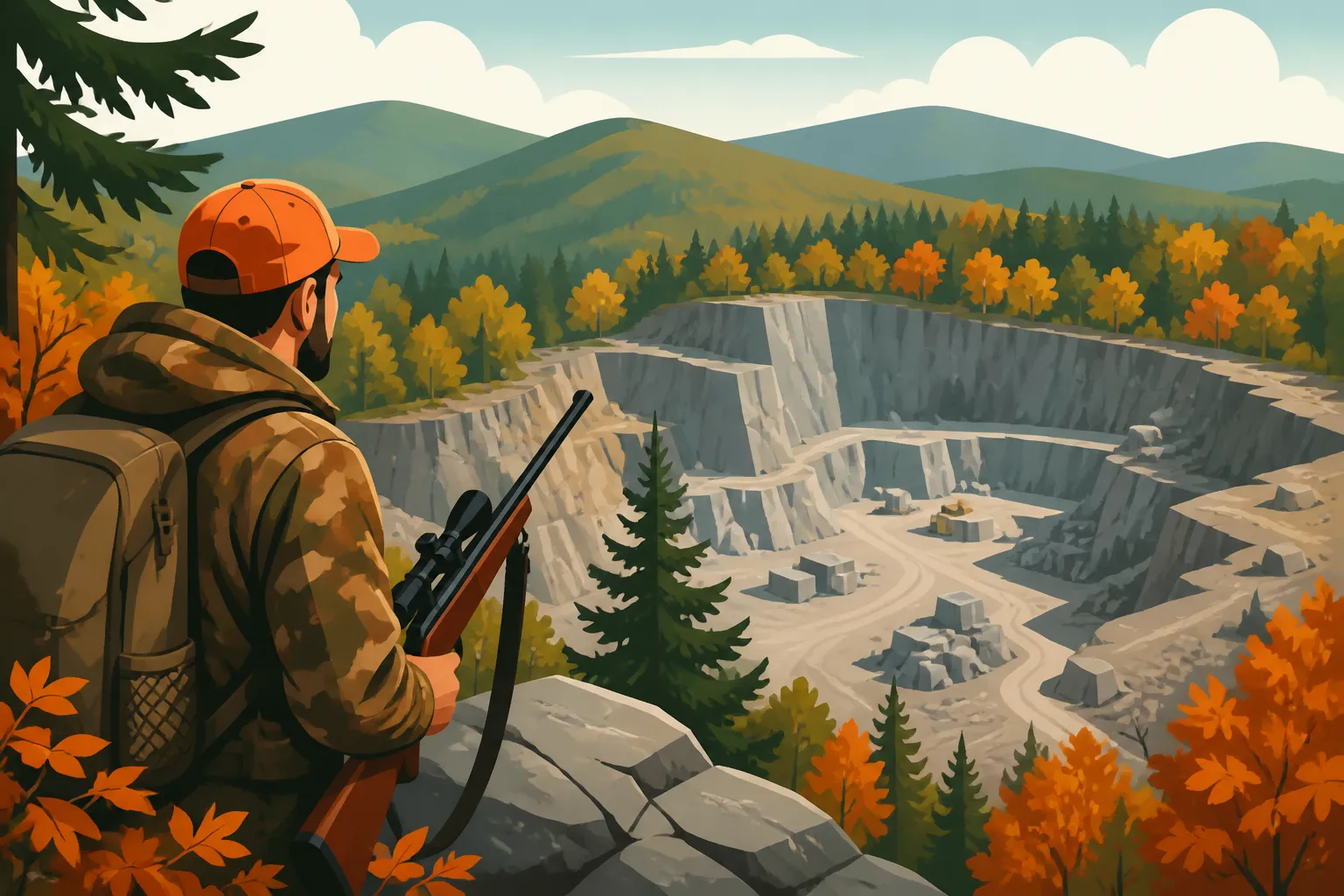
Vermont is famously known for its granite, especially from towns like Barre, and these historic quarrying operations have left behind a distinctive landscape that’s unlike much of the state's other wild acreage. When you hear "granite quarry backcountry," don't just picture a giant hole in the ground. Think about the surrounding terrain: the steep, broken rock faces, the vast piles of tailings and waste rock, the old access roads that have long since been reclaimed by nature, and the dramatic changes in elevation. This isn't just forest; it's a geological marvel shaped by human industry and then slowly re-wilded.
These areas are often characterized by sharp drop-offs, sheer cliffs, and huge, randomly scattered boulders that create endless pockets of cover and shadow. Water, when present, might be in deep, stagnant pools at the bottom of a quarry pit or seeping through rock fissures, creating small, unexpected springs. The vegetation is generally sparse on the most exposed rock but can be surprisingly thick in pockets of deeper soil, especially in ravines or sheltered depressions. Imagine trying to navigate through a field of scattered cars, but they're all made of rock, some as big as small buildings, covered in moss and slippery lichen. It’s an environment that demands respect and careful planning.
The sheer scale of some of these old quarry landscapes means that deer can move through them with incredible secrecy. A buck might bed down on a small ledge with an unbeatable view of approach, or simply vanish into a maze of broken rock where a human can barely squeeze through. Understanding these unique topographical features is the first step in unlocking their hunting potential. You'll need to shed any preconceived notions about what good deer habitat looks like, because a granite quarry backcountry throws all those rules out the window. It's a place where adaptability isn't just a suggestion; it's a requirement for success.
Deer Movement and Behavior in Quarry Backcountry
Deer, being the adaptable creatures they are, learn to navigate and even thrive in these rugged granite quarry environments, often utilizing them precisely because most hunters shy away. Their movement patterns here will differ significantly from what you might observe in softer, more uniform terrain. These quarry zones often act as security cover, offering places where deer feel less pressured and more secure during daylight hours. They might not find the richest food sources directly within the quarry, but they certainly find refuge.
The Draw of Security and Sparse Pressure
The biggest draw for deer in these areas is the profound sense of security. The broken terrain, the steep climbs, and the general difficulty of human access mean these spots typically see very little hunting pressure. A wise old buck knows this. He'll often retreat to these impenetrable pockets during periods of high hunting activity, such as during Vermont's November Rifle Season or Hunting the Rut in Early-to-Mid November. You might find very little sign in terms of heavily used trails, but that doesn't mean deer aren't there. They just move differently. They might pick their way silently through rock fields, using small depressions and behind large boulders as cover, rather than following well-worn paths.
Food and water sources are often limited in the immediate quarry area, but deer will travel to and from nearby richer feeding grounds. This often means finding transitional areas—the edges where the quarry landscape meets more traditional hardwood forests, small timbered ravines, or even pockets of old apple trees that have managed to establish themselves in a sheltered crevice. When scouting, you’re not just looking for typical browse lines; you're looking for the subtle hints of deer moving through rocky terrain, like scuff marks on mossy boulders, bits of hair on rough rock edges, or even droppings tucked into sheltered nooks.
Adapting to Steep, Broken Terrain
Deer are incredibly agile, and they're built for navigating steep, uneven ground. They'll use narrow ledges that seem impossible for a human, or ascend scree slopes that would challenge even the most experienced hiker. Their ability to move silently through a jumble of rocks is astounding, especially compared to a heavy-footed human hunter. Because of this, listening becomes an even more critical skill here. You might hear the faint click of a hoof on rock long before you see the deer.
Thermals and wind patterns in these broken landscapes are notoriously unpredictable. Instead of smooth, consistent air currents, you’ll encounter swirling eddies, updrafts against sheer rock faces, and downdrafts into deep pits. This means checking your wind constantly is absolutely essential, and understanding how the sun affects these micro-thermals throughout the day. A small, sheltered ravine might hold a thermal pocket, while fifty yards away on an exposed ridge, the wind is ripping in a completely different direction. This complexity makes standard wind-checking challenging, but it also creates opportunities if you can predict localized air currents. Mapping tools like onX Hunt can help visualize elevation changes, which in turn helps predict thermal movement, but ground-truthing with a puff bottle is vital here.
Strategic Hunting Approaches for Granite Quarry Backcountry
Successfully hunting Vermont's granite quarry backcountry demands a departure from conventional tactics. You're not just hunting deer; you're hunting this specific landscape. It requires patience, a keen eye, and a willingness to work harder and smarter. These strategies focus on leveraging the terrain to your advantage and moving through it as efficiently and quietly as possible.
Slow and Steady Still-Hunting
In this environment, aggressive pushing or loud movements will almost certainly alert any deer in the vicinity long before you get a shot. The broken ground, while offering cover, also makes quiet movement incredibly difficult. Therefore, a slow, methodical still-hunting approach is often the most effective. Think of it as a chess match against the terrain itself. You should take only a few steps, then stop and thoroughly scan your surroundings for minutes at a time. Still-Hunting Green Mountain National Forest Timber principles apply, but with an added layer of rocky complexity. Look not just for deer, but for parts of deer: an ear flick, the glint of an antler, a subtle change in color against the rock and shadows.
When moving, prioritize silent footing over speed. Test each step before committing your weight, looking for stable rock or mossy patches that won't crunch or scrape. Use the boulders and elevation changes to your advantage, peeking over ridges or around rock formations to expand your field of view without exposing your entire silhouette. This is where a good pair of binoculars, like those mentioned in Optics for Vermont's Green Mountain Terrain, becomes invaluable – allowing you to glass distant pockets and ledges without having to physically climb to them.
Leveraging Aerial Imagery and Scouting
Before you even step foot in a granite quarry backcountry, spend significant time studying the area using mapping applications like onX Hunt or even tools like GoHunt's satellite imagery. These digital resources are absolutely critical for understanding the topography of such a complex area. Look for subtle benches, narrow ravines, old logging roads that are now faint lines, and any flat spots that might indicate a potential bedding area or a funnel. Reading Aerial Photos for Green Mountain Deer becomes an art form in these areas.
Pay close attention to changes in vegetation visible from above. Patches of denser timber, even small ones, could indicate deeper soil and better browse, acting as magnets for deer. Look for any signs of water sources, however small, as these are precious in rocky terrain. Once you've identified potential pinch points, travel corridors, or bedding areas from your armchair scouting, then plan your physical scouting trips carefully. These trips should focus on confirming your aerial observations and looking for fresh sign. Don’t expect obvious rubs or scrape lines everywhere, but rather subtle indications of deer passage like scuffed rocks or droppings in sheltered spots.
Strategic Stand Placement or Ground Blinds
Given the challenging terrain, traditional tree stand placement can be difficult or even impossible in many parts of a quarry backcountry. The trees might be sparse, stunted, or simply not in a location that offers a good shot angle. This often makes ground blinds a more practical option. Whether it's a natural blind brushed into a jumble of rocks or a portable blind, concealment is key. Focus on areas that offer a commanding view of a potential travel corridor or a sheltered pocket where deer might bed. Using a Ground Blind on Public Land can be highly effective in such environments.
Consider placing a ground blind overlooking a small, flat bench on a steep slope, or a narrow pass between two large rock formations. These are natural funnels where deer movement might be concentrated. Be mindful of your scent cone, especially with the swirling thermals. Set up downwind of where you expect deer to approach, but be prepared for unexpected wind shifts. The key is to find spots where deer feel secure moving but where you can still get an ethical shot. Due to the limited visibility and difficult footing, shots can be tricky, so practice at various angles and distances, especially on uneven ground.
| Strategy Type | Best Use in Quarry Backcountry | Pros | Cons |
|---|---|---|---|
| Still-Hunting | Covering large, varied terrain; actively seeking deer movement. | Highly adaptable; covers ground; allows for immediate reactions. | Very physically demanding; requires extreme stealth; noise is a major challenge. |
| Ground Blinds | Overlooking pinch points, bedding areas, or sparse food sources. | Offers excellent concealment; can be set up in difficult tree-stand areas. | Requires early setup; fixed location; thermals can be unpredictable. |
| Spot-and-Stalk | Glassing vast open rock faces/clearings from a distance, then moving. | Effective for identifying distant deer; good for active deer. | Requires specialized optics; very difficult to execute silently in broken terrain; long approach can spook game. |
| Elevated Stand | Limited to specific locations with suitable trees near travel routes. | Good visibility; scent lifted; generally easier to remain still. | Very challenging to find suitable trees; difficult to transport and install; limited shot angles. |
Essential Gear and Safety Considerations
Hunting granite quarry backcountry is inherently more demanding than hunting flatter, more forgiving terrain. Your gear choices, physical conditioning, and safety protocols become paramount. Skimping on any of these can lead to a miserable, unsuccessful, or even dangerous outing.
Footwear and Clothing for Rugged Terrain
Your boots are perhaps the most critical piece of gear. You need exceptional ankle support, a stiff sole for navigating sharp rocks, and superior traction. Soft-soled boots will quickly break down, and weak ankle support is an invitation for a sprain or worse on loose rock. Look for a sturdy pair of full-grain leather or heavy-duty synthetic boots designed for mountaineering or serious backpacking. Waterproofing is also essential, as hidden puddles and seeping ground are common. Best Boots for Green Mountain Ridge Trails offers excellent advice that is directly applicable here.
Layering your clothing is also non-negotiable. This terrain means you'll be exerting yourself climbing, then potentially sitting still for long periods while glassing or waiting. Rapid changes in elevation can also mean rapid changes in temperature. Start with a moisture-wicking base layer, add insulating layers, and have a good waterproof and windproof outer shell. Even on a clear day, the wind can whip through exposed rock faces. And always remember your blaze orange, as per Vermont regulations, especially during firearms seasons.
Navigation, Optics, and Communication
Getting lost in a granite quarry backcountry can be a serious situation. The terrain is disorienting, and landmarks can look similar. A reliable GPS unit or a smartphone with a robust mapping app like onX Hunt is an absolute necessity. Make sure you download offline maps before you leave home, as cell service will likely be non-existent in these remote areas. Carry a compass and physical map as a backup, and know how to use them. Mark your starting point and any key features or potential escape routes. Best GPS App for Vermont Public Land is a must-read for this kind of hunt.
Good optics are also essential. A quality pair of binoculars, perhaps even a rangefinder binocular combo as discussed in Best Rangefinder Binocular Combo for Open Country, will allow you to pick apart distant rock faces and thickets without expending precious energy. A rangefinder is crucial for accurate shot placement across varied and often steep terrain, where distances can be deceiving.
Given the remoteness, carrying a satellite communicator (like an InReach or Zoleo) is a smart safety measure. It allows you to send emergency messages even without cell service, providing invaluable peace of mind for yourself and your loved ones. Always let someone know your exact hunting plan, including your intended route and expected return time.
Physical Conditioning and Game Retrieval
This type of hunting is physically demanding. You'll be climbing, scrambling, and navigating uneven ground for hours. Good cardiovascular fitness and strong legs are vital. If you harvest an animal, the challenge truly begins. Extracting a deer, let alone a bear, from a deep quarry pit or across a field of boulders is an immense task. Consider bringing a sturdy game cart if the terrain allows for any sections of easier pulling, but be prepared for quartering the animal and packing it out in pieces on a frame pack. Packing Meat Out of a Steep Ravine and Best Backpack Frame for a Quartered Moose offer relevant advice that can be scaled down for deer.
Always carry a well-stocked first-aid kit, and know how to use its contents. A fall on sharp rocks can lead to serious cuts or sprains. Plan for enough water and high-energy snacks for your entire outing, plus extra. The exertion in this terrain will dehydrate you quickly. Hunting a granite quarry backcountry isn't for the faint of heart, but for those willing to embrace the challenge, it can offer a truly unique and rewarding Vermont hunting experience.
Disclaimer
This article is for general informational purposes only and does not constitute professional advice. Laws, prices and regulations vary by location and change over time. Consult a qualified professional for guidance on your specific situation.